
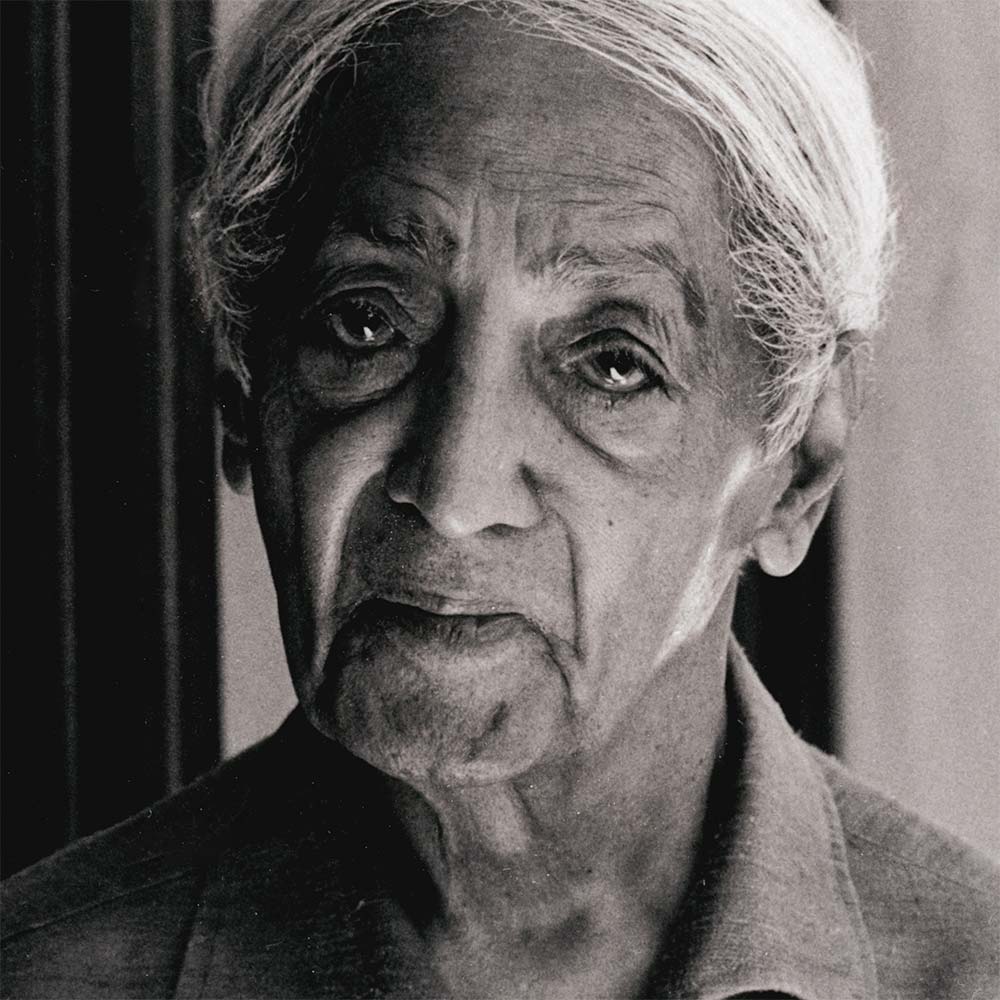
Photo of J. Krishnamurti

The intellect is an incomplete instrument and cannot understand a movement that is total.

Read More

The intellect is an incomplete instrument and cannot understand a movement which is total. Then what is examination? If the intellect cannot explore, what is the instrument that can explore?

If the intellect is the product of the brain, it must always be conditioned by memory and knowledge. It can project very far, but it is still tethered.

Read More

If the intellect is the product of the brain, it must always be conditioned by memory and knowledge. It can project very far, but it is still tethered. The intellect can seek freedom; it can never find it. It can be free only within the radius of its own tether; in itself it is limited. And freedom must be beyond the capacity of the intellect; it must be something outside that field.

Intellectually, verbally, we can compete with each other, explain each other away, but that does not mean a thing.

Read More

Intellectually, verbally, we can compete with each other, explain each other away, but that does not mean a thing. What to you may be a complete action may appear to me as incomplete action – that is not the point. The point is whether your mind, as that of a human being, acts completely. A human being of the world is not an individual. ‘Individual’ means indivisible. An individual is one who is undivided in himself, who is nonfragmentary, who is whole, sane, healthy. Also, ‘whole’ means holy. When you say, ‘I am an individual,’ you are nothing of the kind. Live a life of no authority, of no comparison, and you will find out what an extraordinary thing it is. You have tremendous energy when you are not competing, not comparing and not suppressing; you are really alive, sane, whole and therefore sacred.

Our social structure is very intellectual; we are cultivating the intellect at the expense of every other factor of our being, and therefore we are suffocated with ideas.

Read More

As our society is mostly constructed on the intellectual or verbal level, the idea comes first and action follows. Action is then the handmaid of an idea, and the mere construction of ideas is obviously detrimental to action. Ideas breed further ideas, and when there is merely the breeding of ideas, there is antagonism, and society becomes top-heavy with the intellectual process of ideation. Our social structure is very intellectual; we are cultivating the intellect at the expense of every other factor of our being, and therefore we are suffocated with ideas.

The intellect has produced a world of tradition.

Read More

The intellect has produced a world of tradition. Tradition is the result of thought, which is part of the intellect, and that tradition has been handed over from generation to generation. The mind is caught in that, so it is a mechanical mind. It has got a great deal of energy for going to temples, reading books, doing everlasting rituals, prayers, building temples, talking endlessly about the Gita or Upanishads, and the interpretations of those, and you think that is religion. That certainly gives you a mechanical energy – an energy based on the past and the continuity of that past through the present, modifying the future. That’s the whole movement of tradition. That movement creates a great deal of energy, and that energy has not solved our human problems. It hasn’t solved our relationship with each other. It has not brought about an explosive, creative life.

It is the intellect with its movement of thought that brings about the fragmentation of our human condition.

Read More

We give fantastic importance to the intellect. We mean by the intellect the capacity to reason logically, sanely or without sanity, objectively or personally. It is the intellect with its movement of thought that brings about the fragmentation of our human condition. It is the intellect that has divided the world linguistically, nationally and religiously, divided man from man. The intellect is the central factor of the degeneration of mankind throughout the world, for the intellect is only a part of the human condition and capacity. When the part is extolled, praised and given honours, when it assumes all-importance, then one’s life, which is relationship, action and conduct, becomes contradictory and hypocritical. Then anxiety and guilt come into being.

The intellect, with its capacity to think reasonably or unreasonably, having its illusions and clarity, has become predominant, and that is the cause of our decay, because we are not acting with all our being.

Read More

The intellect is only a part of our whole being. The intellect can argue, it has theories, it is capable of deep inquiry, but it is not the whole nature of man, the wholeness of man. A part has become all-important and is therefore fragmenting the world and fragmenting your actions. The intellect, with its capacity to think reasonably or unreasonably, having its illusions and clarity, has become predominant, and that is the cause of our decay, because we are not acting with all our being. We are using the word ‘intellect’ to mean the capacity to think reasonably, logically and objectively, or unreasonably, without clarity, being caught in illusions. The intellect being only a part, not the whole, when that rules our life, there are divisions between man and man, country and country, class and class, religion and religion. It is the function of thought and intellect to divide, and as that dominates the world, it is the basic cause of our degeneration.

The intellect seeks power through knowledge and the dominance it gives. The intellect is ever seeking security, openly or surreptitiously, and security means personal power.

Krishnamurti, The World Within

Read More

The intellect seeks power in devious ways. It seeks power through cleverness, brilliancy, sharpness, through the dominance of reason and thought, through theories and formulations, through prestige, political and social, through organisations, religious and economic. The intellect seeks power through knowledge and the dominance it gives. The intellect is ever seeking security, openly or surreptitiously, and security means personal power. It is the seat of personal aggrandisement and personal cessation. It is the source of self-contradiction and all its problems, and its answers are its own creation in its search for security and power. This search, hidden, subtle and cunningly devious, creates in its wake the complex human problems in relationship, of greed, envy, fear, and so on. Without understanding the ways of power, merely to abstain from sexual and other forms of power only gives greater strength to the hidden cravings.

The intellect knows pleasure and the pursuit of pleasure, but it will never know what love is.

Read More

Love is always new. Pleasure is always old. Love alone can bring about something totally new, which the intellect can never understand. The intellect knows pleasure and the pursuit of pleasure, but it will never know what love is.

Your intellect has built walls of self-protection against all discovery and spontaneity, against freedom and understanding. The intellect will never find the answer.

Krishnamurti, The World Within

Read More

If, on seeing that mountain, you do not respond to its beauty, and you realise that you do not, then such a realisation will give you a shock. Similarly, when you realise that the thinker himself is ignorance, you are not startled by it: you move on to other things. You have made yourself shockproof by your reasons, explanations, decisions and conclusions. Your intellect has built walls of self-protection against all discovery and spontaneity, against freedom and understanding. The intellect will never find the answer. But if you allow yourself to inquire into why you are not startled by the thought that the thinker is sorrow, then you will break down the self-enclosing walls. If you live with this dead numbness of the intellect and do not escape from it, then you will find that the rock against which you have been beating your head will melt away. You have become numb, and you do not allow yourself to realise it, to feel it. Only when you are shaken by its reality – the reality of numbness – is there the beginning of the cessation of the thinker and its thought. Then only is there the intimation of the eternal.

The intellect cannot build a bridge between itself and freedom.

Krishnamurti, The Only Revolution

Read More

Within the narrow culture of society, there is no freedom. If there is no freedom, there is disorder. Living within this disorder, man seeks freedom in ideologies, in theories, in what he calls God. This escape is not freedom. It is the yard of the prison which separates man from man. Can thought, which has brought this conditioning upon itself, come to an end, break down this structure, and go beyond and above it? Obviously it cannot, and that is the first factor to see. The intellect cannot possibly build a bridge between itself and freedom. Thought, which is the response of memory, experience and knowledge, is always old, as is the intellect, and the old cannot build a bridge to the new.

All philosophies are intellectual and therefore not whole.

Read More

What man has done to man has no limit. He has tortured him; he has burned him; he has killed him; he has exploited him in every possible way. This has been the story of man against man; the clever exploit the stupid or ignorant. All philosophies are intellectual and therefore not whole. These philosophies have enslaved man. They have invented concepts of what society should be and sacrificed man to their concepts; the ideals of the so-called thinkers have dehumanised man. Exploitation of others seems to be the way of our daily life. We use each other, and each one accepts this. Out of this peculiar relationship, dependence arises with all the misery, confusion and agony that is inherent in dependence. Man has been both inwardly and outwardly so treacherous. How can there be love in these circumstances?

War is intellectually justified as a means of bringing peace. When the intellect has the upper hand in human life, it brings about an unprecedented crisis.

Read More

Man is not important – systems and ideas have become important. Man no longer has any significance. We can destroy millions of men as long as we produce a result and the result is justified by ideas. We have a magnificent structure of ideas to justify evil and surely that is unprecedented. Evil is evil; it cannot bring about good. War is not a means to peace. War may bring about secondary benefits, like more efficient aeroplanes, but it will not bring peace to man. War is intellectually justified as a means of bringing peace. When the intellect has the upper hand in human life, it brings about an unprecedented crisis.

Listen with your heart, with your mind, not with the little part of the intellect.

Read More

Don’t be caught by words. Listen to what is being said. Listen with your heart, with your mind, not with the little part of the intellect. Listen to what you have said. You have hindered yourself. You have made the mind a slave to the words. The sun was now getting stronger, and the shadows were deepening. The vendor on the road was shouting, calling loud his wares, and a bus went rattling by. The birds were not so noisy; they had withdrawn into the shadows. The day was settling down to the noise, the quarrels, the ambitions, greeds and envies. And the day passes by without ever looking, without ever listening.

One needs a total harmony, a harmony of the mind, the intellect, the capacity to reason logically, sanely; and of the heart, the capacity to have compassion, love, kindliness and consideration; and of the physical.

Read More

One needs a total harmony. A harmony of the mind, the intellect, the capacity to reason logically, sanely; and of the heart, the capacity to have compassion, love, kindliness and consideration; and of the physical with all its complexities. One can see that there must be such harmony, because only then can existence function healthily and totally. Can religion based on belief, on an insight of the few who have established a church, an organised priesthood, and so on, can such a structure bring about harmony in you? Or is it that such harmony has nothing whatsoever to do with belief, with any saviour, with any guru, with any sense of an outside agency, or an inward effort to bring about harmony?

These quotes only touch on the many subjects Krishnamurti inquired into during his lifetime. His timeless and universal teachings can be explored using the Index of Topics where you will find texts, audio and video related on many themes. Another option is to browse our selection of curated articles or more short quotes. Krishnamurti’s reply when asked what lies at the heart of his teachings can be found here. Many Krishnamurti books are available, a selection of which can be explored here. To find out more about Krishnamurti’s life, please see our introduction and the biography. We also host a weekly podcast, and offer free downloads. Please visit our YouTube channel for hundreds of specially selected shorter clips. Below, you can learn more about Krishnamurti and our charity which he founded in 1968.
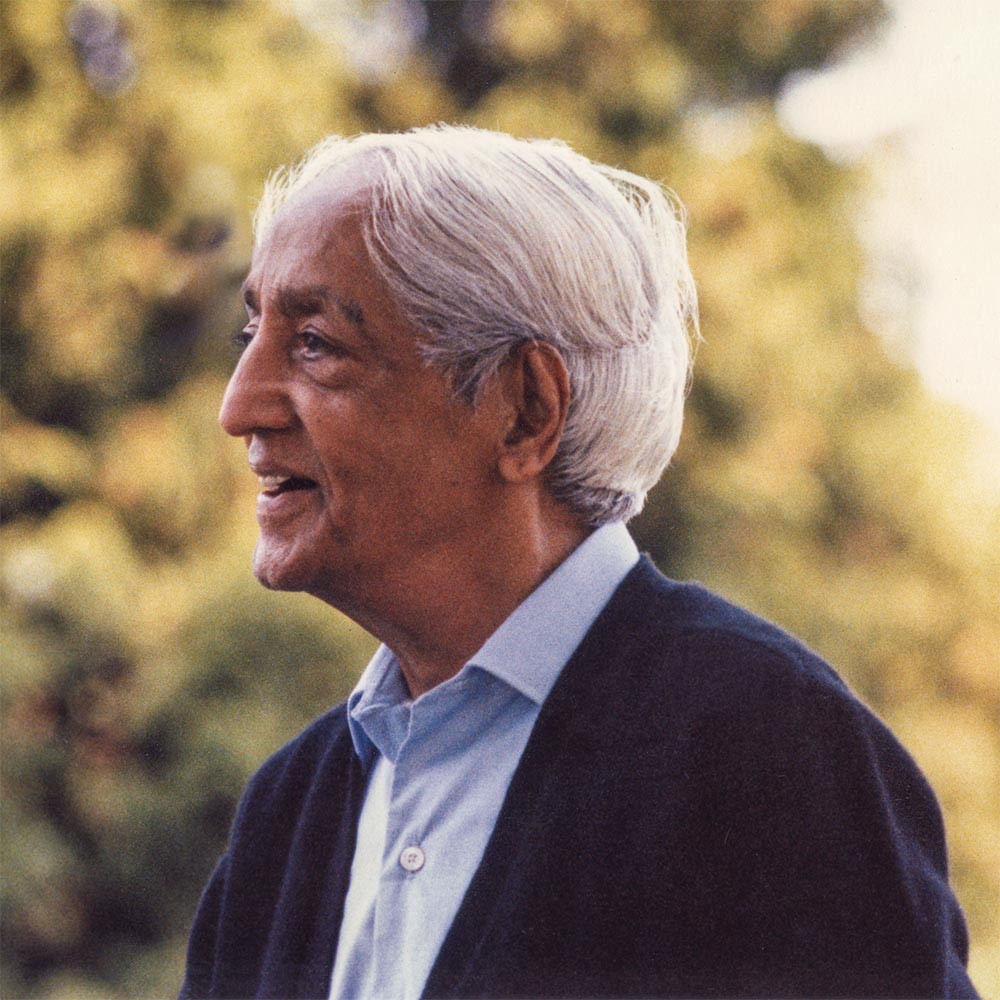
Krishnamurti outdoors smiling

Who Was Krishnamurti?

J. Krishnamurti (1895-1986) is widely regarded as one of the greatest thinkers and religious teachers of all time. He spoke throughout the world to large audiences and to individuals, including writers, scientists, philosophers and educators, about the need for a radical change in mankind. Referring to himself, Krishnamurti said:

He is acting as a mirror for you to look into. That mirror is not an authority. It has no authority, it’s just a mirror. And when you see it clearly, understand what you see in that mirror, then throw it away, break it up.

Krishnamurti was concerned with all humanity and held no nationality or belief and belonged to no particular group or culture. In the latter part of his life, along with continuing to give public talks, he travelled mainly between the schools he had founded in India, Britain and the United States, which educate for the total understanding of man and the art of living. He stressed that only this profound understanding can create a new generation that will live in peace.

Krishnamurti reminded his listeners again and again that we are all human beings first and not Hindus, Muslims or Christians, that we are like the rest of humanity and are not different from one another. He asked that we tread lightly on this earth without destroying ourselves or the environment. He communicated to his listeners a deep sense of respect for nature. His teachings transcend man-made belief systems, nationalistic sentiment and sectarianism. At the same time, they give new meaning and direction to mankind’s search for truth. His teaching is timeless, universal and increasingly relevant to the modern age.

I am nobody. It is as simple as that. I am nobody. But what is important is who you are, what you are.

Krishnamurti

Krishnamurti spoke not as a guru but as a friend. His talks and discussions are based not on tradition-based knowledge but on his own insights into the human mind and his vision of the sacred, so he always communicated a sense of freshness and directness, although the essence of his message remained unchanged over the years. When Krishnamurti addressed large audiences, people felt that he was talking to each of them personally, addressing their own particular problem. In his private interviews, he was a compassionate teacher, listening attentively to those who came to him in sorrow, and encouraging them to heal themselves through their own understanding. Religious scholars found that his words threw new light on traditional concepts. Krishnamurti took on the challenge of modern scientists and psychologists and went with them step by step, discussing their theories and sometimes enabling them to discern the limitations of their theories.

Krishnamurti left a large body of literature in the form of public talks, writings, discussions with teachers and students, scientists, psychologists and religious figures, conversations with individuals, television and radio interviews, and letters. Many of these have been published as books, in over 60 languages, along with hundreds of audio and video recordings.
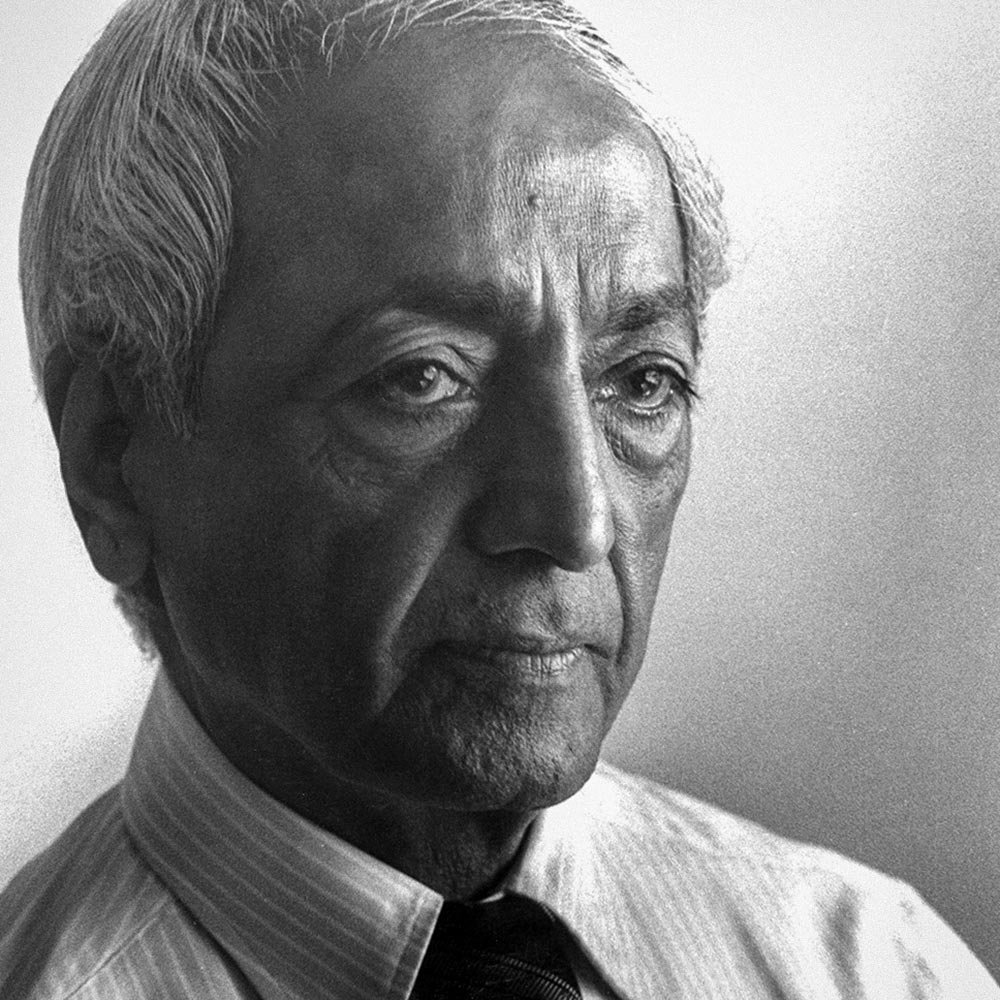
Three-quarters portrait photo of Krishnamurti

The Krishnamurti Foundation

Established in 1968 as a registered charity, and located at The Krishnamurti Centre, Krishnamurti Foundation Trust exists to preserve and make available Krishnamurti’s teachings.

The Foundation serves a global audience by providing worldwide free access to Krishnamurti videos, audio and texts to those who may be interested in pursuing an understanding of Krishnamurti’s work in their own lives.

In describing his intentions for the Foundations, Krishnamurti said: 

The Foundations will see to it that these teachings are kept whole, are not distorted, are not made corrupt.