
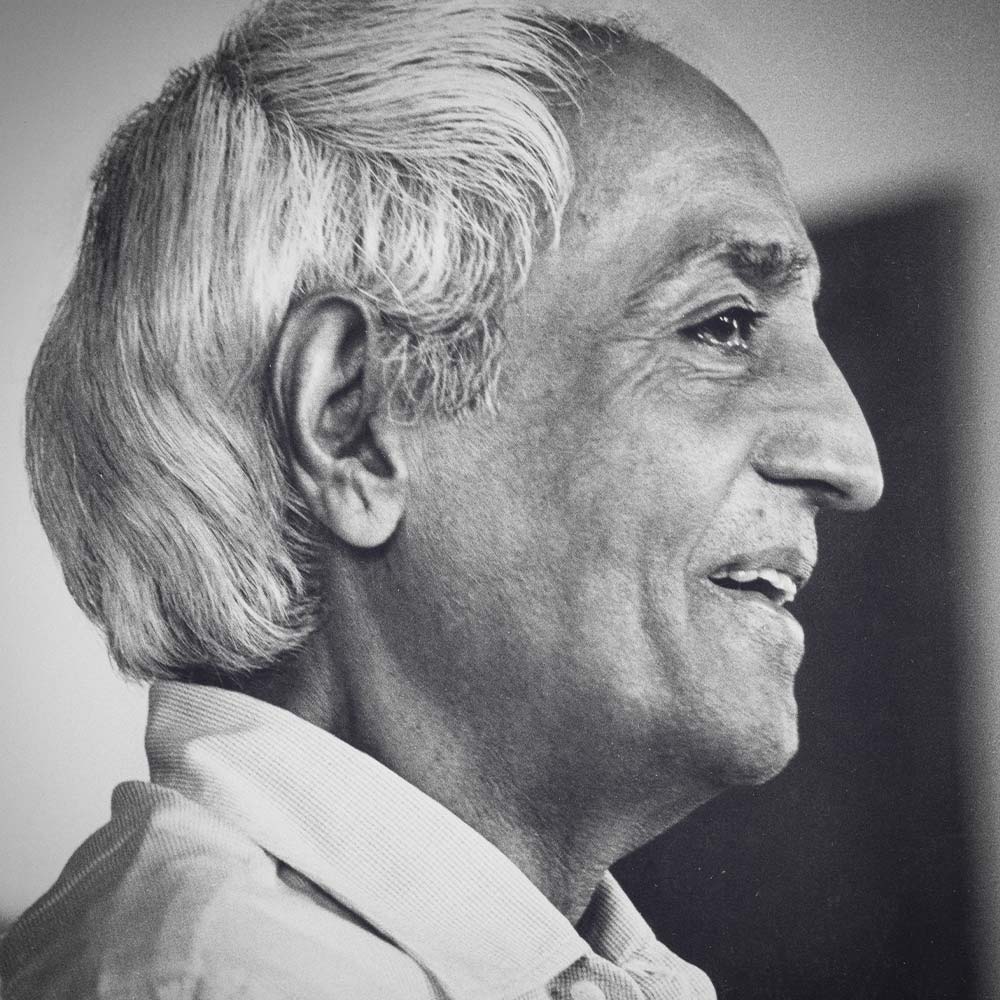
Photo of J. Krishnamurti

We are not happy. If we were happy, our world would be entirely different.

Read More

We are not happy. If we were happy, our world would be entirely different; our civilisation and culture would be wholly, radically different. We are unhappy human beings, petty, miserable, struggling, vain, surrounding ourselves with useless, futile things, satisfied with petty ambitions, with money and position. We are unhappy beings, though we may have knowledge, money, big houses, plenty of children, cars and experiences. We are unhappy, suffering human beings, and because we are suffering, we want happiness, and so we are led away by those who promise this happiness – social, economic or spiritual. So we want to escape from ‘what is’ – the suffering, the pain, the loneliness, the despair. We want to run away from it, and the very running away gives us experience, and that experience we call happiness. Is there any other kind of happiness?

The moment you are conscious that you are happy, it is not happiness.

Read More

What do you mean by happiness? Some will say happiness consists of getting what you want. You want a car, and you get it, and you are happy. I want to go to Europe, and if I can, I am happy. I want to be the greatest politician, and if I become one, I am happy; if I cannot, I am unhappy. So what you call happiness is getting what you want, achievement, success or becoming noble. As long as you want something and you can get it, you feel perfectly happy; you are not frustrated. But if you cannot get what you want, unhappiness begins. All of us are concerned with this, and if we are prevented, we are unhappy. We are not saying people should not have what they want – that is not the problem. We are trying to find out what happiness is and whether it is something of which you are conscious. The moment you are conscious that you are happy, that you have much, is that happiness? The moment you are conscious that you are happy, it is not happiness, is it? So you cannot go after happiness; happiness is not a thing to be pursued. It comes. But if you seek it, it will evade you.

Happiness through something must invariably beget conflict, for then the means is vastly more significant and important than happiness itself.

Read More

In the search for happiness, we create problems, and in them we get caught. We find a certain happiness in the self-forgetfulness of sex, and so we use it as a means to achieve what we desire. Happiness through something must invariably beget conflict, for then the means is vastly more significant and important than happiness itself. If I get happiness through the beauty of that chair, then the chair becomes all-important to me, and I must guard it against others. In this struggle, the happiness which I once felt in the beauty of the chair is utterly forgotten, lost. In itself, the chair has little value, but I have given it an extraordinary value, for it is the means of my happiness. So the means becomes a substitute for happiness.

Happiness comes when you are doing something because you really love to do it, not because it gives you riches or makes you a prominent person.

Krishnamurti, Life Ahead

Read More

Comparison makes us feel that we have something; it gives us a sense of satisfaction. If one is clever and compares oneself with somebody who is not so clever, one feels very happy. That is, we think we are happy through pride or comparison, but the man who feels happy by comparing himself with another who has less is a most miserable human being because there is always somebody who has more – and so it goes on and on. Surely, comparison is not happiness. Happiness is entirely different; it is not a thing to be sought after. Happiness comes when you do something because you really love it, not because it brings you riches or makes you a prominent person.

You want something eternal, a permanent happiness. Is there such a thing?

Krishnamurti, Life Ahead

Read More

See how the mind plays tricks on itself. Because you are unhappy, miserable, in poor circumstances, you want something eternal, a permanent happiness. Is there such a thing? Instead of thinking about permanent happiness, find out how to be free of the diseases which are gnawing at you and creating pain, both physical and psychological. When you are free, there is no problem; you don’t ask whether there is eternal happiness or what that happiness is. It is a lazy, foolish man who, being in prison, wants to know what freedom is; and lazy, foolish people will tell him. To the man in prison, freedom is mere speculation. But if he gets out of that prison, he does not speculate about freedom: it is there.

What is the good of my asking if there is happiness when I am suffering? Can I understand suffering? That is my problem, not how to be happy.

Read More

What is the good of my asking if there is happiness when I am suffering? Can I understand suffering? That is my problem, not how to be happy. I am happy when I am not suffering, but the moment I am conscious of it, it is not happiness. I must understand what suffering is. Can I understand suffering when a part of my mind is running away, seeking happiness, seeking a way out of this misery? So must I not, if I am to understand suffering, be completely one with it, not reject it, not justify it, not condemn it, not compare it, but completely be with it and understand it? The truth of what happiness is will come if I know how to listen. I must know how to listen to suffering. If I can listen to suffering, I can listen to happiness, because that is what I am.

Truth or happiness cannot come without undertaking the journey into the ways of the self.

Read More

In a state of self-defence, how can there be venturing on the uncharted sea? Truth or happiness cannot come without undertaking the journey into the ways of the self. You cannot travel far if you are anchored. Identification is a refuge. A refuge needs protection, and that which is protected is soon destroyed. Identification brings destruction upon itself, and hence the constant conflict between various identifications.

Because we are not happy, we invest in things, thinking they will give us happiness, and one of the things in which we invest is God.

Read More

If we really loved, do you know what a different world this would be? We would be really happy people. Therefore, we would not invest our happiness in things, in family, in ideals. We would be happy, and therefore things, people and ideals would not dominate our lives. They are all secondary things. Because we do not love and because we are not happy, we invest in things, thinking they will give us happiness, and one of the things in which we invest is God.

Resistance against sorrow is also a barrier to happiness.

Read More

There is no duality in ecstasy. It is a state that spontaneously comes into being without our willing it. Suffering is an indication of duality. Without understanding this, we perpetuate duality through intellectual efforts and processes of overcoming it, giving ourselves over to its opposite, developing virtues, and so forth. All such attempts only strengthen duality. If there is a lack of sensibility to ugliness and sorrow, there must also be deep insensitiveness to beauty and joy. Resistance against sorrow is also a barrier to happiness. What is ecstasy? It is the state of being when the mind and heart are in complete union, when fear does not tear them asunder, when the mind is not withholding.

There is happiness only when the self and its demands are put aside.

Krishnamurti, Think on These Things

Read More

Happiness is not something you can seek; it is a result, a by-product. If you pursue happiness for itself, it will have no meaning. Happiness comes uninvited, and the moment you are conscious that you are happy, you are no longer happy. I wonder if you have noticed this. When you are suddenly joyous about nothing in particular, there is just the freedom of smiling, of being happy, but the moment you are conscious of it, you have lost it. Being self-consciously happy, or pursuing happiness, is the very ending of happiness. There is happiness only when the self and its demands are put aside.

Happiness does not come when you are striving for it – and that is the greatest secret.

Krishnamurti, Think on These Things

Read More

There is no lasting happiness in the things we know. The kiss is followed by the tear, laughter by misery and desolation. Everything withers, decays. So while you are young, you must begin to find out what this strange thing called happiness is. That is an essential part of education. Happiness does not come when you are striving for it – and that is the greatest secret, though it is very easily said. I can put it in a few simple words, but merely listening to me and repeating what you have heard will not make you happy. Happiness is strange; it comes when you are not seeking it. When you are not making an effort to be happy, then unexpectedly, mysteriously, happiness is there, born of purity and a loveliness of being.

Will the multiplication of things bring creative happiness? Will worldly possessions free thought and feeling from bondage and pain?

Krishnamurti, The World Within

Read More

Will the multiplication of things bring creative happiness? Will worldly possessions free thought and feeling from bondage and pain? By emphasising the material, will we not create disasters, ruthless brutality, appalling misery? The outer never conquers the inner; it may modify it, but it is the inner – greed, passion, the craving for power – that overcomes the outer. In freeing thought-feeling from sensuality, worldliness, personal fame and immortality, there is found an inner richness, an indestructible happiness, an immortality that is not personal continuation. It is this imperishable richness that will bring order and clarity to this world.

Happiness is not of yesterday; happiness is not the product of time. Happiness is always in the present, a timeless state.

Read More

Happiness is not of yesterday; happiness is not the product of time. Happiness is always in the present, a timeless state. Have you noticed that when you have ecstasy, a creative joy, a series of bright clouds surrounded by dark clouds, in that moment there is no time: there is only the immediate present. The mind, coming in after experiencing in the present, remembers and wishes to continue it, gathering more and more of itself, thereby creating time. So time is created by the ‘more’; time is acquisition, and time is also detachment, which is still an acquisition of the mind. Therefore, merely disciplining the mind in time, conditioning thought within the framework of time, which is memory, does not reveal that which is timeless.

It is our earth. It is not a communist world or a capitalist world; it is our world in which to live, to enjoy, to be happy.

Read More

It is our earth. It is not a communist world or a capitalist world; it is our world in which to live, to enjoy, to be happy. That is the first necessity, to have that feeling – which is not a sentiment but an actuality in which there is love, a feeling that it is ours. Without that feeling, we become merely employees, either of the state or of a business. But when there is the feeling that this is our earth, there will be no employer and the employed, no feeling that one is the boss and the other is the employee. But we have not that feeling of ‘ourness’ – each man is out for himself; each nation, each group, each party, each religion is out for itself. We are human beings living on this earth; it is our earth to be cherished, created and cared for.

Only when creative intelligence is awakened in the individual is there a possibility of a peaceful and happy life.

Read More

With the world falling into ruin about us, we discuss theories and vain political questions. We play with superficial reforms. Does this not indicate utter thoughtlessness on our part? Some may agree that it does, but go on doing exactly as they have always done – and that is the sadness of existence. When we hear a truth and do not act upon it, it becomes a poison within ourselves, and that poison spreads, bringing psychological disturbances, imbalance and ill health. Only when creative intelligence is awakened in the individual is there a possibility of a peaceful and happy life.

These quotes only touch on the many subjects Krishnamurti inquired into during his lifetime. His timeless and universal teachings can be explored using the Index of Topics where you will find texts, audio and video related on many themes. Another option is to browse our selection of curated articles or more short quotes. Krishnamurti’s reply when asked what lies at the heart of his teachings can be found here. Many Krishnamurti books are available, a selection of which can be explored here. To find out more about Krishnamurti’s life, please see our introduction and the biography. We also host a weekly podcast, and offer free downloads. Please visit our YouTube channel for hundreds of specially selected shorter clips. Below, you can learn more about Krishnamurti and our charity which he founded in 1968.
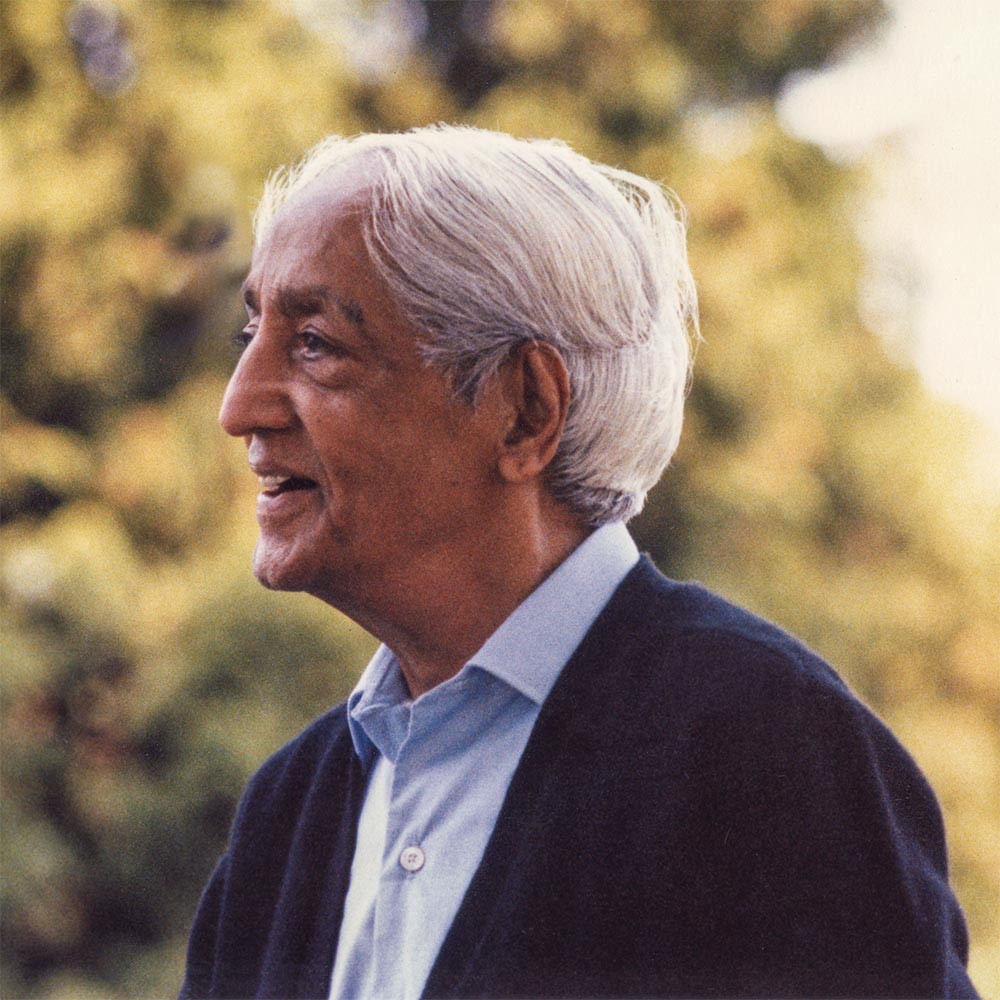
Krishnamurti outdoors smiling

Who Was Krishnamurti?

J. Krishnamurti (1895-1986) is widely regarded as one of the greatest thinkers and religious teachers of all time. He spoke throughout the world to large audiences and to individuals, including writers, scientists, philosophers and educators, about the need for a radical change in mankind. Referring to himself, Krishnamurti said:

He is acting as a mirror for you to look into. That mirror is not an authority. It has no authority, it’s just a mirror. And when you see it clearly, understand what you see in that mirror, then throw it away, break it up.

Krishnamurti was concerned with all humanity and held no nationality or belief and belonged to no particular group or culture. In the latter part of his life, along with continuing to give public talks, he travelled mainly between the schools he had founded in India, Britain and the United States, which educate for the total understanding of man and the art of living. He stressed that only this profound understanding can create a new generation that will live in peace.

Krishnamurti reminded his listeners again and again that we are all human beings first and not Hindus, Muslims or Christians, that we are like the rest of humanity and are not different from one another. He asked that we tread lightly on this earth without destroying ourselves or the environment. He communicated to his listeners a deep sense of respect for nature. His teachings transcend man-made belief systems, nationalistic sentiment and sectarianism. At the same time, they give new meaning and direction to mankind’s search for truth. His teaching is timeless, universal and increasingly relevant to the modern age.

I am nobody. It is as simple as that. I am nobody. But what is important is who you are, what you are.

Krishnamurti

Krishnamurti spoke not as a guru but as a friend. His talks and discussions are based not on tradition-based knowledge but on his own insights into the human mind and his vision of the sacred, so he always communicated a sense of freshness and directness, although the essence of his message remained unchanged over the years. When Krishnamurti addressed large audiences, people felt that he was talking to each of them personally, addressing their own particular problem. In his private interviews, he was a compassionate teacher, listening attentively to those who came to him in sorrow, and encouraging them to heal themselves through their own understanding. Religious scholars found that his words threw new light on traditional concepts. Krishnamurti took on the challenge of modern scientists and psychologists and went with them step by step, discussing their theories and sometimes enabling them to discern the limitations of their theories.

Krishnamurti left a large body of literature in the form of public talks, writings, discussions with teachers and students, scientists, psychologists and religious figures, conversations with individuals, television and radio interviews, and letters. Many of these have been published as books, in over 60 languages, along with hundreds of audio and video recordings.
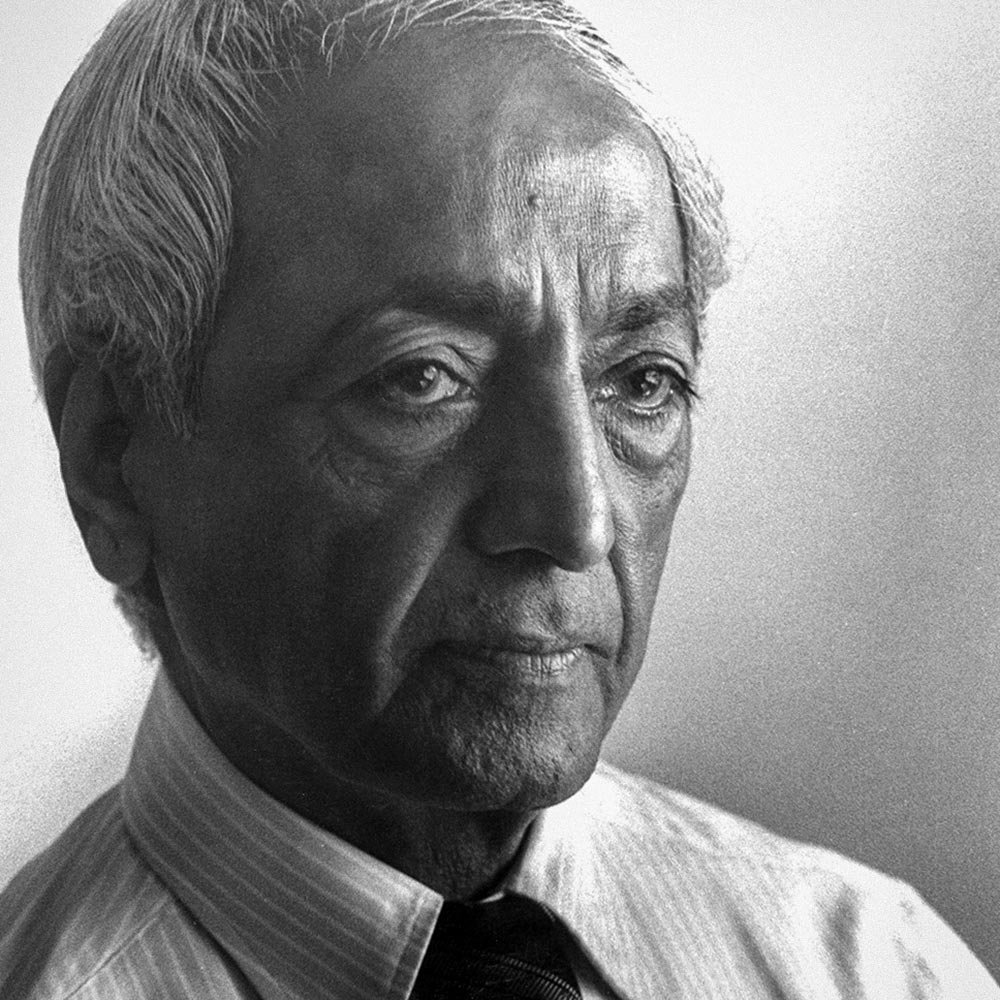
Three-quarters portrait photo of Krishnamurti

The Krishnamurti Foundation

Established in 1968 as a registered charity, and located at The Krishnamurti Centre, Krishnamurti Foundation Trust exists to preserve and make available Krishnamurti’s teachings.

The Foundation serves a global audience by providing worldwide free access to Krishnamurti videos, audio and texts to those who may be interested in pursuing an understanding of Krishnamurti’s work in their own lives.

In describing his intentions for the Foundations, Krishnamurti said: 

The Foundations will see to it that these teachings are kept whole, are not distorted, are not made corrupt.