
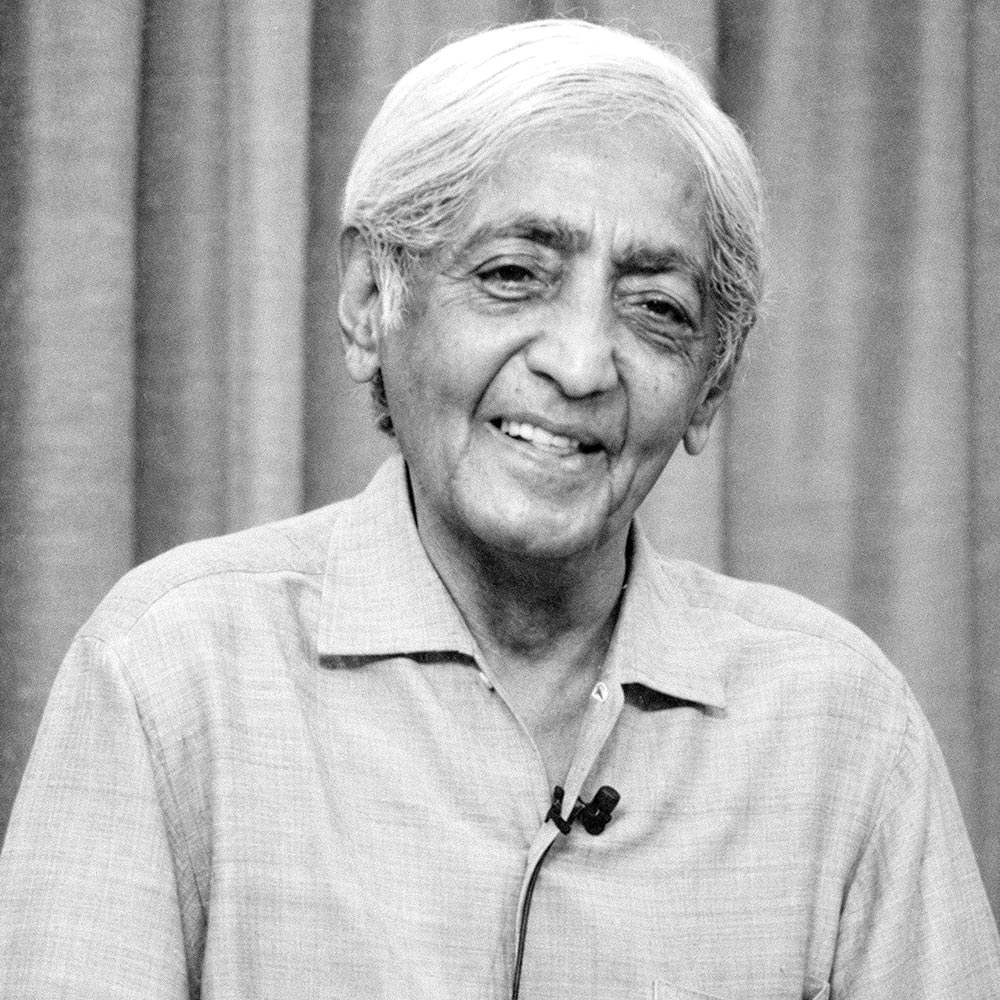
Photo of J. Krishnamurti

If your mind is free to discover what is true, there comes an abundant and incorruptible richness in which there is great joy.

Krishnamurti, Think on These Things

Read More

There must first be freedom of the mind for creativeness to take place. Technique can be then be used to express that creativeness. But to have the technique is meaningless without a creative mind, without the extraordinary creativeness which comes with the discovery of what is true. Unfortunately, most of us do not know this creativeness because we have burdened our minds with knowledge, tradition, memory, with what some other person has said. Whereas, if your mind is free to discover what is true, there comes an abundant and incorruptible richness in which there is great joy. Then all one’s relationships – with people, with ideas, with things – have quite a different meaning.

Have you ever wondered why it is that as people grow older they seem to lose all joy in life?

Krishnamurti, Think on These Things

Read More

Have you ever wondered why it is that as people grow older they seem to lose all joy in life? Why is it that we seem to lose that joyous intimation of something beyond, something of greater significance? Why do so many of us, as we grow into so-called maturity, become dull, insensitive to joy, to beauty, to the open skies and the marvellous earth? We are so concerned with ourselves – that is one explanation. We struggle to become somebody, to achieve and maintain a certain position; we have children and other responsibilities, and we have to earn money. All these external things soon weigh us down, and thereby we lose the joy of living. Look at the older faces around you, see how sad most of them are, how careworn and rather ill, how withdrawn, aloof and sometimes neurotic. Don’t you ask yourself why?

The one who is joyous, really happy, is not caught up in effort.

Read More

The one who is joyous, really happy, is not caught up in effort. To be without effort does not mean that you stagnate, that you are dull or stupid; on the contrary, only the wise, the extraordinarily intelligent, are really free of effort and struggle. But when we hear of effortlessness, we want to be like that; we want to achieve a state in which we will have no strife or conflict; so we make that our goal, our ideal, and strive after it. The moment we do this, we have lost the joy of living; we are again caught up in effort and struggle. The object of struggle varies, but all struggle is essentially the same. One may struggle to bring about social reform, or to find God, or to create a better relationship with one’s wife or husband, or with one’s neighbour; one may sit on the banks of the Ganga, worship at the feet of some guru, and so on. All this is effort, struggle. So what is important is not the object of struggle, but to understand struggle itself. Is it possible for the mind to be not just casually aware that for the moment it is not struggling, but completely free of struggle all the time so that it discovers a state of joy?

The becomer, whether in the outer world or in the spiritual world, is a machine; he will never know what real joy is

Read More

The becomer, whether in the outer world or in the spiritual world, is a machine; he will never know what real joy is. One will know joy only when one sees what one is and lets that complexity, that beauty, that ugliness, that corruption act without attempting to become something else. To do this is very difficult because the mind is always wanting to be something. You want to become philosophers or great writers. You worship the god of success, not the thing ‘that is’. However poor you may be, however empty, however dull, if you can see the thing as it is, then that will begin to transform itself. But a mind occupied in becoming something never understands the being. The understanding of the being of what one is, brings an extraordinary elation, a release of creative thought, creative life.

You must be sensitive to sorrow as well as to joy, and not eschew the one and seek out the other.

Read More

Many sannyasis, yogis and saints have denied themselves pleasure. They have tortured themselves and forced the mind to resist, to be insensitive to pleasure in every form. It is a pleasure to see the beauty of a tree, a cloud, or moonlight on the water, or of a human being. To deny that pleasure is to deny beauty. On the other hand, there are people who reject the ugly and cling to the beautiful. They want to remain in the lovely garden of their own making, and shut out the noise, the smell and the brutality that exist beyond the wall. Very often they succeed in this, but you cannot shut out the ugly and hold to the beautiful without becoming dull and insensitive. You must be sensitive to sorrow as well as to joy, and not eschew the one and seek out the other. Life is both death and love.

Her voice came across the water clear and strong. The words and the sound filled one’s whole being, and there was the joy of great purity.

Read More

The dawn had now fully come, and the morning star was barely visible over the tree; but the night still held back the day. A woman sat on a mat under the tree, tuning a stringed instrument that rested on her lap. Presently she sang something in Sanskrit; it was deeply religious, and as the words filled the morning air, the whole atmosphere of the place seemed to change, becoming charged with a strange fullness and meaning. Then she began to sing a song that is sung only at that hour of the morning. It was enchanting. She was utterly unaware that anyone was listening to her, nor did she care if anyone did, for she was wholly absorbed in that song. She had a good voice, and was thoroughly enjoying herself in a grave and serious manner. One could hardly hear the stringed instrument, but her voice came across the water clear and strong. The words and the sound filled one’s whole being, and there was the joy of great purity.

To have a cause for joy is no longer joy.

Read More

On the terrace, meditation was gladness. There was no reason for this ecstasy – to have a cause for joy is no longer joy – it was simply there, and thought could not capture it and make it into a remembrance. It was too strong and active for thought to play with, and thought and feeling became very quiet and still. It came wave upon wave, a living thing which nothing could contain, and with this joy there was benediction. It was all so utterly beyond all thought and demand.

How can there be joy in meditation if it is the coaxing of desire and pain; how can it flower if you are seeking it through control, suppression and sacrifice?

Read More

The flowering of meditation is goodness. It is not a virtue to be gathered bit by bit, slowly in the space of time; it is not morality made respectable by society nor is it the sanction of authority. It is the beauty of meditation that gives perfume to its flowering. How can there be joy in meditation if it is the coaxing of desire and pain; how can it flower if you are seeking it through control, suppression and sacrifice; how can it blossom in the darkness of fear or in corrupting ambition and in the smell of success; how can it bloom in the shadow of hope and despair? You will have to leave all these far behind, without regret, easily, naturally.

Joy has nothing whatsoever to do with pleasure. You may have a moment of great joy, but thinking about it reduces it to pleasure.

Krishnamurti, Inward Revolution

Read More

When you discard all authority in yourself totally, when you are no longer following any system, and when you have understood fear, pleasure, then you have understood order. And in the understanding of fear and pleasure there is joy. Joy has nothing whatsoever to do with pleasure. You may have a moment of great joy but thinking about it reduces it to pleasure.

You can cultivate pleasure; you can think about it endlessly. You cannot do that with joy. The moment you think about joy, it has gone.

Krishnamurti, Beyond Violence

Read More

Thought nourishes pleasure, which has nothing whatever to do with joy. Joy is not the product of thought; it is not pleasure. You can cultivate pleasure; you can think about it endlessly. You cannot do that with joy. The moment you think about joy, it has gone. It has become something from which you derive pleasure and therefore something you are afraid to lose.

You cannot remember joy and cultivate it; it comes uninvited.

Krishnamurti, Beyond Violence

Read More

There is a great difference between joy and pleasure. You can cultivate pleasure, think about it a great deal and have more of it. You had pleasure yesterday, and you can think about it, chew on it, and you want it repeated tomorrow. In pleasure, there is a motive in which there is possessiveness, domination and conformity. There is great pleasure in conformity: Hitler, Mussolini and Stalin made people conform, because there is great security and safety in it. When you see all that, when you are free of it – actually, not verbally, never to be jealous, never to dominate or be possessed – when the mind has swept away all that, you know what love is; you do not have to seek it. When the mind has understood the meaning of the word ‘love’, you are bound to ask what death is, because love and death go together. If the mind does not know how to die to the past, it does not know what love is. Love is not of time; it is not a thing to be remembered. You cannot remember joy and cultivate it; it comes uninvited.

You cannot run after joy; it is there when you are not there. You and joy cannot exist together. In joy there is no separation.

Read More

Joy is not yours. You cannot cultivate it, whereas you can cultivate pleasure. You cannot run after joy; it is there when you are not there. You and joy cannot exist together. In joy there is no separation. Ecstasy is not exclusive; in it there are no fragmentations as the ‘you’ and ‘me’, ‘we’ and ‘they’. Pleasure can never become joy. There is no road leading from one to the other. The mind that seeks pleasure cannot come to joy, but when there is joy, pleasure has quite a different meaning.

Joy can never become mechanical. It happens and then thought, thinking about it, makes it into pleasure.

Read More

If there is no beauty with all its marvel in one’s heart, then action becomes very superficial. Your gods and your literature, the trees, the women and men, are used for your own personal pleasure. Is love pleasure, desire? Without understanding this basically, sex becomes a problem. We never ask ourselves why civilisations, whether in the East or the West, have given to it such enormous meaning and importance both religiously and humanly. Pleasure becomes mechanical, as thought is mechanical – whatever it touches becomes routine, boring, or is used to sustain a particular form of pleasure. Pleasure is one thing and joy is another. Joy can never become mechanical. It happens and then thought, thinking about it, makes it into pleasure. It is the same with profound enjoyment; the moment thought captures it, it turns to envy.

There are such moments, such rare, happy, joyous moments, when there is complete love, complete communion.

Read More

In love there is no friction, there is not the one and the other, there is complete unity. It is a state of integration, a complete being. There are such moments, such rare, happy, joyous moments, when there is complete love, complete communion. What generally happens is that love is not what is important but the other; the object of love becomes important; the one to whom love is given becomes important and not love itself. Then the object of love, for various reasons, either biological, verbal or because of a desire for gratification, for comfort and so on, becomes important and love recedes. Then possession, jealousy and demands create conflict, and love recedes further and further; the further it recedes, the more the problem of relationship loses its significance, its worth and its meaning. Therefore, love is one of the most difficult things to comprehend.

Inward riches alone bring peace and joy.

Krishnamurti, The World Within

Read More

There is no such thing as living alone, for all living is a relationship. But to live alone without direct relationship demands swifter and greater awareness for self-discovery. A lone existence, without this keen and flowing awareness, strengthens the already dominant tendencies, thus causing imbalance and distortion. This is what one fears: the set and peculiar habits of thought and feelings that come with age. It is now that one has to become aware of them and, by understanding them, make away with them. Inward riches alone bring peace and joy.

These quotes only touch on the many subjects Krishnamurti inquired into during his lifetime. His timeless and universal teachings can be explored using the Index of Topics where you will find texts, audio and video related on many themes. Another option is to browse our selection of curated articles or more short quotes. Krishnamurti’s reply when asked what lies at the heart of his teachings can be found here. Many Krishnamurti books are available, a selection of which can be explored here. To find out more about Krishnamurti’s life, please see our introduction and the biography. We also host a weekly podcast, and offer free downloads. Please visit our YouTube channel for hundreds of specially selected shorter clips. Below, you can learn more about Krishnamurti and our charity which he founded in 1968.
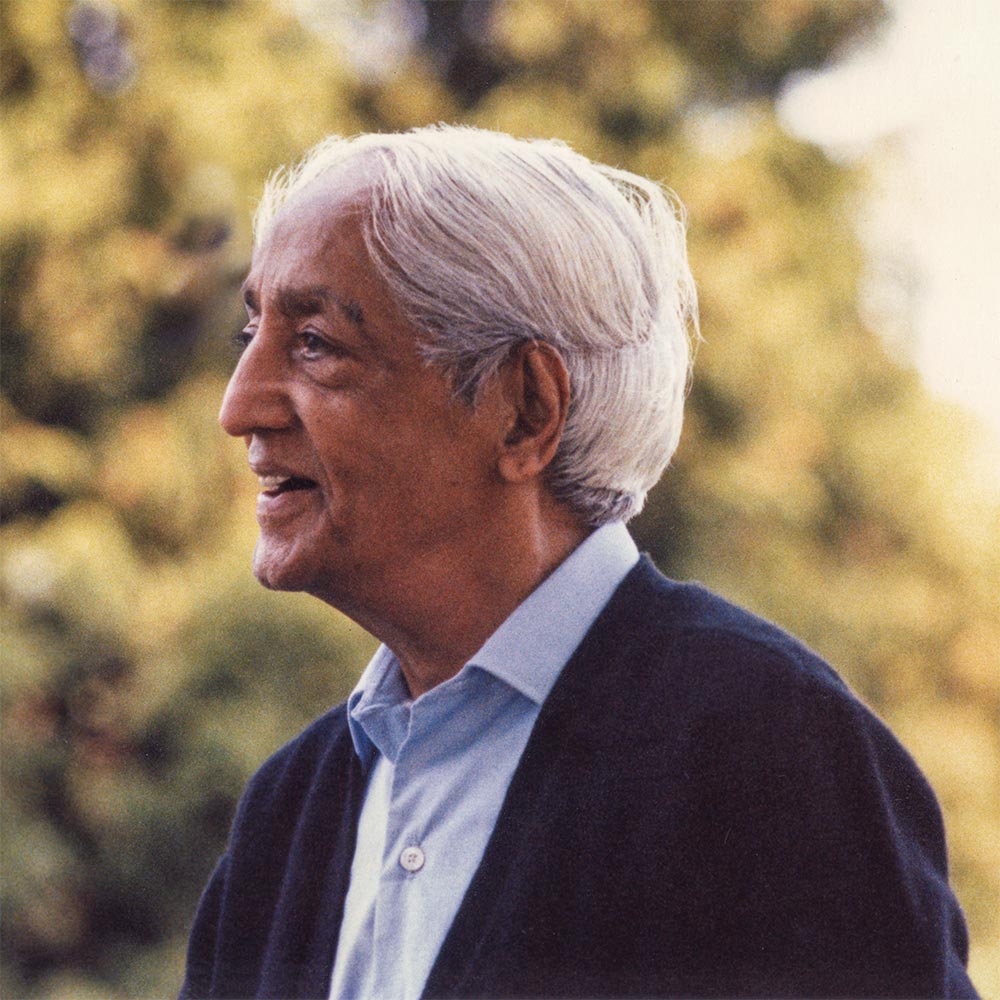
Krishnamurti outdoors smiling

Who Was Krishnamurti?

J. Krishnamurti (1895-1986) is widely regarded as one of the greatest thinkers and religious teachers of all time. He spoke throughout the world to large audiences and to individuals, including writers, scientists, philosophers and educators, about the need for a radical change in mankind. Referring to himself, Krishnamurti said:

He is acting as a mirror for you to look into. That mirror is not an authority. It has no authority, it’s just a mirror. And when you see it clearly, understand what you see in that mirror, then throw it away, break it up.

Krishnamurti was concerned with all humanity and held no nationality or belief and belonged to no particular group or culture. In the latter part of his life, along with continuing to give public talks, he travelled mainly between the schools he had founded in India, Britain and the United States, which educate for the total understanding of man and the art of living. He stressed that only this profound understanding can create a new generation that will live in peace.

Krishnamurti reminded his listeners again and again that we are all human beings first and not Hindus, Muslims or Christians, that we are like the rest of humanity and are not different from one another. He asked that we tread lightly on this earth without destroying ourselves or the environment. He communicated to his listeners a deep sense of respect for nature. His teachings transcend man-made belief systems, nationalistic sentiment and sectarianism. At the same time, they give new meaning and direction to mankind’s search for truth. His teaching is timeless, universal and increasingly relevant to the modern age.

I am nobody. It is as simple as that. I am nobody. But what is important is who you are, what you are.

Krishnamurti

Krishnamurti spoke not as a guru but as a friend. His talks and discussions are based not on tradition-based knowledge but on his own insights into the human mind and his vision of the sacred, so he always communicated a sense of freshness and directness, although the essence of his message remained unchanged over the years. When Krishnamurti addressed large audiences, people felt that he was talking to each of them personally, addressing their own particular problem. In his private interviews, he was a compassionate teacher, listening attentively to those who came to him in sorrow, and encouraging them to heal themselves through their own understanding. Religious scholars found that his words threw new light on traditional concepts. Krishnamurti took on the challenge of modern scientists and psychologists and went with them step by step, discussing their theories and sometimes enabling them to discern the limitations of their theories.

Krishnamurti left a large body of literature in the form of public talks, writings, discussions with teachers and students, scientists, psychologists and religious figures, conversations with individuals, television and radio interviews, and letters. Many of these have been published as books, in over 60 languages, along with hundreds of audio and video recordings.
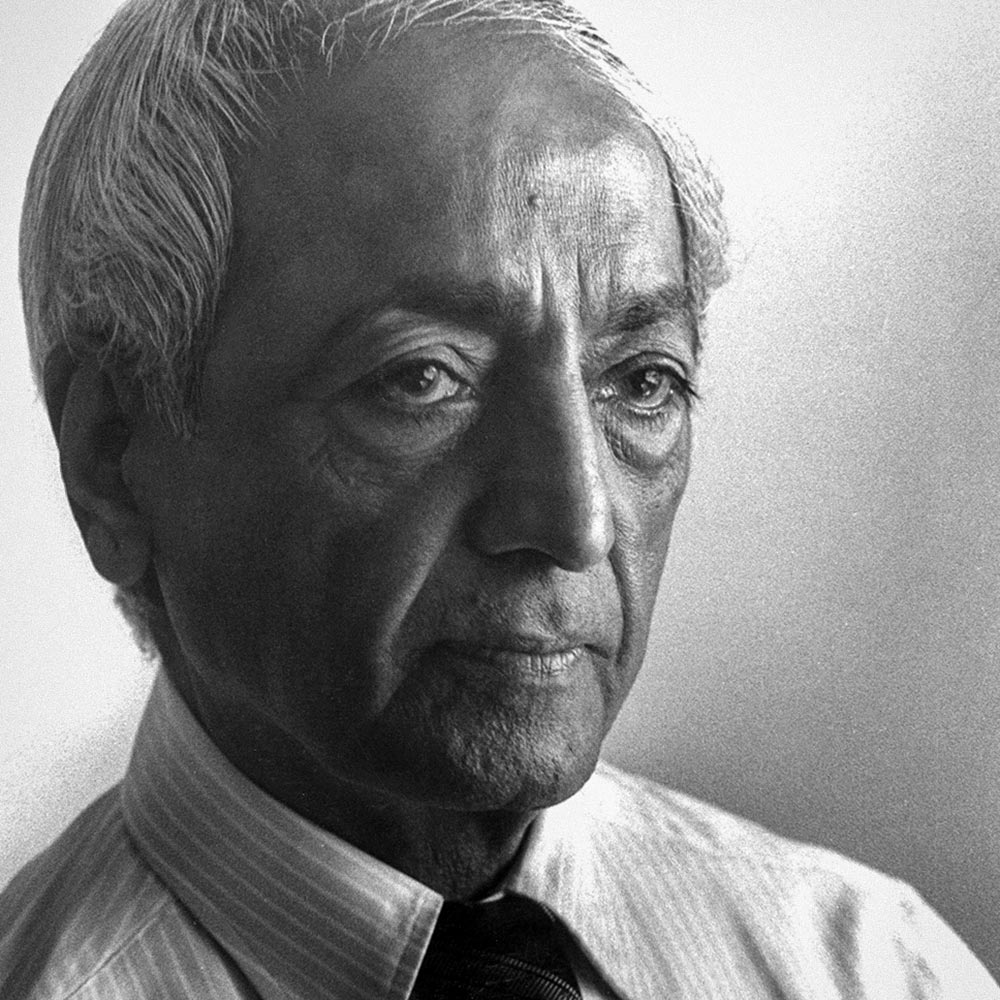
Three-quarters portrait photo of Krishnamurti

The Krishnamurti Foundation

Established in 1968 as a registered charity, and located at The Krishnamurti Centre, Krishnamurti Foundation Trust exists to preserve and make available Krishnamurti’s teachings.

The Foundation serves a global audience by providing worldwide free access to Krishnamurti videos, audio and texts to those who may be interested in pursuing an understanding of Krishnamurti’s work in their own lives.

In describing his intentions for the Foundations, Krishnamurti said: 

The Foundations will see to it that these teachings are kept whole, are not distorted, are not made corrupt.