
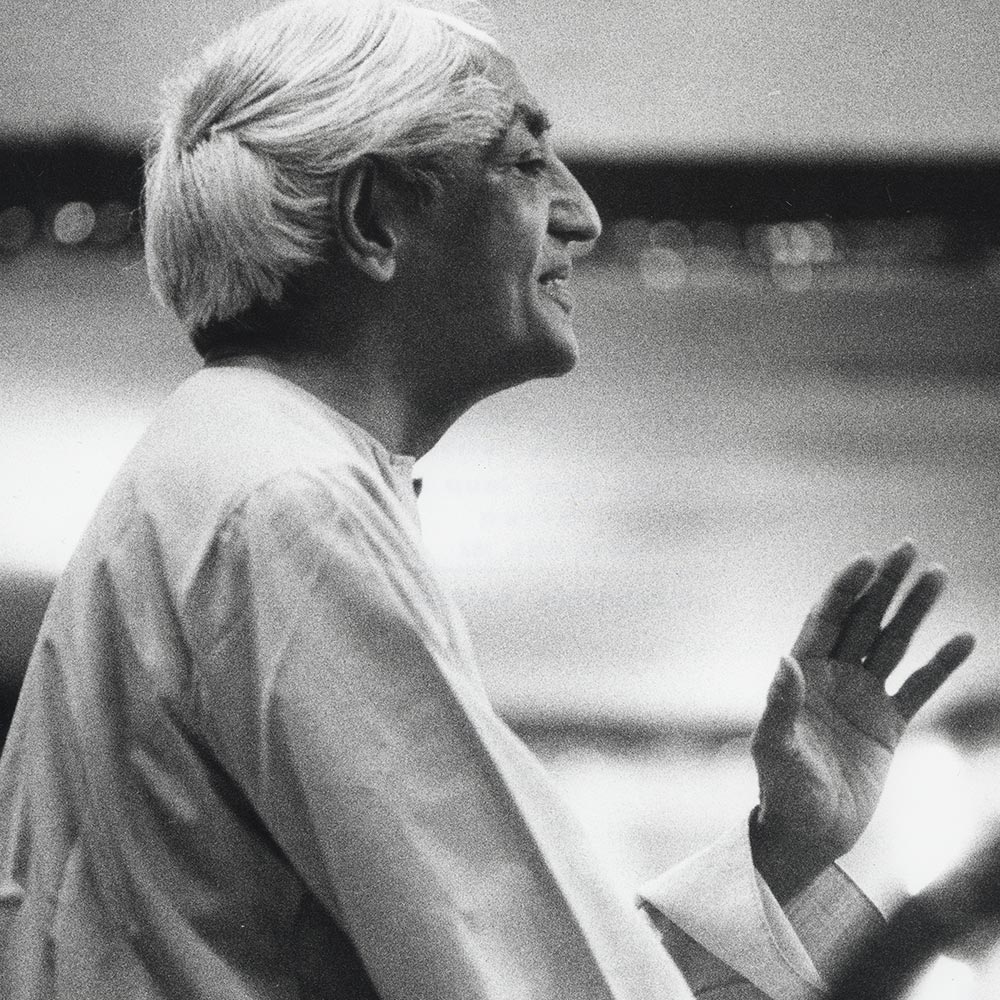
Photo of J. Krishnamurti

Tranquillity does not come into being with abstinence or denial; it comes with the understanding of ‘what is’. To understand ‘what is’ needs swift awareness, for ‘what is’ is not static.

Read More

As we are concerned with what others think of us, so we are anxious to know all about them. From this arise the crude and subtle forms of snobbishness and the worship of authority. Thus we become more and more externalised and inwardly empty. The more externalised we are, the more sensations and distractions there must be, and this gives rise to a mind that is never quiet, that is not capable of deep search and discovery. Gossip is an expression of a restless mind; but merely to be silent does not indicate a tranquil mind. Tranquillity does not come into being with abstinence or denial; it comes with the understanding of ‘what is’. To understand ‘what is’ needs swift awareness, for ‘what is’ is not static.

Ignorance is the lack of self-awareness, and knowledge is ignorance when there is no understanding of the ways of the self. Understanding of the self is freedom from knowledge.

Read More

Addiction to knowledge is like any other addiction – it offers an escape from the fear of emptiness, of loneliness, of frustration, and of being nothing. The light of knowledge is a delicate covering, under which lies a darkness the mind cannot penetrate. The mind is frightened of this unknown, and so it escapes into knowledge, into theories, hopes and imagination. This very knowledge is a hindrance to the understanding of the unknown. To put aside knowledge is to invite fear, and to deny the mind, which is the only instrument of perception one has, is to be vulnerable to sorrow and joy. But it is not easy to put aside knowledge. To be ignorant is not to be free of knowledge. Ignorance is the lack of self-awareness, and knowledge is ignorance when there is no understanding of the ways of the self. Understanding of the self is freedom from knowledge.

Instantaneous understanding comes when we meet on the same level at the same time.

Read More

To communicate with one another, even if we know each other very well, is extremely difficult. I may use words that may have to you a significance different from mine. Understanding comes when we, you and I, meet on the same level at the same time. That happens only when there is real affection between people, between husband and wife, between intimate friends. That is real communion. Instantaneous understanding comes when we meet on the same level at the same time.

Authority prevents the understanding of oneself.

Read More

Authority prevents the understanding of oneself. Under the shelter of an authority or guide, you may temporarily have a sense of security, a sense of well-being, but that is not the understanding of the total process of oneself. Authority, in its very nature, prevents the full awareness of oneself and therefore ultimately destroys freedom. In freedom alone can there be creativeness.

Learning implies the love of understanding and the love of doing a thing for itself.

Krishnamurti, Life Ahead

Read More

Learning is not merely the cultivation of memory or the accumulation of knowledge, but the capacity to think clearly and sanely, without illusion. It is to start from facts and not from beliefs and ideals. There is no learning if thought originates from conclusions. Merely to acquire information or knowledge is not to learn. Learning implies the love of understanding and the love of doing a thing for itself. Learning is possible only when there is no coercion of any kind.

Understanding is not a matter of remembrance. It is a continuous intensity, a constant discovery.

Krishnamurti, Life Ahead

Read More

What I am saying is not something to be merely remembered. It is not intended that you should try to store in your mind what you hear, to be recollected and either thought about or acted upon later. If you merely store in your mind what I am telling you, it will be nothing but memory; it won’t be a living thing, something you really understand. It is understanding that matters, not recollection. I hope you see the difference between the two. Understanding is immediate, direct; it is something you experience intensely. But if you merely remember what you have heard, it will only serve as a pattern, a guide to be followed, a slogan to be repeated, an idea to be imitated, an ideal on which to base your life. Understanding is not a matter of remembrance. It is a continuous intensity, a constant discovery.

In the very understanding of escape is the stopping of escape, and the mind is able to look at itself.

Read More

In the very understanding of escape is the stopping of escape, and the mind is able to look at itself. In looking at itself, there must be no evaluation, no judgement. Then the fact is important in itself, and there is complete attention, without any desire for distraction. Therefore, the mind is no longer empty. Complete attention is the good.

Conclusions are hindrances to understanding.

Read More

Our difficulty is that we have built around ourselves conclusions which we call ‘understanding’. These conclusions are hindrances to understanding. If you go into this more deeply, you will see that there must be complete abandonment of all that has been accumulated for the being of understanding and wisdom. To be simple is not a conclusion, an intellectual concept for which you strive. There can be simplicity only when the self with its accumulation ceases.

Perception and understanding don’t involve time at all.

Krishnamurti, Inward Revolution

Read More

Perception involves a mind that is not caught in the bondage of time. Once you understand this fact, your whole structure of thought changes. Perception and understanding don’t involve time at all. What is involved is seeing clearly, and to see clearly you must have space – not only outward but inward space. That means space in the mind. When the mind is chattering, it is filled with knowledge – knowledge being the past, apart from technological knowledge which is obvious and necessary. When the mind is crowded with knowledge of yesterday, the events of yesterday, the pain of yesterday, the various remembrances of yesterday, there is no space. Where there is no space, there is conflict.

If you have an ideal, it acts as an impediment to the understanding of ‘what is’. Aren’t you afraid of something or other? You had a physical pain a week ago, and you don’t want that pain repeated. Somebody has hurt you, and there is fear of that hurt. Fear breeds violence. Unless you really are free of fear, you are bound to create chaos in the world. And fear cannot be suppressed by an ideal, like the ideal of courage. See what happens. You are afraid, and you have an idea that by developing courage you can get rid of fear, which is avoiding ‘what is’ and hoping through courage to get rid of fear. If you have an ideal, it acts as an impediment to the understanding of ‘what is’.

Krishnamurti, Inward Revolution

Read More

Krishnamurti, Inward Revolutio

Seeing is understanding. You cannot understand through the mind, through the intellect, or through a fragment. There is understanding only when the mind is completely quiet.

Read More

Seeing, observing and listening are the greatest acts. You cannot see if you are looking out from a little corner; you cannot see what is happening in the world, the despair, the anxiety, the aching loneliness, the tears of the relatives of people who have been killed. But you have to see all this, not emotionally, nor sentimentally, not saying, ‘I am against war’ or ‘I am for war,’ as sentimentality and emotionalism are the most destructive things because they avoid facts and so avoid ‘what is’. So, seeing is all-important. Seeing is understanding; you cannot understand through the mind, through the intellect, or through a fragment. There is understanding only when the mind is completely quiet, which means when there is no image.

Out of understanding comes order.

Read More

In the highest mathematics is the highest order, absolute order. That absolute order, one must have in oneself. As virtue cannot be cultivated or put together, so order cannot be engendered, put together by the mind. What the mind can do is to find out what disorder is. You know disorder. Living the way we live is total disorder. As things are, each man is out for himself; there is no cooperation, no love. There is complete callousness as to what happens in other countries, or at your neighbour’s. Be aware of this disorder, and out of the understanding of this disorder understand how it has come about, the cause of it. When you understand the causes, the forces that are at work bringing about this disorder, understand it truly, not merely intellectually, then out of that understanding will come order.

Understanding comes only through self-knowledge, which is awareness of one’s total psychological process.

Read More

The ignorant man is not the unlearned, but he who does not know himself. The learned man is stupid when he relies on books, on knowledge, and on authority to give him understanding. Understanding comes only through self-knowledge, which is awareness of one’s total psychological process. Thus education, in the true sense, is the understanding of oneself, for it is within each one of us that the whole of existence is gathered.

There is no ‘right’ relationship; there is only the understanding of relationship.

Read More

There is no ‘right’ relationship; there is only the understanding of relationship. Right relationship implies the mere acceptance of a formula, as does right thought. Right thought and right thinking are two different things. Right thought is merely conforming to what is right, what is respectable. Right thinking is movement; it is the product of understanding, and understanding is constantly undergoing modification and change.

Can understanding ever come about through a method? Understanding means love and the sanity of the mind. And love cannot be practised or taught.

Krishnamurti, The Urgency of Change

Read More

Can understanding ever come about through a method? Understanding means love and the sanity of the mind. And love cannot be practised or taught. The sanity of the mind can only come about when there is clear perception, seeing things as they are unemotionally, not sentimentally. Neither of these things can be taught by another, nor by a system invented by yourself or by another.

These quotes only touch on the many subjects Krishnamurti inquired into during his lifetime. His timeless and universal teachings can be explored using the Index of Topics where you will find texts, audio and video related on many themes. Another option is to browse our selection of curated articles or more short quotes. Krishnamurti’s reply when asked what lies at the heart of his teachings can be found here. Many Krishnamurti books are available, a selection of which can be explored here. To find out more about Krishnamurti’s life, please see our introduction and the biography. We also host a weekly podcast, and offer free downloads. Please visit our YouTube channel for hundreds of specially selected shorter clips. Below, you can learn more about Krishnamurti and our charity which he founded in 1968.
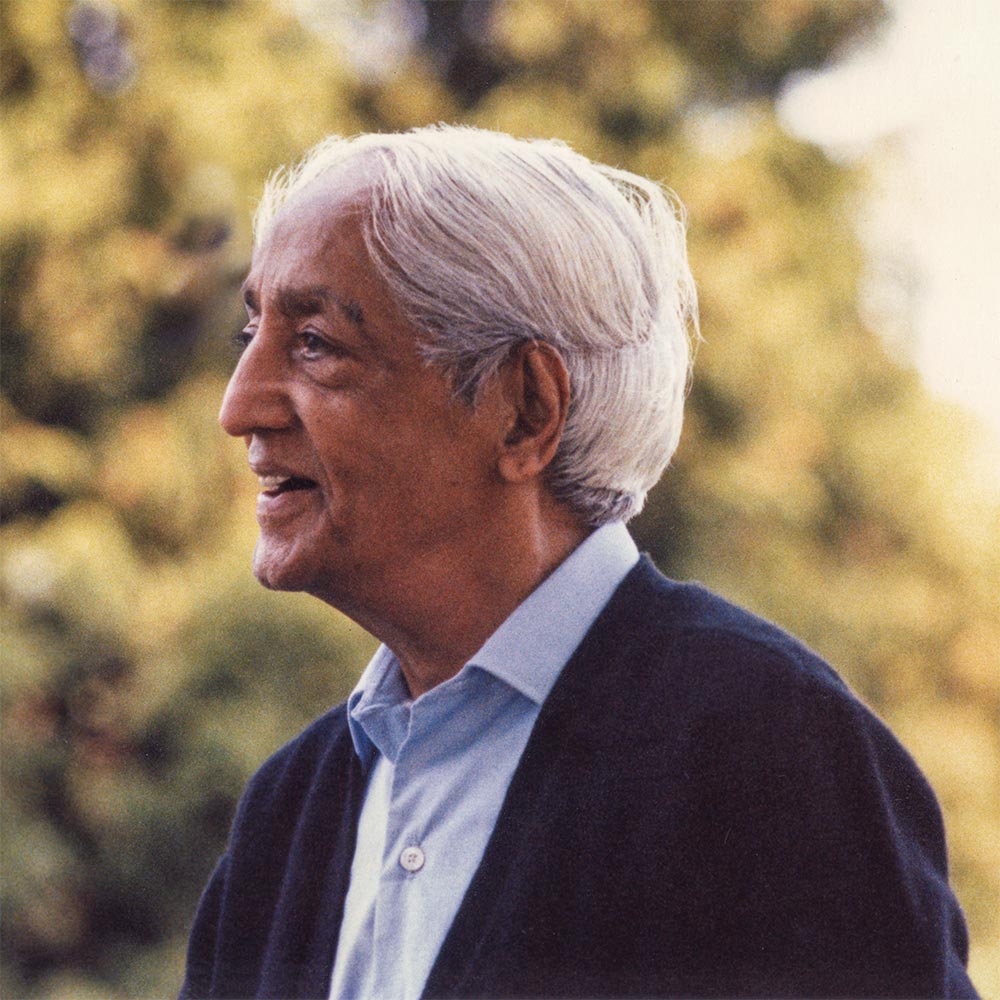
Krishnamurti outdoors smiling

Who Was Krishnamurti?

J. Krishnamurti (1895-1986) is widely regarded as one of the greatest thinkers and religious teachers of all time. He spoke throughout the world to large audiences and to individuals, including writers, scientists, philosophers and educators, about the need for a radical change in mankind. Referring to himself, Krishnamurti said:

He is acting as a mirror for you to look into. That mirror is not an authority. It has no authority, it’s just a mirror. And when you see it clearly, understand what you see in that mirror, then throw it away, break it up.

Krishnamurti was concerned with all humanity and held no nationality or belief and belonged to no particular group or culture. In the latter part of his life, along with continuing to give public talks, he travelled mainly between the schools he had founded in India, Britain and the United States, which educate for the total understanding of man and the art of living. He stressed that only this profound understanding can create a new generation that will live in peace.

Krishnamurti reminded his listeners again and again that we are all human beings first and not Hindus, Muslims or Christians, that we are like the rest of humanity and are not different from one another. He asked that we tread lightly on this earth without destroying ourselves or the environment. He communicated to his listeners a deep sense of respect for nature. His teachings transcend man-made belief systems, nationalistic sentiment and sectarianism. At the same time, they give new meaning and direction to mankind’s search for truth. His teaching is timeless, universal and increasingly relevant to the modern age.

I am nobody. It is as simple as that. I am nobody. But what is important is who you are, what you are.

Krishnamurti

Krishnamurti spoke not as a guru but as a friend. His talks and discussions are based not on tradition-based knowledge but on his own insights into the human mind and his vision of the sacred, so he always communicated a sense of freshness and directness, although the essence of his message remained unchanged over the years. When Krishnamurti addressed large audiences, people felt that he was talking to each of them personally, addressing their own particular problem. In his private interviews, he was a compassionate teacher, listening attentively to those who came to him in sorrow, and encouraging them to heal themselves through their own understanding. Religious scholars found that his words threw new light on traditional concepts. Krishnamurti took on the challenge of modern scientists and psychologists and went with them step by step, discussing their theories and sometimes enabling them to discern the limitations of their theories.

Krishnamurti left a large body of literature in the form of public talks, writings, discussions with teachers and students, scientists, psychologists and religious figures, conversations with individuals, television and radio interviews, and letters. Many of these have been published as books, in over 60 languages, along with hundreds of audio and video recordings.
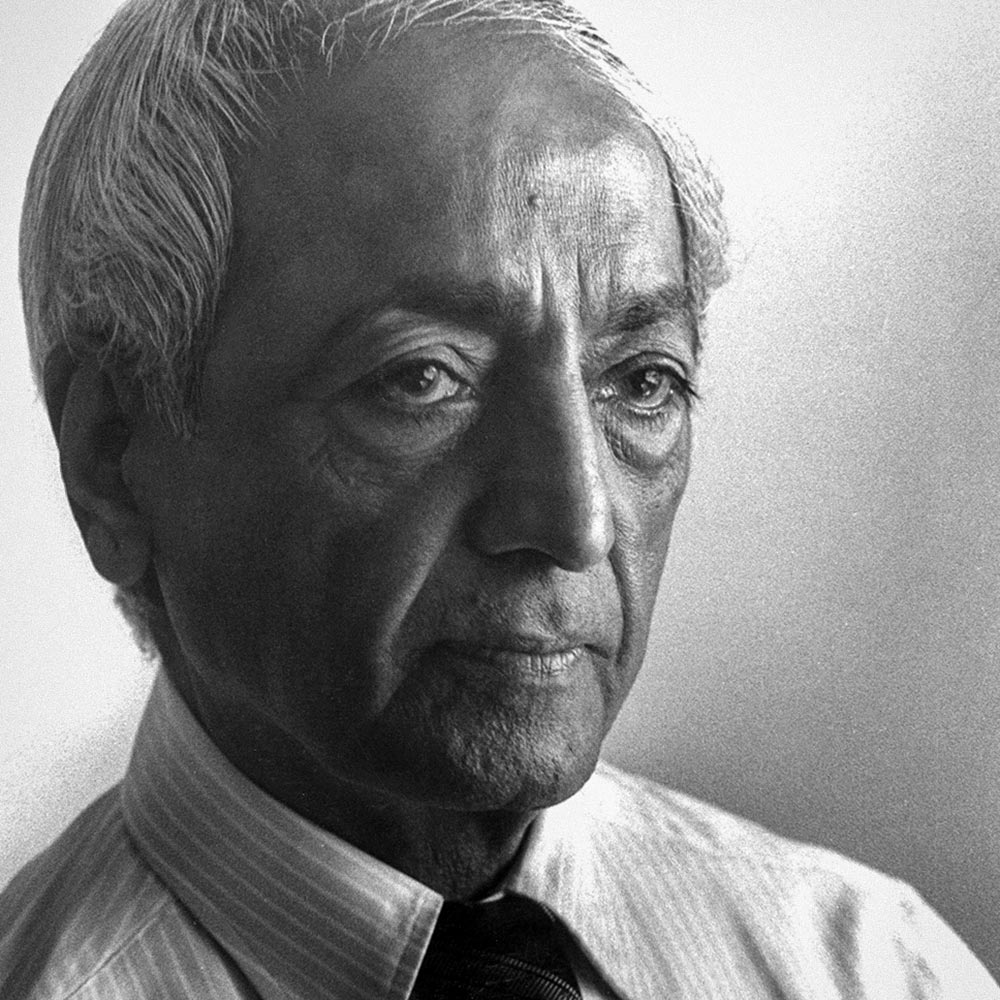
Three-quarters portrait photo of Krishnamurti

The Krishnamurti Foundation

Established in 1968 as a registered charity, and located at The Krishnamurti Centre, Krishnamurti Foundation Trust exists to preserve and make available Krishnamurti’s teachings.

The Foundation serves a global audience by providing worldwide free access to Krishnamurti videos, audio and texts to those who may be interested in pursuing an understanding of Krishnamurti’s work in their own lives.

In describing his intentions for the Foundations, Krishnamurti said: 

The Foundations will see to it that these teachings are kept whole, are not distorted, are not made corrupt.