
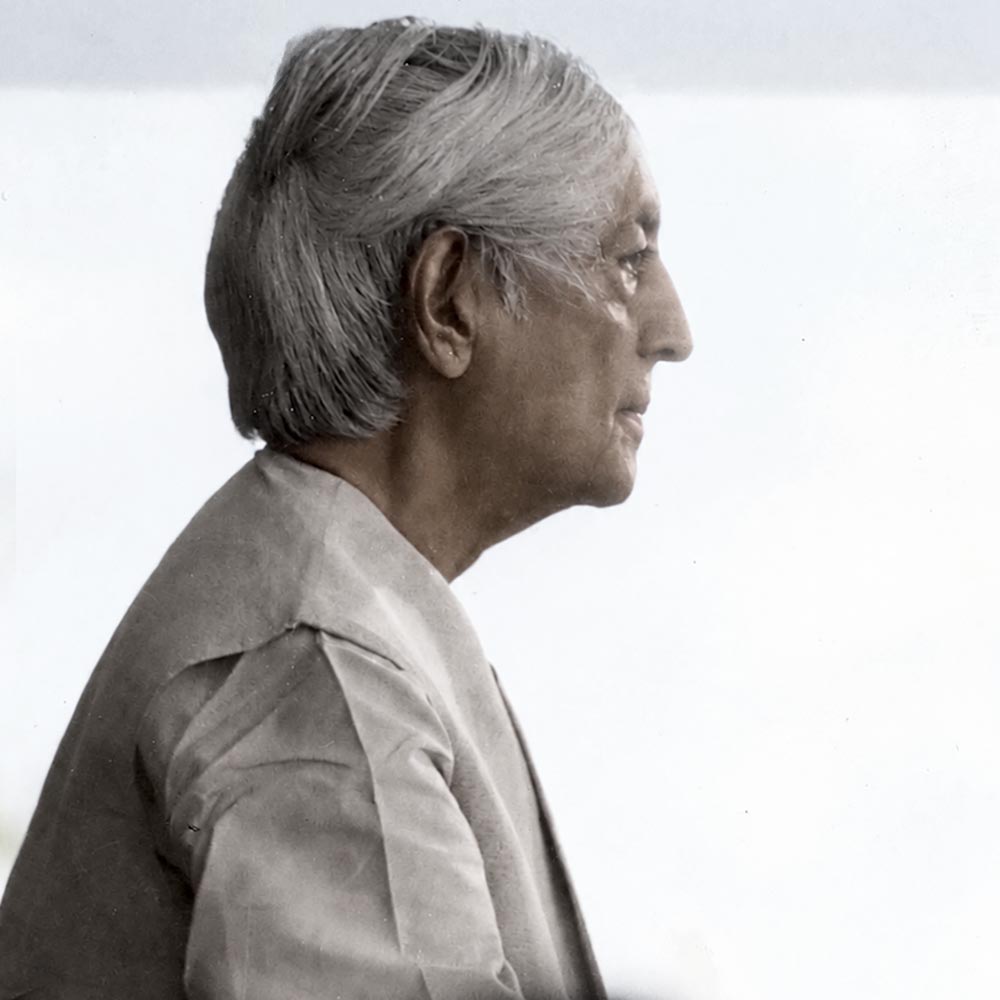
Photo of J. Krishnamurti

The act of learning is the act of pure observation, and this observation is not held within the limitation of memory.

Read More

The act of learning is the act of pure observation, and this observation is not held within the limitation of memory. We learn to earn a living, but we never live. The capacity to earn a living takes most of our life; we have hardly any time for other things. We find time for gossip, to be entertained, to play, but all this is not living. There is a whole field that is actual living which is totally neglected.

Non-action is the total attention of observation. In this observation, that which is being observed undergoes a transformation.

Read More

Action and non-action require great energy. We have used ‘positive’ energy in wars, in writing books, in performing surgery, and to work beneath the seas. Non-action requires far more than the so-called positive action. Positive action is to control, to support, to escape. Non-action is the total attention of observation. In this observation, that which is being observed undergoes a transformation. This silent observation demands not only physical energy, but also deep psychological energy. We are used to the former, and this conditioning limits our energy. In a complete, silent observation, which is non-action, there is no expenditure of energy, and so energy is limitless.

Is it possible to observe something in its entirety, wholly, and in the very observation of that totality, see the ending of it?

Krishnamurti, This Light in Oneself

Read More

Is it possible to observe something in its entirety, wholly, and in the very observation of that totality, see the ending of it? Is it possible to observe your hurt or your anxiety or your guilt, totally? Suppose I feel guilty. Can I look at that guilt, see how it arose and what was the reason for it, see how I am dreading more of it, see the entire structure of guilt, and observe it wholly? Of course I can, but I can observe it wholly only when I am aware of the nature of being hurt. I can be aware of it if there is no direction or motive involved in that awareness.

Awareness implies an observation in which there is no choice whatsoever, just observing without interpretation, translation or distortion.

Krishnamurti, This Light in Oneself

Read More

Meditation is the emptying of the mind of the activity of the self. And you cannot empty the mind of the activity of the self by any practice or method, or by asking what to do. You have to find out for yourself your own activity of the self: the habits, the verbal statements, the gestures, the deceptions, the guilt that you cultivate and hold on to as though it were some precious thing instead of throwing it away, the punishments – all the activities of the self. That demands awareness. Now, what is being aware? Awareness implies an observation in which there is no choice whatsoever, just observing without interpretation, translation or distortion. That will not take place as long as there is an observer trying to be aware. Can you be aware, attentive, so that in that attention there is only observation and not the observer?

There is observation which becomes harmonious, which is true, when the observer is not, but there is only observation.

Read More

Despair can never be dissolved through escape, only by observing it. So we come to the question of how to observe – how to observe ourselves so that in that observation there is no conflict at all. Because conflict is corruption; it is a waste of energy; it is the battle of our life, from the moment we are born till we die. Is it possible to live without a single moment of conflict? To do that, to find that out for ourselves, one has to learn how to observe our whole movement. There is observation which becomes harmonious, which is true, when the observer is not, but there is only observation.

In observation there is not only the understanding of the building of images, but also the ending of all images.

Read More

If the mind is attentive and does not move away from suffering at all, then you will see that out of total attention comes not only energy and passion, but also that suffering comes to an end. In the same way, all images can end instantly when there is no preference for any image; this is very important. When you have no preference, you have no prejudice. Then you are attentive; then you can look. In that observation there is not only the understanding of the building of images, but also the ending of all images.

There must be the observation of the outer and the inner, which sharpens the brain. This very sharpness of the brain makes it quiet.

Krishnamurti, Meeting Life

Read More

There must be an astonishing intelligence. This intelligence operates all the time, whether you are asleep or awake. So there must be the observation of the outer and the inner, which sharpens the brain. This very sharpness of the brain makes it quiet. It is this sensitivity and intelligence that make thought operate only when it has to; the rest of the time the brain is not dormant but watchfully quiet. And so the brain with its reactions doesn’t bring about conflict; it functions without struggle and therefore without distortion. Then the doing and the acting are immediate, as when you see danger. Therefore there is always a freedom from conceptual accumulations. It is this conceptual accumulation which is the observer, the ego, the ‘me’, which divides, resists and builds barriers. When the ‘me’ is not, the whole of life is in the beauty of living, the beauty of relationship, without substituting one image for another. Then only is the infinitely greater possible.

To sow the seeds of clarity, seriousness and right behaviour, one needs careful observation, careful watchfulness.

Krishnamurti, Meeting Life

Read More

Life isn’t just sex, smoking pot, taking LSD, going to church or making a name for oneself in business; or throwing out the whole thing in despair and leading a riotous, bohemian, uncertain kind of existence. There is something more important in life, a much deeper issue, which requires a great deal of seriousness. And it is only when one is young that one can sow the seeds of seriousness which will flower and blossom as one lives. But to sow these seeds of clarity, seriousness and right behaviour, one needs careful observation, careful watchfulness.

The simplicity is in the observation, not in the problem which may be complex.

Read More

We are not simple people who look at things simply; we have complex minds. Society evolves, becoming more and more complex – like our own minds. To understand something very complex, one has to be very simple. To understand a very complex problem, you must look at the problem itself without bringing into the investigation conclusions, answers, suppositions and theories. When you look at the problem – and knowing that the answer is in the problem – your mind becomes very simple. The simplicity is in the observation, not in the problem which may be complex.

To observe very clearly there must be freedom, which implies that the very observation is action. That observation brings about a radical revolution.

Read More

Can the mind be completely free from all conditioning, so that a totally different kind of life can be lived? To find this out, there must be freedom to observe, not as a Christian, a Hindu, a German or a Russian, or as anything else. To observe very clearly, there must be freedom, which implies that the very observation is action. That observation brings about a radical revolution. To be capable of such observation, you need great energy.

Observation means non-abstraction. There is only observation, not the observer, who is an abstraction.

Krishnamurti, To Be Human

Read More

Observation means non-abstraction. There is only observation, not the observer, who is an abstraction. The observer is an abstraction, an idea, a conclusion. The observer is the past. Through the eyes of the past, you are looking at the trees, the mountains, your wife or husband, your children. That is part of your laziness. Now, to see that, to have an insight into it, to be aware of this extraordinary structure of illusion, which is an abstraction, that observation in itself is total security.

Insight can take place only when knowledge has come to an end, and there is pure observation without any direction.

Krishnamurti, To Be Human

Read More

Insight can take place only when knowledge has come to an end, and there is pure observation without any direction. That insight is not the result of constant examination, constant analysis, examining day after day; it is sudden cessation of all knowledge and seeing something directly. That insight brings about a fundamental change in the very brain cells that carry memory. When you have an insight into attachment, you go behind the word, behind your reactions of asserting and not asserting; you observe how the mind has built up this whole process of attachment. You can only observe it when you don’t want to discard it. You can only observe when you see that the observer is that thing which you are seeing. The observer has created the attachment and then disassociated himself from it and tries to change, control, shape, deny, alter, go beyond. When you have an insight of that kind, out of that comes intelligence.

Discipline comes in the observation of ‘what is’ and learning about it; this learning about itself is its own discipline.

Krishnamurti, Beyond Violence

Read More

A mind capable of understanding what truth is, what reality is – if there is such a thing as reality – must be completely free of all the human tricks, deceptions and illusions. This takes a lot of work. It means an inward discipline; a discipline which is not imitation, conformity or adjustment. Discipline comes in the observation of ‘what is’ and learning about it; this learning about itself is its own discipline. Therefore, there is order and with it the end of disorder in oneself. All this, from the beginning of these talks till now, is part of meditation.

Observation is not possible if there is any form of prejudice, conclusion or formula.

Krishnamurti, Beyond Violence

Read More

Observation is not possible if there is any form of prejudice, conclusion or formula, according to which you are observing. If you are observing according to what a psychologist has said to you, you really are not observing yourself; therefore, there is no self-knowing. You need a mind that is able to stand completely alone, not burdened by the propaganda or the experiences of others. Enlightenment does not come through a leader or through a teacher; it comes through the understanding of what is in yourself, not going away from yourself. The mind has to understand actually what is going on in its own psychological field; it must be aware of what is going on without any distortion, without any choice, without any resentment, bitterness, explanation or justification. It must just be aware.

Only when the brain is quiet can there be right observation.

Read More

Self-critical awareness is essential. Imagination and illusion distort clear observation. Illusion will always exist as long as the urge for the continuation of pleasure and the avoidance of pain exist; the demand for those experiences which are pleasurable to continue or be remembered; the avoidance of pain, suffering. Both these breed illusion. To wipe away illusion altogether, pleasure and sorrow must be understood, not by control or sublimation, identification or denial. Only when the brain is quiet can there be right observation. Can the brain ever be quiet? It can when the brain, being highly sensitive, without the power of distortion, is negatively aware.

These quotes only touch on the many subjects Krishnamurti inquired into during his lifetime. His timeless and universal teachings can be explored using the Index of Topics where you will find texts, audio and video related on many themes. Another option is to browse our selection of curated articles or more short quotes. Krishnamurti’s reply when asked what lies at the heart of his teachings can be found here. Many Krishnamurti books are available, a selection of which can be explored here. To find out more about Krishnamurti’s life, please see our introduction and the biography. We also host a weekly podcast, and offer free downloads. Please visit our YouTube channel for hundreds of specially selected shorter clips. Below, you can learn more about Krishnamurti and our charity which he founded in 1968.
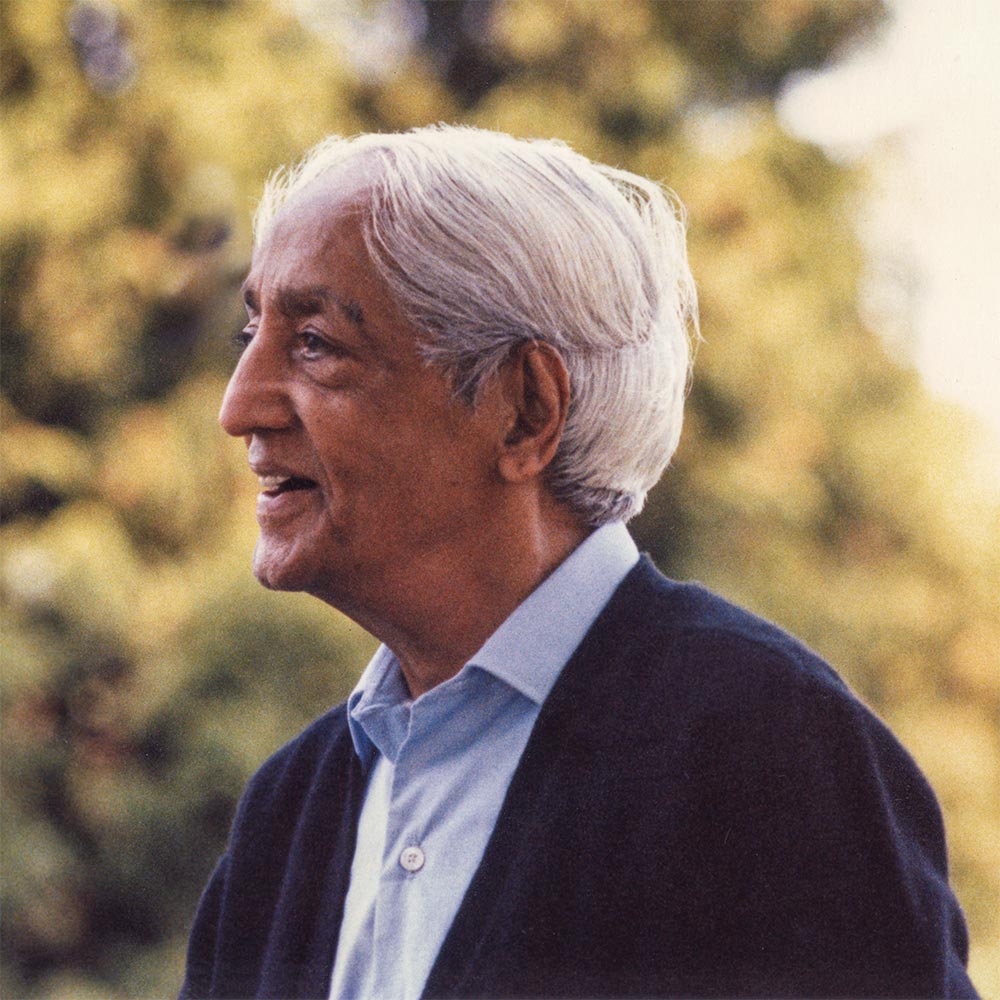
Krishnamurti outdoors smiling

Who Was Krishnamurti?

J. Krishnamurti (1895-1986) is widely regarded as one of the greatest thinkers and religious teachers of all time. He spoke throughout the world to large audiences and to individuals, including writers, scientists, philosophers and educators, about the need for a radical change in mankind. Referring to himself, Krishnamurti said:

He is acting as a mirror for you to look into. That mirror is not an authority. It has no authority, it’s just a mirror. And when you see it clearly, understand what you see in that mirror, then throw it away, break it up.

Krishnamurti was concerned with all humanity and held no nationality or belief and belonged to no particular group or culture. In the latter part of his life, along with continuing to give public talks, he travelled mainly between the schools he had founded in India, Britain and the United States, which educate for the total understanding of man and the art of living. He stressed that only this profound understanding can create a new generation that will live in peace.

Krishnamurti reminded his listeners again and again that we are all human beings first and not Hindus, Muslims or Christians, that we are like the rest of humanity and are not different from one another. He asked that we tread lightly on this earth without destroying ourselves or the environment. He communicated to his listeners a deep sense of respect for nature. His teachings transcend man-made belief systems, nationalistic sentiment and sectarianism. At the same time, they give new meaning and direction to mankind’s search for truth. His teaching is timeless, universal and increasingly relevant to the modern age.

I am nobody. It is as simple as that. I am nobody. But what is important is who you are, what you are.

Krishnamurti

Krishnamurti spoke not as a guru but as a friend. His talks and discussions are based not on tradition-based knowledge but on his own insights into the human mind and his vision of the sacred, so he always communicated a sense of freshness and directness, although the essence of his message remained unchanged over the years. When Krishnamurti addressed large audiences, people felt that he was talking to each of them personally, addressing their own particular problem. In his private interviews, he was a compassionate teacher, listening attentively to those who came to him in sorrow, and encouraging them to heal themselves through their own understanding. Religious scholars found that his words threw new light on traditional concepts. Krishnamurti took on the challenge of modern scientists and psychologists and went with them step by step, discussing their theories and sometimes enabling them to discern the limitations of their theories.

Krishnamurti left a large body of literature in the form of public talks, writings, discussions with teachers and students, scientists, psychologists and religious figures, conversations with individuals, television and radio interviews, and letters. Many of these have been published as books, in over 60 languages, along with hundreds of audio and video recordings.
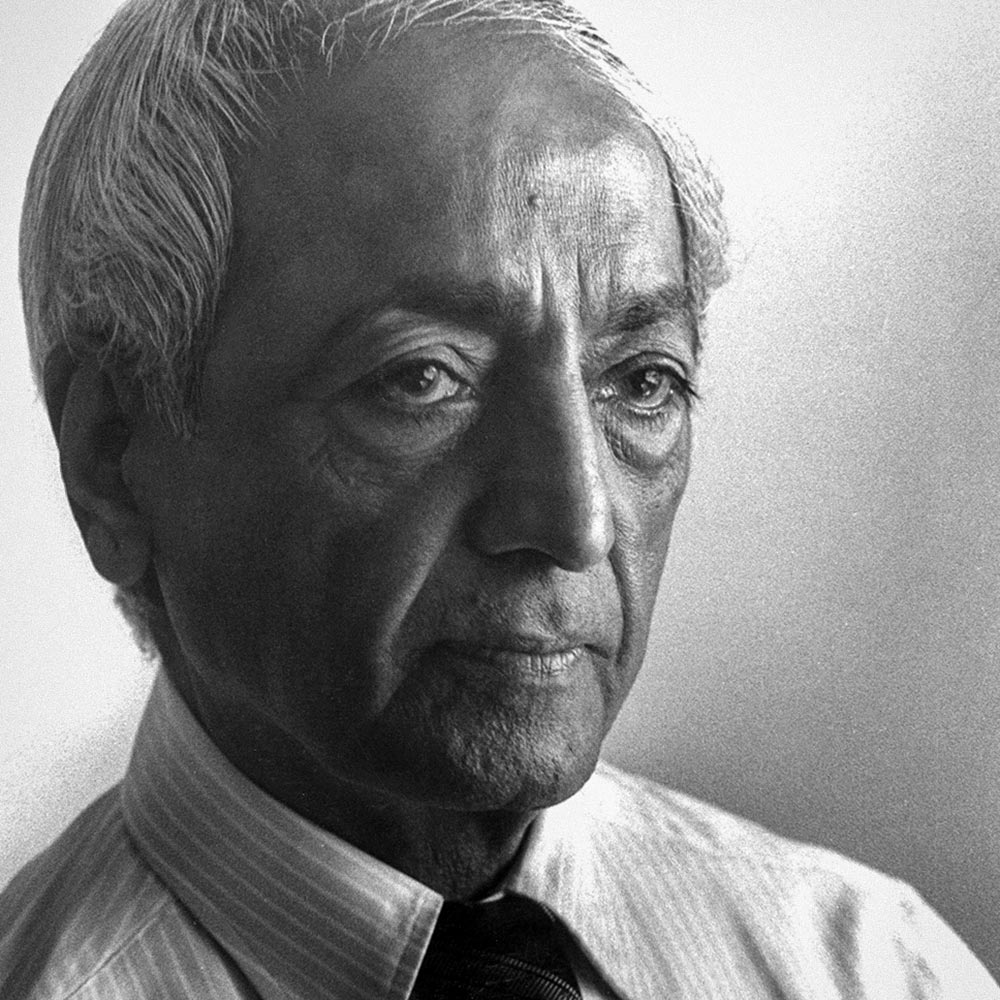
Three-quarters portrait photo of Krishnamurti

The Krishnamurti Foundation

Established in 1968 as a registered charity, and located at The Krishnamurti Centre, Krishnamurti Foundation Trust exists to preserve and make available Krishnamurti’s teachings.

The Foundation serves a global audience by providing worldwide free access to Krishnamurti videos, audio and texts to those who may be interested in pursuing an understanding of Krishnamurti’s work in their own lives.

In describing his intentions for the Foundations, Krishnamurti said: 

The Foundations will see to it that these teachings are kept whole, are not distorted, are not made corrupt.