
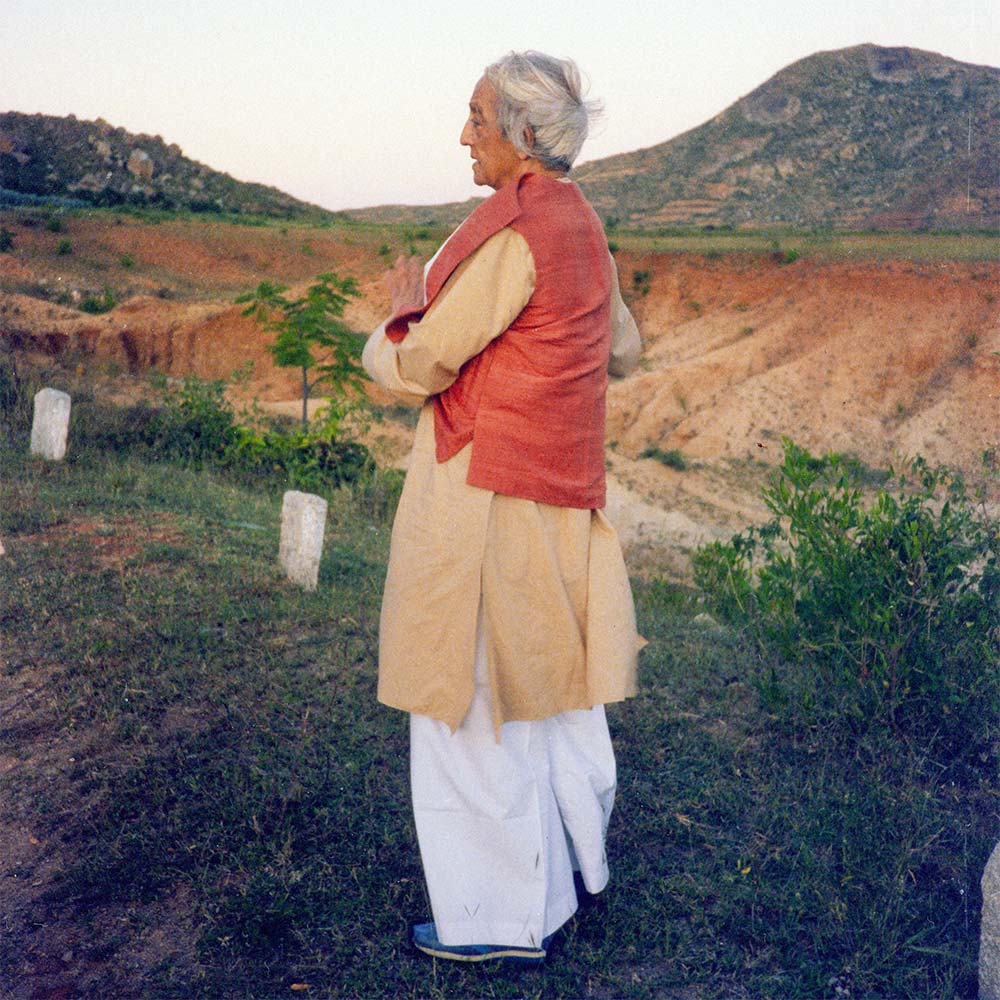
Photo of J. Krishnamurti

When becoming is rooted in the mind, it conditions all your thinking and activity; then it is a matter of using time as a means of achieving. But is there such thing as becoming?

Krishnamurti, Questions and Answers

Read More

One must understand the question of psychological time, the constant becoming, or not becoming – which are the same. When becoming is rooted in the mind, it conditions all your thinking, all your activity; then it is a matter of using time as a means of achieving. But is there such a thing as becoming? ‘I am violent, I will be non-violent.’ That means that becoming is an idea. I am violent, and I project the idea of not being violent, so I create duality – the violent and non-violent – and so there is conflict. Or I say, ‘I must control myself, I must suppress, I must analyse, I must go to a psychologist.’ Without creating the opposite, the fact is violence. The fact. Non-violence is non-fact. If you see the truth that if you are violent, the concept of non-violence brings about this conflict between the opposites, the non-fact has no value. To observe the whole movement of violence, do so without any direction, without any motive. If you do that, there is the end of violence, which is immediate perception and action.

Fear is the process of the mind in the struggle of becoming. In becoming good, there is the fear of evil; in becoming complete, there is the fear of loneliness; in becoming great, there is the fear of being small.

Read More

Fear can exist only in relationship. It cannot exist by itself, in isolation. There is no such thing as abstract fear; there is fear of the known or the unknown, fear of what one has done or what one may do; fear of the past or of the future. The relationship between what one is and what one desires to be causes fear. Fear arises when you interpret the fact of what you are in terms of reward and punishment. Fear comes with responsibility and the desire to be free from it. There is fear in the contrast between pain and pleasure. Fear exists in the conflict of the opposites. The worship of success brings the fear of failure. Fear is the process of the mind in the struggle of becoming. In becoming good, there is the fear of evil; in becoming complete, there is the fear of loneliness; in becoming great, there is the fear of being small. Comparison is not understanding; it is prompted by fear of the unknown in relation to the known. Fear is uncertainty in search of security.

Man is frightened of not being or not becoming. He must have a goal, a purpose, an end in view, and the supreme nothingness seems a denial of life.

Read More

Meditation is the summation of all energy, which explodes into nothingness. Man is frightened of not being or not becoming. He must have a goal, a purpose, an end in view, and the supreme nothingness seems a denial of life. The understanding of the movement of all thought and action, which is living, is the movement of nothingness, of meditation.

Can we immediately and altogether stop thinking in terms of becoming? That is the only new approach.

Read More

Our problem is to put an end to psychological becoming. Can you put an end instantaneously to that becoming? That is the only new approach. Every other way is the old approach. At present, all forms of approach are gradual. I am this, but I will become that tomorrow; I am a clerk, but I will be the manager in ten years’ time; I am angry, but I will slowly become virtuous. That is becoming, which is the process of time; and where there is time, there must be the wave of confusion also. So our problem is, can we immediately and altogether stop thinking in terms of becoming? That is the only new approach.

There is a difference between being virtuous and becoming virtuous. Being virtuous comes through the understanding of ‘what is’; becoming virtuous is postponement.

Read More

The understanding of what you are, without distortion, is the beginning of virtue. Virtue is essential, for it gives freedom. It is only in virtue that you can discover, that you can live – not in the cultivation of a virtue, which merely brings about respectability, not understanding and freedom. There is a difference between being virtuous and becoming virtuous. Being virtuous comes through the understanding of ‘what is’, whereas becoming virtuous is postponement, the covering up of ‘what is’ with what you would like to be. Therefore, in becoming virtuous, you are avoiding action directly upon ‘what is’. This process of avoiding ‘what is’ through the cultivation of the ideal is considered virtuous, but if you look at it closely and directly, you will see that it is nothing of the kind. It is merely a postponement of coming face to face with ‘what is’. Virtue is not the becoming of what is not; virtue is the understanding of ‘what is’ and therefore freedom from ‘what is’. Virtue is essential in a society that is rapidly disintegrating

A mind occupied in becoming something never understands the being. The understanding of the being of what one is brings an extraordinary elation, a release of creative thought, creative life.

Read More

The becomer, whether in the outer world or in the spiritual world, is a machine; he will never know what real joy is. One will know joy only when one sees what one is and let that complexity, that beauty, that ugliness, that corruption act without attempting to become something else. To do this is very difficult because the mind is always wanting to be something. You want to become a philosopher or a great writer. You worship the god of success, not the thing ‘that is’. However poor you may be, however empty, however dull, if you can see the thing as it is, that will begin to transform itself. But a mind occupied in becoming something never understands the being. The understanding of the being of what one is brings an extraordinary elation, a release of creative thought, creative life.

Becoming is the continuation of time and sorrow. Becoming does not contain being. Being is always in the present.

Read More

The utopian, the man of brotherhood and the sannyasi are all consumed with their own becoming, achievement and expansion. They do not see that this desire denies peace, brotherhood and supreme happiness. Ambition in any form – for the group, for individual salvation or for spiritual achievement – is action postponed. Desire is ever of the future; the desire to become is inaction in the present. The now has greater significance than the tomorrow. In the now is all time, and to understand the now is to be free of time. Becoming is the continuation of time and sorrow. Becoming does not contain being. Being is always in the present, and being is the highest form of transformation. Becoming is merely modified continuity, and there is radical transformation only in the present, in being.

Becoming and being have no relationship with each other; they move in entirely different directions; the one does not lead to the other.

Read More

Stillness is not in the measure of time. Becoming and being have no relationship with each other; they move in entirely different directions; the one does not lead to the other. In the stillness of being, the past as the watcher, as the experiencer, is not. There is no activity of time. It is not a remembrance that is communicating, but the actual movement itself – the movement of silence into the measureless. It is a movement that does not start from a centre, that does not go from one point to another; it has no centre, no observer. It is a journey of the total being, and the total being has no contradiction of desire. In this journey of the whole, there is no point of departure and no point of arrival. The whole mind is still, and this stillness is a movement which is not the journeying of the mind.

Being is infinitely more significant than becoming. Being is not the opposite of becoming.

Read More

Being is infinitely more significant than becoming. Being is not the opposite of becoming; if it is the opposite or in opposition, there is no being. When becoming dies completely, then there is being. But this being is not static; it is not acceptance nor is it mere denial; becoming involves time and space. All striving must cease; then only there is being. Being is not within the field of social virtue and morality. It shatters the social formula of life. This being is life, not the pattern of life. Where life is, there is no perfection; perfection is an idea, a word; life, the being, is beyond any formula of thought. It is there when the word, the example, the pattern are destroyed.

‘Being’ is not the end of ‘becoming’.

Read More

In the field of becoming, the movement is from the known to the known. When we die to this, something else comes into being which cannot be comprehended by a mind that is within the limitations of the known, the memory, the experience, the knowledge. The ‘being’ is not the end of ‘becoming’. When it is recognised as ‘being’ it is still part of the ‘becoming’, in which effort, struggle, confusion and misery are involved.

The essence of being is nonbeing, and to ‘see’ the depth of non-being, there must be freedom from becoming.

Read More

There was the essence of depth. The essence of thought is that state when thought is not. However deeply and widely thought is pursued, thought will always remain shallow, superficial. The ending of thought is the beginning of that essence. The ending of thought is negation, and what is negative has no positive way; there is no method, no system to end thought. The method, the system is a positive approach to negation and thus thought can never find the essence of itself. It must cease for the essence to be. The essence of being is nonbeing, and to ‘see’ the depth of non-being, there must be freedom from becoming.

When there is the cessation of becoming, of craving in its many forms, there is the falling away of dualism – the ‘me’ and the ‘not me’.

Krishnamurti, The World Within

Read More

There is no self-knowledge without meditation, and meditation is not possible without self-knowledge. Self-knowledge comes through alert watchfulness of all our thoughts-feelings; this awareness is dulled if there is identification. Realising that we do identify and so prevent understanding, we must perceive the necessity of kindly, tolerant detachment, suspending judgement. We must observe the conflicts of our thoughts-feelings, their contradictions, their appetites, their hidden pursuits. If we attempt to do this earnestly and alertly all day, we will find that we will need, naturally without any artificial enforcement, during the day, periods for intense self-awareness, self-observation. Out this self-knowledge, right thinking comes. Meditation is to free thought-feeling so that it can discover, for that which is discovered, being truth, is liberating and creative. When there is the cessation of becoming, of craving in its many forms, there is the falling away of dualism – the ‘me’ and the ‘not me’, the one who prays and that which is prayed to. And then we shall experience true being. Our happiness lies in its discovery and not in the delusions of craving, however noble.

Only when the desire to become ends is there the action of being.

Read More

To become simple is to continue in complexity. It is not possible to become simple, but one can approach complexity with simplicity. Being simple and becoming simple are two entirely distinct processes, each leading in a different direction. Only when the desire to become ends is there the action of being. But before we go into all that, may one ask why you feel that you must have the quality of simplicity? What is the motive behind this urge?

The action of being is so revolutionary that society rejects it and concerns itself exclusively with the action of becoming.

Krishnamurti, Think on These Things

Read More

As long as your desires fit into the established pattern, you are a respectable citizen. But the moment you have a complete desire, which is not of the pattern, you become a danger. Society is always watching to prevent you from having a complete desire, a desire which would be the expression of your total being and therefore bring about a revolutionary action. The action of being is entirely different from the action of becoming. The action of being is so revolutionary that society rejects it and concerns itself exclusively with the action of becoming, which is respectable because it fits into the pattern. But any desire that expresses itself in the action of becoming, which is a form of ambition, has no fulfilment. Sooner or later, it is thwarted, impeded, frustrated, and we revolt against that frustration in mischievous ways.

Meditation is the uncovering of the whole process of becoming and being – the negation of becoming in order to be.

Krishnamurti, Meeting Life

Read More

Meditation is the uncovering of the whole process of becoming and being – the negation of becoming in order to be. All this can be seen by a meditative mind at a glance, and this glance doesn’t involve time at all. Seeing truth is not a matter of time; either you see or you don’t see. The incapacity to see cannot become capable of seeing. So negation is the movement of meditation, and there is no way, no path, no system that can lead a chattering, shallow mind to the heights of bliss. The seeing of this instantly is the truth that frees the shallow mind from itself. Humility is always at the beginning – but there is no beginning and no end. And this is the bliss beyond measure.

These quotes only touch on the many subjects Krishnamurti inquired into during his lifetime. His timeless and universal teachings can be explored using the Index of Topics where you will find texts, audio and video related on many themes. Another option is to browse our selection of curated articles or more short quotes. Krishnamurti’s reply when asked what lies at the heart of his teachings can be found here. Many Krishnamurti books are available, a selection of which can be explored here. To find out more about Krishnamurti’s life, please see our introduction and the biography. We also host a weekly podcast, and offer free downloads. Please visit our YouTube channel for hundreds of specially selected shorter clips. Below, you can learn more about Krishnamurti and our charity which he founded in 1968.
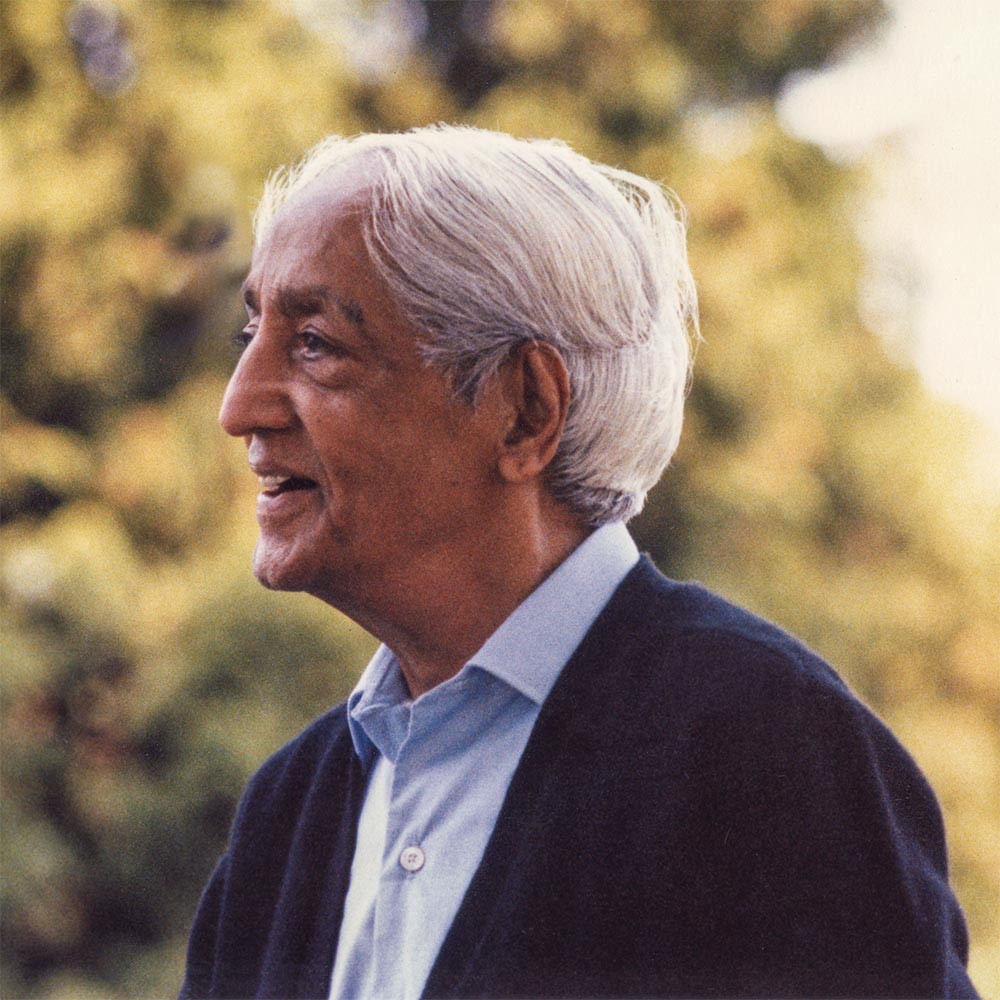
Krishnamurti outdoors smiling

Who Was Krishnamurti?

J. Krishnamurti (1895-1986) is widely regarded as one of the greatest thinkers and religious teachers of all time. He spoke throughout the world to large audiences and to individuals, including writers, scientists, philosophers and educators, about the need for a radical change in mankind. Referring to himself, Krishnamurti said:

He is acting as a mirror for you to look into. That mirror is not an authority. It has no authority, it’s just a mirror. And when you see it clearly, understand what you see in that mirror, then throw it away, break it up.

Krishnamurti was concerned with all humanity and held no nationality or belief and belonged to no particular group or culture. In the latter part of his life, along with continuing to give public talks, he travelled mainly between the schools he had founded in India, Britain and the United States, which educate for the total understanding of man and the art of living. He stressed that only this profound understanding can create a new generation that will live in peace.

Krishnamurti reminded his listeners again and again that we are all human beings first and not Hindus, Muslims or Christians, that we are like the rest of humanity and are not different from one another. He asked that we tread lightly on this earth without destroying ourselves or the environment. He communicated to his listeners a deep sense of respect for nature. His teachings transcend man-made belief systems, nationalistic sentiment and sectarianism. At the same time, they give new meaning and direction to mankind’s search for truth. His teaching is timeless, universal and increasingly relevant to the modern age.

I am nobody. It is as simple as that. I am nobody. But what is important is who you are, what you are.

Krishnamurti

Krishnamurti spoke not as a guru but as a friend. His talks and discussions are based not on tradition-based knowledge but on his own insights into the human mind and his vision of the sacred, so he always communicated a sense of freshness and directness, although the essence of his message remained unchanged over the years. When Krishnamurti addressed large audiences, people felt that he was talking to each of them personally, addressing their own particular problem. In his private interviews, he was a compassionate teacher, listening attentively to those who came to him in sorrow, and encouraging them to heal themselves through their own understanding. Religious scholars found that his words threw new light on traditional concepts. Krishnamurti took on the challenge of modern scientists and psychologists and went with them step by step, discussing their theories and sometimes enabling them to discern the limitations of their theories.

Krishnamurti left a large body of literature in the form of public talks, writings, discussions with teachers and students, scientists, psychologists and religious figures, conversations with individuals, television and radio interviews, and letters. Many of these have been published as books, in over 60 languages, along with hundreds of audio and video recordings.
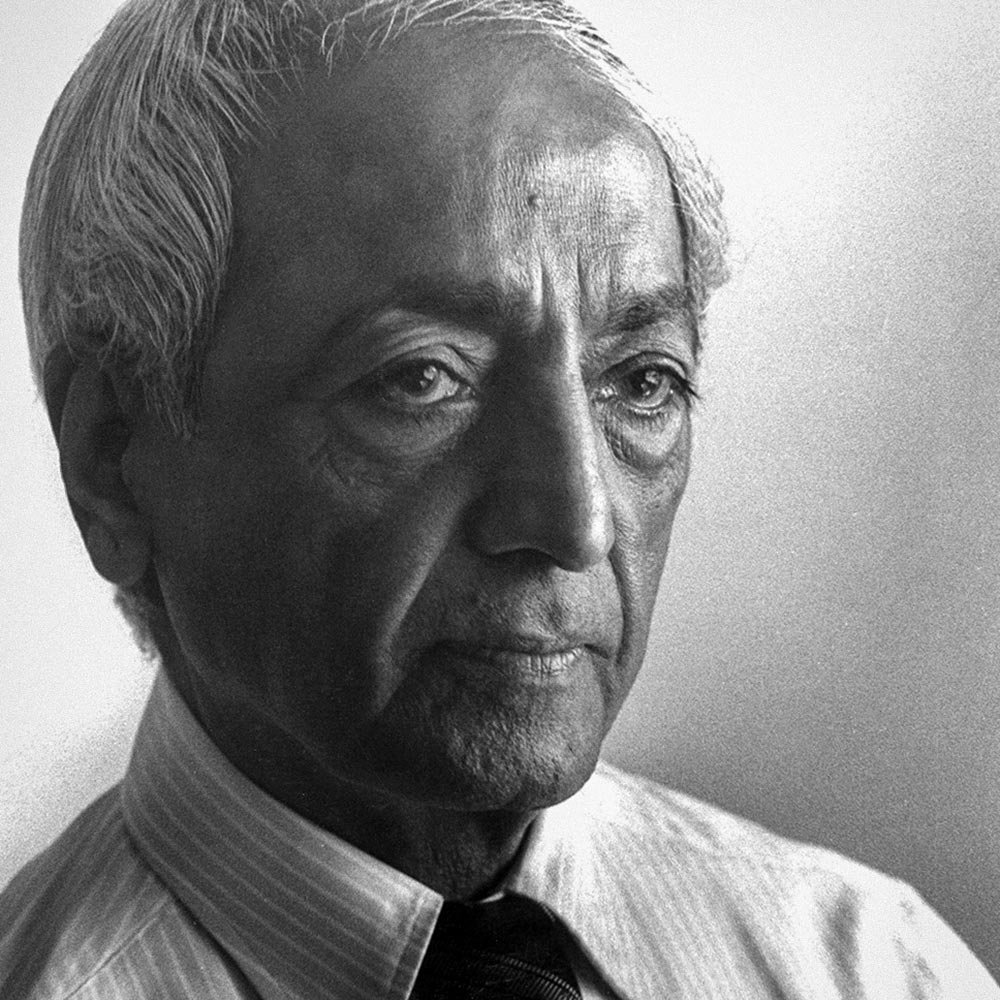
Three-quarters portrait photo of Krishnamurti

The Krishnamurti Foundation

Established in 1968 as a registered charity, and located at The Krishnamurti Centre, Krishnamurti Foundation Trust exists to preserve and make available Krishnamurti’s teachings.

The Foundation serves a global audience by providing worldwide free access to Krishnamurti videos, audio and texts to those who may be interested in pursuing an understanding of Krishnamurti’s work in their own lives.

In describing his intentions for the Foundations, Krishnamurti said: 

The Foundations will see to it that these teachings are kept whole, are not distorted, are not made corrupt.