
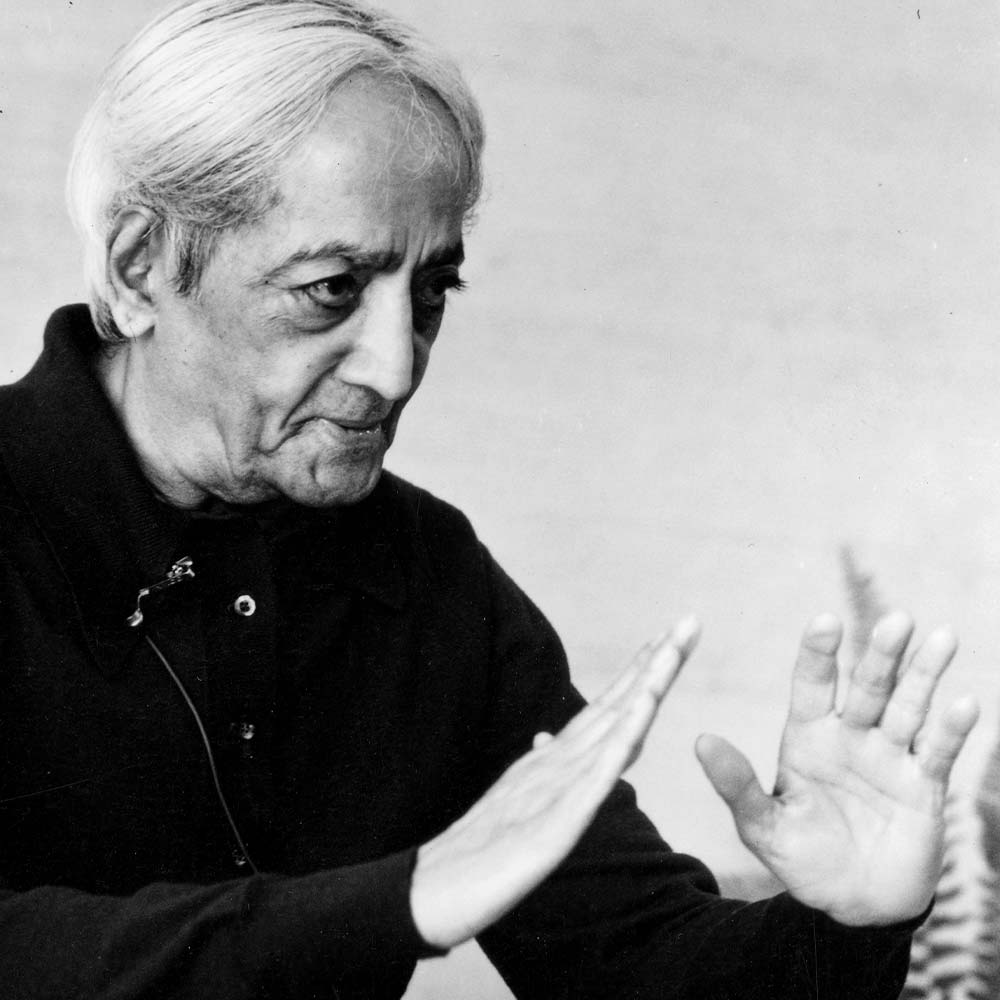
Photo of J. Krishnamurti

For belief, we are willing to destroy each other. All religions talk about love and being kind to one another, but belief itself destroys goodness, love and deep kindness.

Read More

We say we are Jews, Hindus, Muslims, Christians. This division, with its supposed security, divides people and so brings about insecurity, wars and hatred. There is one group of people against another group, one person against another. Your belief separates you from those who don’t believe as you do. You may talk about loving your neighbour but beneath those words, you are separating yourself by your belief, by your tradition and that peculiar arrogance that comes with the certainty of your own particular belief. So you see why we want to believe. For that belief, we are willing to destroy each other. All religions talk about love and being kind to one another, but belief itself destroys goodness, love and deep kindness.

Idea and belief set man against man, just as the sword does. Idea and belief are the very antithesis of love.

Read More

To be on top is what every individual, group and ideology is trying to do, and so sustaining cruelty, violence. There can be creation only in peace, and how can there be peace if there is mutual usage? To talk of peace is utter nonsense as long as our relationship with the one or the many is based on need and use. The need and use of another must inevitably lead to power and dominance. The power of an idea and the power of the sword are similar; both are destructive. Idea and belief set man against man, just as the sword does. Idea and belief are the very antithesis of love.

All beliefs are divisive, whether political or religious.

Read More

Religion is a form of science. That is, to know and to go beyond all knowledge, to comprehend the nature and immensity of the universe, not through a telescope, but through the immensity of the mind and the heart. This immensity has nothing whatsoever to do with any organised religion. How easily man becomes a tool of his own belief, his own fanaticism, committed to some kind of dogma that has no reality. No temple, mosque or church holds truth. They are symbols, perhaps, but symbols are not the actual. In worshipping a symbol, you lose the real, the truth. But unfortunately the symbol has been given far greater importance than truth. We worship the symbol. All religions are based on conclusions and beliefs, and all beliefs are divisive, whether political or religious.

Beliefs can never bring people together except in conflicting groups.

Read More

To be an integrated human being is to understand the entire process of one’s consciousness, both the hidden and the open. This is not possible if we give undue emphasis to the intellect. We attach great importance to the cultivation of the mind, but inwardly we are insufficient, poor and confused. This living in the intellect is the way of disintegration; for ideas, like beliefs, can never bring people together except in conflicting groups. As long as we depend on thought as a means of integration, there must be disintegration; and to understand the disintegrating action of thought is to be aware of the ways of the self, the ways of one’s own desire. We must be aware of our conditioning and its responses, both collective and personal. It is only when one is fully aware of the activities of the self with its contradictory desires and pursuits, its hopes and fears, that there is a possibility of going beyond the self.

You may say you cannot live without your beliefs; you must have your ideals, your faith, otherwise you are lost. Yet in your faith, ideals and beliefs, you are already lost.

Krishnamurti, Can Conflict End?

Read More

Why do we have ideals, faiths and beliefs? Christian, Buddhist, Hindu, American, Indian – why? Is it that our brain is incapable of living without illusion? Is your brain strong, vital, capable of understanding things as they are without creating an ideal? An ideal is non-existent. Christians and all religious people believe that you must not kill, and Christians have probably killed more than anybody else. And so it goes on, even though we know that ideals, faiths and beliefs of every kind divide people. That is a fact. Can we be free of ideals, of faith, of being identified with one group versus another group – can we be free of all this? Can we, or is it impossible? Is it possible to have a free brain that is not cluttered with a lot of rubbish and illusions? Some may say, ‘No, it is impossible because I cannot live without my beliefs. I must have my ideals, my faith, otherwise I am lost.’ Yet in your faith, ideals and beliefs, you are already lost. That is a fact. We are lost people. Why do I cling to my particular prejudice or ideal? Why have I identified myself with them? Why do I identify myself with anything? Push deeply into it to find out why we do all these things. Why have we allowed ourselves to be programmed?

Beliefs, like ideals, are escapes from fact, and in escapes there is no end to sorrow.

Read More

Belief is so unnecessary, as are ideals. Both dissipate energy which is needed to follow the unfolding of the fact, the ‘what is’. Beliefs, like ideals, are escapes from the fact, and in escapes there is no end to sorrow. The ending of sorrow is the understanding of the fact from moment to moment. There is no system or method that will give understanding, but only a choiceless awareness of a fact. Meditation according to a system is the avoidance of the fact of what you are. It is far more important to understand yourself, the constant changing of the facts about yourself, than to meditate in order to find God, have visions, sensations and other forms of entertainment.

There is no need for belief or faith, but having a belief – in God, in Jesus, in Krishna, or whatever you like – gives a sense of being protected, being ‘in the womb of God’; but it is an illusion.

Krishnamurti, This Light in Oneself

Read More

Your brain, which is the brain of all human beings, evolved through immemorial time, conditioned by cultures, by religions, by economic and social pressures. That brain has had a timeless continuity to now. In that duration, it has found a sense of being safe. That is why you accept tradition: in tradition there is safety, in imitation there is safety, in conformity there is safety. And there is also safety in an illusion. All your gods are illusions put up by thought. A belief or a faith is an illusion. There is no need for belief or faith, but having a belief – in God, in Jesus, in Krishna, or whatever you like – gives a sense of being protected, being ‘in the womb of God’; but it is an illusion. Can the brain discover the end of the continuity of time?

The beliefs of another are superstitions, but your own are reasonable and real. What is sacred?

Read More

You deny the sacred things of another, but you keep your own. The beliefs of another are superstitions, but your own are reasonable and real. What is sacred? On the beach, he had picked up a piece of sea-washed wood, in the shape of a human head. It was made of hardwood, shaped by the waters of the sea, cleansed by many seasons. He had brought it home and put it on the mantelpiece; he looked at it from time to time and admired what the sea had done. One day, he put some flowers around it and then it happened every day; he felt uncomfortable if there were not fresh flowers, and gradually that piece of shaped wood became very important in his life. He would allow no one to touch it except himself; they might desecrate it; he washed his hands before he touched it. It had become holy, sacred, and he alone was the high priest of it; he represented it; it told him of things he could never know by himself. His life was filled with it, and he was, he said, unspeakably happy. What is sacred? Not the things made by the mind or hand or by the sea.

The division of beliefs, ideals, conclusions and prejudices is preventing the spirit of cooperation from flowering.

Read More

See the destructive effect of fragmentation taking place: nation against nation, one group against another, one family against another, one individual against another. It is the same religiously, socially and economically. Each one is striving for himself, for his class, or his particular interest in society. This division of beliefs, ideals, conclusions and prejudices is preventing the spirit of cooperation from flowering. We are human beings, not tribal identities, exclusive and separate. We are human beings caught in conclusions, theories and faiths. We are living creatures, not labels.

Your belief has not brought about peace in the world.

Krishnamurti, Can Conflict End?

Read More

Political opinion is dividing people all over the world. Opinion means a suggestion, lacking proof, based on an emotional reaction, with strong adherence to a conclusion. This divides people, and therefore there is conflict. Can we live without opinion and prejudice? After all, it is prejudice when you believe in some kind of god, when as a Christian you very strongly believe in a saviour, and someone else, a Hindu or Buddhist, believes something else. Your belief in a saviour is just a matter of belief or faith, without any proof. And your belief has not brought about peace in the world. When you see how belief, prejudice, conclusions and ideals divide people and therefore breed conflict, you see that such activity is not intelligence. Will you drop all your prejudices, all your opinions about what you are, what you are not and what you should be? Will you drop all that so that you have a free, uncluttered mind?

True religion is not a set of beliefs and rituals, hopes and fears.

Read More

True religion is not a set of beliefs and rituals, hopes and fears. If we can allow a child to grow up without these hindering influences, then perhaps, as they mature, they will begin to inquire into the nature of reality, of God. That is why, in educating a child, deep insight and understanding are necessary. Most people who are religiously inclined, who talk about God and immortality, do not fundamentally believe in individual freedom and integration; yet religion is the cultivation of freedom in the search for truth. There can be no compromise with freedom. Partial freedom for the individual is no freedom at all. Conditioning of any kind, whether political or religious, is not freedom, and it will never bring peace. Religion is not a form of conditioning. It is a state of tranquillity in which there is reality, God.

Let us put aside beliefs, faith, dogmas, rituals, prayers and all such activities. One must be utterly free of these to have a clear, objective perception.

Read More

Let us put aside beliefs, faith, dogmas, rituals, prayers and all such activities. One must be utterly free of these to have a clear, objective perception; subjective perception is generally rather deceptive. Any concept, however rational, objective or based on experience, is verbal and to be distrusted. Every form of experience is subjectively conditioned and hence limited and personal. The ideal is a projection of thought, away from ‘what is’.

There is no freedom when the mind is tethered to any form of belief or conclusion.

Read More

Intelligence comes about only when there is freedom. Freedom is not to do or think whatever you like and express it or not. Freedom is not something to be taught or learned from a book. There is freedom when there is an understanding of conformity with its action of will and the decision of choice. There is no freedom when the mind is tethered to any form of belief or conclusion. Freedom cannot be when there is fear, when there is identification with something other than ‘what is’. Freedom cannot be when there is the observer and the observed, the thinker and the thought. Freedom is not a reaction, for all reactions are the continuity of conformity. Freedom is not when there is effort, the struggle between opposites, which is an endless corridor. Freedom from the known is the highest form of intelligence.

The hope and belief in immortality is not the experiencing of immortality. Belief and hope must cease for the immortal to be. You the believer, the maker of desire, must cease for the immortal to be.

Read More

In death we seek immortality; in the movement of birth and death, we long for permanency. Caught in the flux of time, we crave for the timeless; being in shadow we believe in light. Death does not lead to immortality; there is immortality only in life without death. In life we know death, for we cling to life. We gather, we become; because we gather, death comes, and knowing death, we cling to life. The hope and belief in immortality is not the experiencing of immortality. Belief and hope must cease for the immortal to be. You, the believer, the maker of desire, must cease for the immortal to be.

The sky was so close, embracing the earth, and there was peace past belief. And night came slowly.

Read More

Walking along the river, with the ceaseless roar of traffic, the river seemed to contain all the earth. Though it was held by rock and cement, it was vast; it was the waters of every river from the mountains to the plains. It became the colour of the sunset, every colour that the eye had ever seen, so splendid and fleeting. The evening breeze was playing with everything, and autumn was touching every leaf. The sky was so close, embracing the earth, and there was peace past belief. And night came slowly.

These quotes only touch on the many subjects Krishnamurti inquired into during his lifetime. His timeless and universal teachings can be explored using the Index of Topics where you will find texts, audio and video related on many themes. Another option is to browse our selection of curated articles or more short quotes. Krishnamurti’s reply when asked what lies at the heart of his teachings can be found here. Many Krishnamurti books are available, a selection of which can be explored here. To find out more about Krishnamurti’s life, please see our introduction and the biography. We also host a weekly podcast, and offer free downloads. Please visit our YouTube channel for hundreds of specially selected shorter clips. Below, you can learn more about Krishnamurti and our charity which he founded in 1968.
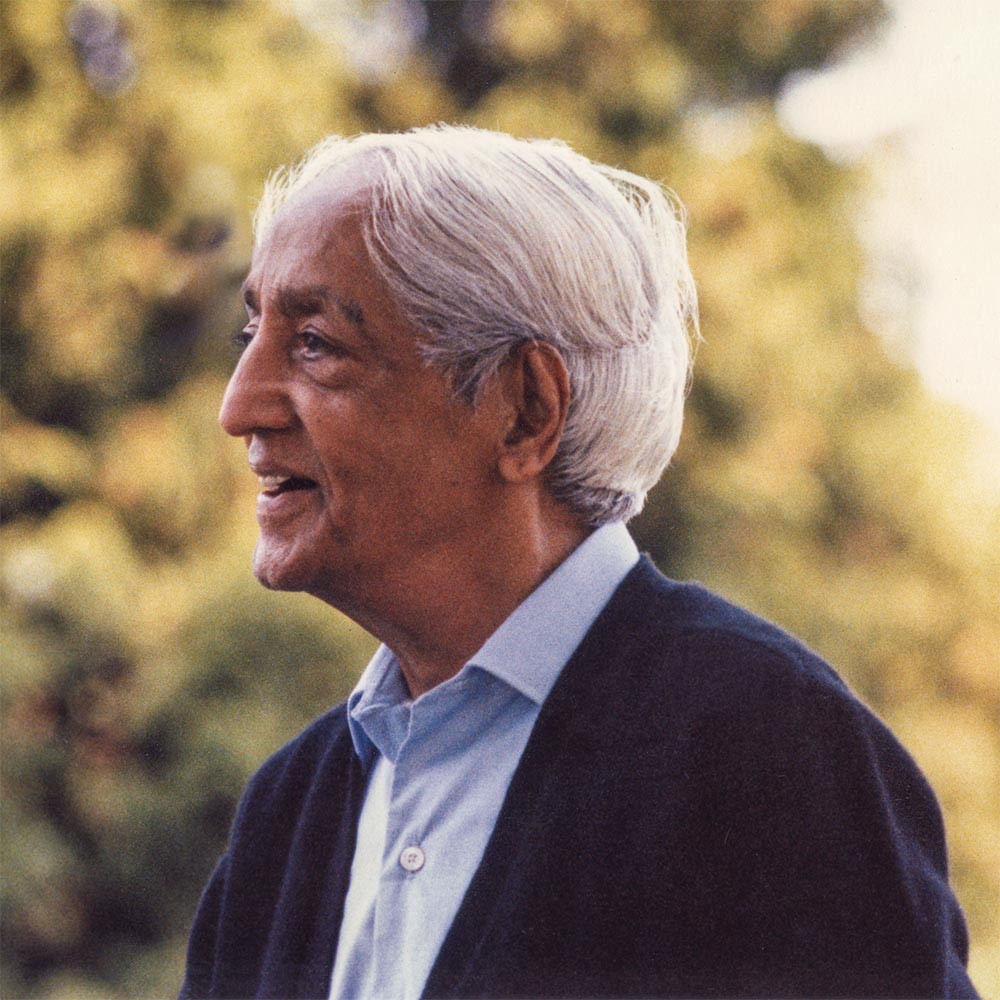
Krishnamurti outdoors smiling

Who Was Krishnamurti?

J. Krishnamurti (1895-1986) is widely regarded as one of the greatest thinkers and religious teachers of all time. He spoke throughout the world to large audiences and to individuals, including writers, scientists, philosophers and educators, about the need for a radical change in mankind. Referring to himself, Krishnamurti said:

He is acting as a mirror for you to look into. That mirror is not an authority. It has no authority, it’s just a mirror. And when you see it clearly, understand what you see in that mirror, then throw it away, break it up.

Krishnamurti was concerned with all humanity and held no nationality or belief and belonged to no particular group or culture. In the latter part of his life, along with continuing to give public talks, he travelled mainly between the schools he had founded in India, Britain and the United States, which educate for the total understanding of man and the art of living. He stressed that only this profound understanding can create a new generation that will live in peace.

Krishnamurti reminded his listeners again and again that we are all human beings first and not Hindus, Muslims or Christians, that we are like the rest of humanity and are not different from one another. He asked that we tread lightly on this earth without destroying ourselves or the environment. He communicated to his listeners a deep sense of respect for nature. His teachings transcend man-made belief systems, nationalistic sentiment and sectarianism. At the same time, they give new meaning and direction to mankind’s search for truth. His teaching is timeless, universal and increasingly relevant to the modern age.

I am nobody. It is as simple as that. I am nobody. But what is important is who you are, what you are.

Krishnamurti

Krishnamurti spoke not as a guru but as a friend. His talks and discussions are based not on tradition-based knowledge but on his own insights into the human mind and his vision of the sacred, so he always communicated a sense of freshness and directness, although the essence of his message remained unchanged over the years. When Krishnamurti addressed large audiences, people felt that he was talking to each of them personally, addressing their own particular problem. In his private interviews, he was a compassionate teacher, listening attentively to those who came to him in sorrow, and encouraging them to heal themselves through their own understanding. Religious scholars found that his words threw new light on traditional concepts. Krishnamurti took on the challenge of modern scientists and psychologists and went with them step by step, discussing their theories and sometimes enabling them to discern the limitations of their theories.

Krishnamurti left a large body of literature in the form of public talks, writings, discussions with teachers and students, scientists, psychologists and religious figures, conversations with individuals, television and radio interviews, and letters. Many of these have been published as books, in over 60 languages, along with hundreds of audio and video recordings.
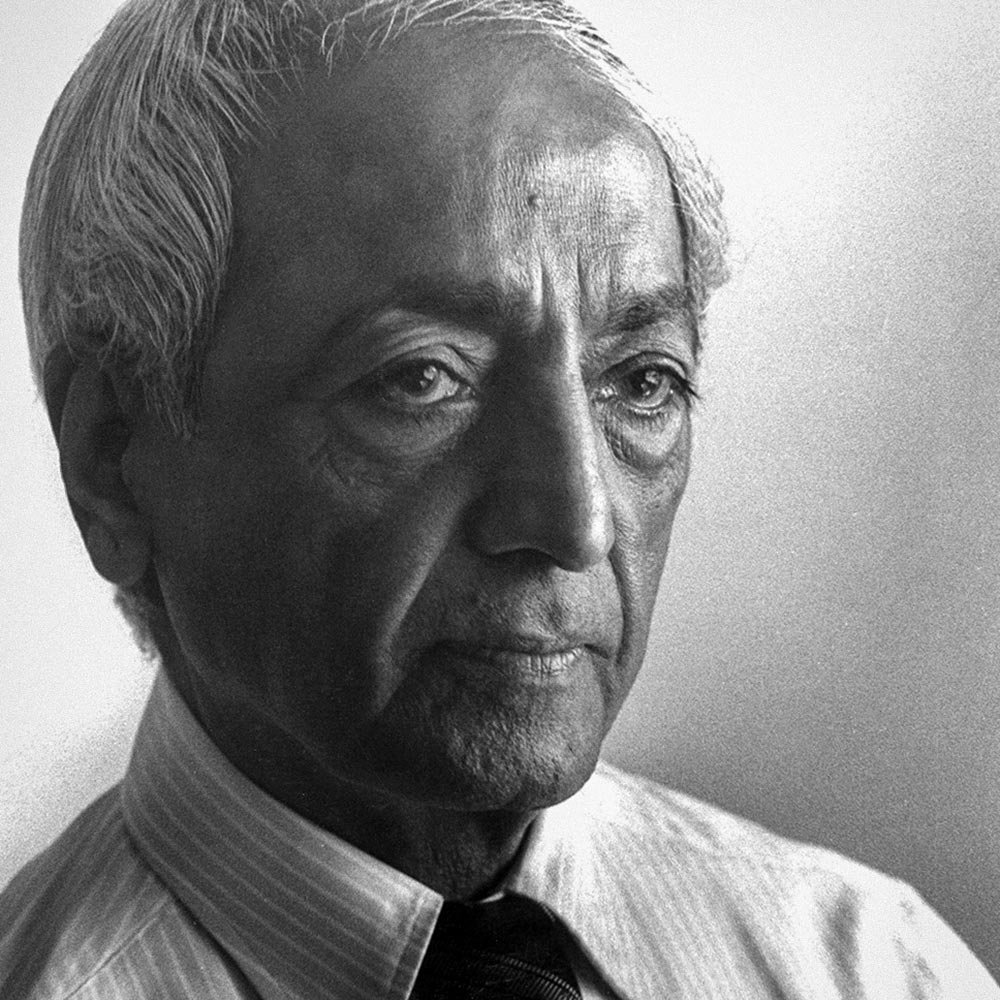
Three-quarters portrait photo of Krishnamurti

The Krishnamurti Foundation

Established in 1968 as a registered charity, and located at The Krishnamurti Centre, Krishnamurti Foundation Trust exists to preserve and make available Krishnamurti’s teachings.

The Foundation serves a global audience by providing worldwide free access to Krishnamurti videos, audio and texts to those who may be interested in pursuing an understanding of Krishnamurti’s work in their own lives.

In describing his intentions for the Foundations, Krishnamurti said: 

The Foundations will see to it that these teachings are kept whole, are not distorted, are not made corrupt.