
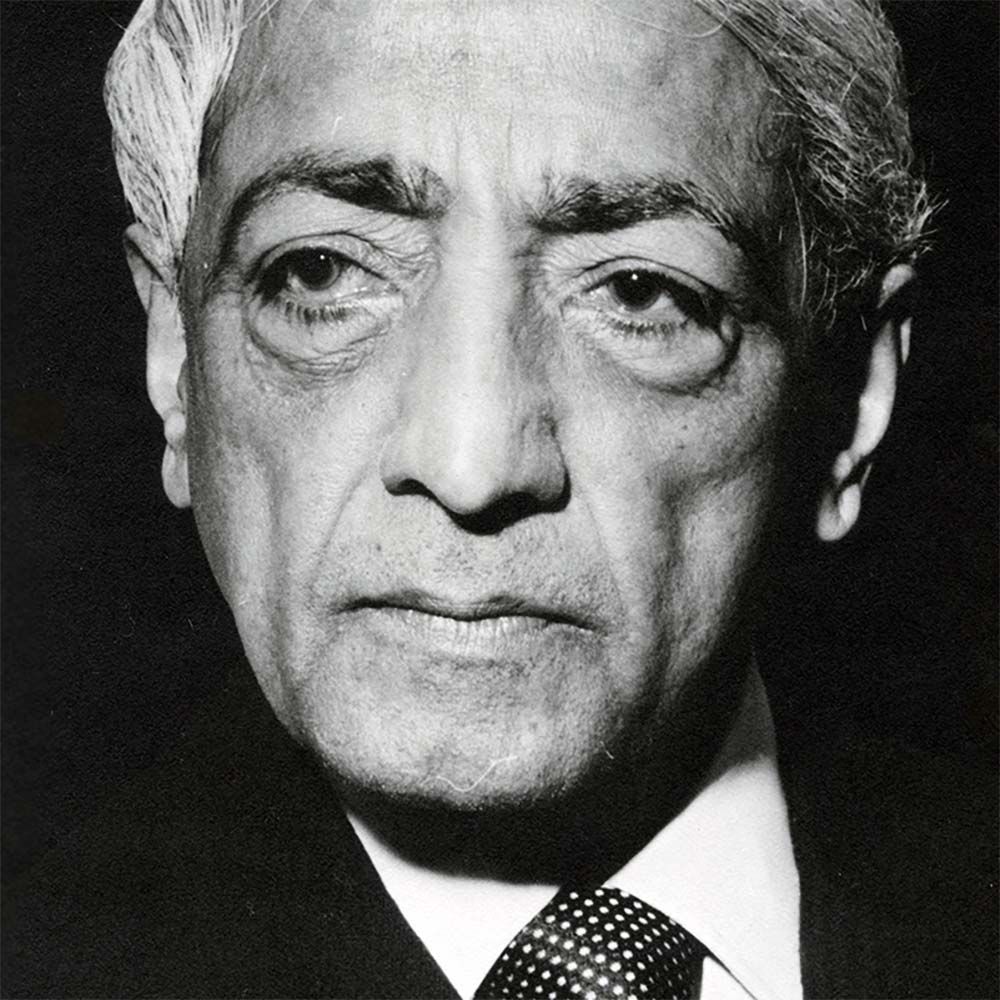
Photo of J. Krishnamurti

We resist a great deal; we don’t want to be disturbed; out of the feeling of hurt, we cling to something we hope will protect us.

Read More

Not wanting to be hurt, I build a wall. I am very shy, or aggressive; before you attack, I am ready to attack you verbally, or with thought. I have been hurt so much in my life; everybody hurts me. Everybody treads on my toes, and I don’t want to be hurt. Is this one of the reasons why fear exists? You have been hurt, haven’t you? And out of that hurt you do all kinds of things. We resist a great deal; we don’t want to be disturbed; out of that feeling of hurt, we cling to something we hope will protect us. Therefore, we become aggressive towards anything that attacks what we are holding on to for protection.

We resist criticism. We cut ourselves off from any relationship that might open the door to our own mind and heart. We become so cunning in our resistance that it gets better with age.

Read More

We destroy ourselves by our moods, our elation, our deep depression. We are too proud to examine ourselves or to let others examine us. We resist criticism. We cut ourselves off from any relationship that might open the door to our own mind and heart. We become so cunning in our resistance that it gets better with age. We manage to make everything someone else’s fault. We pick on someone else’s faults to mask our own. We become deeply suspicious, and every remark, every action, has a double meaning. One grows more and more secretive, lonely, isolated. Can all this be prevented? Who is to prevent it, the world, or me, or you?

When you resist something, the very resistance indicates that you are in conflict with the other.

Read More

There is no such thing as living in isolation. No country, no people, no individual can live in isolation, yet because we seek power in so many different ways, we breed isolation. The nationalist is a curse because through his very nationalistic, patriotic spirit, he is creating a wall of isolation. He is so identified with his country that he builds a wall against another. What happens when you build a wall against something? That something is constantly beating against your wall. When you resist something, the very resistance indicates that you are in conflict with the other. So nationalism, which is a process of isolation, which is the outcome of the search for power, cannot bring about peace in the world.

Resistance and isolation are forms of insecurity, and therefore they breed conflict.

Read More

Resistance and isolation are forms of insecurity, and therefore they breed conflict. That expresses itself in selfish activity, as in the case of a child grabbing things, crying when he can’t get something. Any form of subtle threat or reward breeds a sense of insecurity. When that is not there, love does have an effect. When the mind and heart are completely free of every condemnation or justification, there is the feeling of utter security both psychologically and physically.

Resistance to noise increases the disturbance it makes. And that is what we do in our daily life: keeping the beautiful, we reject the ugly; resisting evil, we cultivate the good; eschewing hate, we think of love.

Read More

Resistance to noise increases the disturbance it makes. And that is what we do in our daily life: keeping the beautiful, we reject the ugly; resisting evil, we cultivate the good; eschewing hate, we think of love. There is always within us this self-contradiction, this conflict of the opposites; and such conflict leads nowhere. To be only partly sensitive is to be paralysed. To be open to beauty and resist ugliness is to have no sensitivity; to welcome silence and reject noise is not to be whole. To be sensitive is to be aware of both silence and noise, neither pursuing the one nor resisting the other; it is to be without self-contradiction, to be whole.

Every forms of resistance intensifies conflict, and conflict makes for insensitivity.

Read More

Is it not possible to free the mind from all resistance, from all conflict? Every form of resistance intensifies conflict, and conflict makes for insensitivity. When the mind is insensitive, then beauty is an escape from ugliness. If beauty is merely an opposite, it is not beauty. Love is not the opposite of hate. Hate, resistance and conflict do not engender love. Love is not a self-conscious activity; it is something outside the field of the mind.

Resistance, whether negative or positive, with its comparisons and justifications, its condemnations and identifications, is the denial of ‘what is’.

Read More

Resistance, which is suppression, substitution or sublimation in any form, is a hindrance to the flow of self-knowledge. Resistance is to be discovered in relationship, in action. Resistance, whether negative or positive, with its comparisons and justifications, its condemnations and identifications, is the denial of ‘what is’. ‘What is’ is the implicit, and awareness of the implicit, without any choice, is the unfoldment of it. This unfoldment is the beginning of wisdom. Wisdom is essential for the coming into being of the unknown, the inexhaustible.

Concentration implies resistance. You resist every other thought from seeping in, or you try to control thought from wandering. So concentration is a form of will, resistance and suppression.

Krishnamurti, Inward Revolution

Read More

They have told you that you must concentrate, that you must learn concentration. Have you ever investigated what concentration implies? There is in that an action of will, which is to resist every other thought and focus your energy, your thought on something, on a sentence, a word or a phrase. You repeat some word that you call a mantra – repeat, repeat. Concentration implies resistance. You resist every other thought from seeping in, or you try to control thought from wandering. So concentration is a form of will, resistance and suppression. You need a free mind, a mind that is alive, full of energy; a mind that is in constant conflict wastes energy. You need energy; everything you do needs energy. If you can put aside your favourite system, if you can see and understand the truth that concentration is merely resistance, and therefore constant conflict and therefore a waste of energy, then you can find out for yourself what is necessary for a mind that is in a state of meditation.

Escape, entertainment and courage are all forms of resistance to the actual fact of fear. The greater the fear, the greater the resistance to it.

Read More

Escape, entertainment and courage are all various forms of resistance to the actual fact of fear. The greater the fear the greater the resistance to it and so various neurotic activities are set up. There is fear, and the mind – or the ‘me’ – says, ‘There must be no fear,’ and so there is duality. There is the ‘me’ which is different from fear, which escapes from fear and resists it, which cultivates energy, theorises or goes to the analyst; and there is the ‘not me’. The ‘not me’ is fear; the ‘me’ is separate from that fear. So there is immediate conflict between the fear, and the ‘me’ that is overcoming that fear. There is the watcher and the watched.

When you resist, control, suppress, or try to transcend – which are all the same thing for they are all acts of the will – you have thickened the wall of resistance, and so you become more and more enslaved, narrow, petty.

Krishnamurti, The Only Revolution

Read More

When you resist, control, suppress, or try to transcend – which are all the same thing for they are all acts of the will – you have thickened the wall of resistance, and so you become more and more enslaved, narrow, petty. And it is from this pettiness, this narrowness, that you want to be free, and that very want is the reaction which is going to create another barrier, more pettiness. So we move from one resistance, one barrier, to another – sometimes giving to the wall of resistance a different colouring, a different quality, or some word of nobility. But resistance is bondage, and bondage is pain.

We resist the actual – the actual sorrow, anger, despair, or a moment of joy. Can one look at sorrow without any form of resistance or avoidance?

Read More

We resist the actual – the actual sorrow, anger, despair, or a moment of joy. Can one look at sorrow without any form of resistance or avoidance, look at it not only with the senses but also without the self-pitying process, and not escape from it; neither condemning it nor accepting it, which are both forms of avoiding ‘what is’? ‘What is’ is sorrow or pain. Looking is always in the present. If you say, ‘ I have looked,’ and you look at the present with what you have learned from that look and with the memory of that look, then you are really looking with eyes that are clouded by past memories, and so you do not look at all. Really to look at this sorrow, with which humanity has lived since we began, is to look without time. When there is no resistance, then this sorrow loses it sting.

Resistanced against sorrow is also a barrier to happiness.

Read More

There is no duality in ecstasy. It is a state which spontaneously comes into being without our willing it. Suffering is an indication of duality. Without understanding this, we perpetuate duality through the many intellectual efforts and processes of overcoming it, giving oneself over to its opposite, developing virtues, and so forth. All such attempts only strengthen duality. If there is a lack of sensibility to ugliness, to sorrow, there must also be deep insensitiveness to beauty, to joy. Resistance against sorrow is also a barrier to happiness. What is ecstasy? That state of being when the mind and heart are in complete union, when fear does not tear them asunder, when the mind is not withholding.

Discipline is the cultivation of resistance, and where there is resistance there is no understanding.

Read More

Right meditation is essential for the purgation of the mind, for without the emptying of the mind there can be no renewal. Mere continuity is decay. The mind withers away by constant repetition, by the friction of wrong usage, by sensations which make it dull and weary. The control of the mind is not important; what is important is to find out the interests of the mind. The mind is a bundle of conflicting interests, and merely to strengthen one interest against another is what we call concentration, the process of discipline. Discipline is the cultivation of resistance, and where there is resistance there is no understanding. A well-disciplined mind is not a free mind, and it is only in freedom that any discovery can be made. There must be spontaneity to uncover the movements of the self.

The more you resist or struggle against something, the less you comprehend it.

Krishnamurti, Life Ahead

Read More

The problem of discipline is really quite complex. Most of us think that through some form of discipline, we shall eventually have freedom. Discipline is the cultivation of resistance, is it not? By resisting, by building a barrier within ourselves against something we consider wrong, we think we shall be more capable of understanding and of being free to live fully. But that is not a fact, is it? The more you resist or struggle against something, the less you comprehend it. Only when there is freedom, real freedom to think, to discover, can you find out anything.

Not to be hurt implies having no resistance. Having no resistance means having no image.

Read More

Not to be hurt implies having no resistance. Having no resistance means having no image. Not to be hurt means vitality, energy, and that energy is dissipated when I have images. That energy is dissipated when I compare myself with you, compare my image with your image. That energy is dissipated in conflict, in trying to become your image, which I have projected for myself. That energy is wasted when I am imitating the image I have projected about you. So the dissipation of energy is this factor. And when I am energetic, which can only take place when there is attention, I am not hurt.

These quotes only touch on the many subjects Krishnamurti inquired into during his lifetime. His timeless and universal teachings can be explored using the Index of Topics where you will find texts, audio and video related on many themes. Another option is to browse our selection of curated articles or more short quotes. Krishnamurti’s reply when asked what lies at the heart of his teachings can be found here. Many Krishnamurti books are available, a selection of which can be explored here. To find out more about Krishnamurti’s life, please see our introduction and the biography. We also host a weekly podcast, and offer free downloads. Please visit our YouTube channel for hundreds of specially selected shorter clips. Below, you can learn more about Krishnamurti and our charity which he founded in 1968.
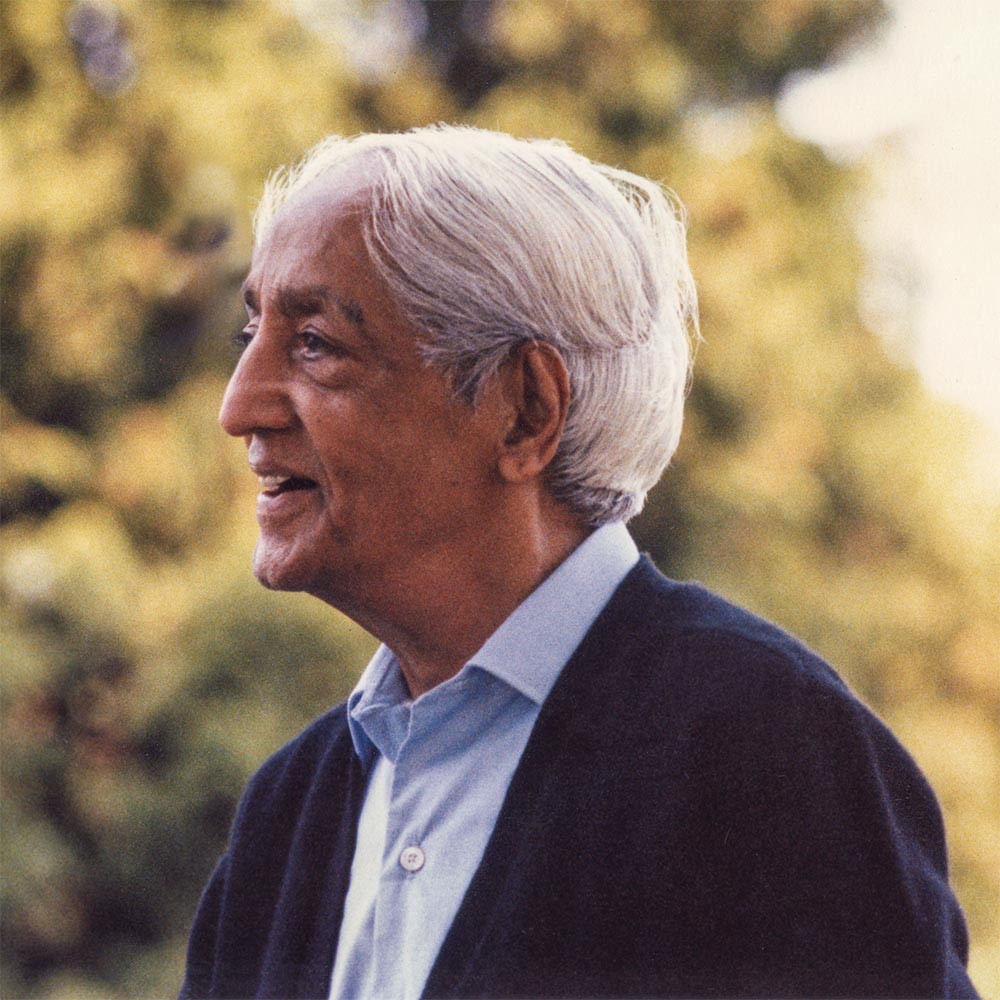
Krishnamurti outdoors smiling

Who Was Krishnamurti?

J. Krishnamurti (1895-1986) is widely regarded as one of the greatest thinkers and religious teachers of all time. He spoke throughout the world to large audiences and to individuals, including writers, scientists, philosophers and educators, about the need for a radical change in mankind. Referring to himself, Krishnamurti said:

He is acting as a mirror for you to look into. That mirror is not an authority. It has no authority, it’s just a mirror. And when you see it clearly, understand what you see in that mirror, then throw it away, break it up.

Krishnamurti was concerned with all humanity and held no nationality or belief and belonged to no particular group or culture. In the latter part of his life, along with continuing to give public talks, he travelled mainly between the schools he had founded in India, Britain and the United States, which educate for the total understanding of man and the art of living. He stressed that only this profound understanding can create a new generation that will live in peace.

Krishnamurti reminded his listeners again and again that we are all human beings first and not Hindus, Muslims or Christians, that we are like the rest of humanity and are not different from one another. He asked that we tread lightly on this earth without destroying ourselves or the environment. He communicated to his listeners a deep sense of respect for nature. His teachings transcend man-made belief systems, nationalistic sentiment and sectarianism. At the same time, they give new meaning and direction to mankind’s search for truth. His teaching is timeless, universal and increasingly relevant to the modern age.

I am nobody. It is as simple as that. I am nobody. But what is important is who you are, what you are.

Krishnamurti

Krishnamurti spoke not as a guru but as a friend. His talks and discussions are based not on tradition-based knowledge but on his own insights into the human mind and his vision of the sacred, so he always communicated a sense of freshness and directness, although the essence of his message remained unchanged over the years. When Krishnamurti addressed large audiences, people felt that he was talking to each of them personally, addressing their own particular problem. In his private interviews, he was a compassionate teacher, listening attentively to those who came to him in sorrow, and encouraging them to heal themselves through their own understanding. Religious scholars found that his words threw new light on traditional concepts. Krishnamurti took on the challenge of modern scientists and psychologists and went with them step by step, discussing their theories and sometimes enabling them to discern the limitations of their theories.

Krishnamurti left a large body of literature in the form of public talks, writings, discussions with teachers and students, scientists, psychologists and religious figures, conversations with individuals, television and radio interviews, and letters. Many of these have been published as books, in over 60 languages, along with hundreds of audio and video recordings.
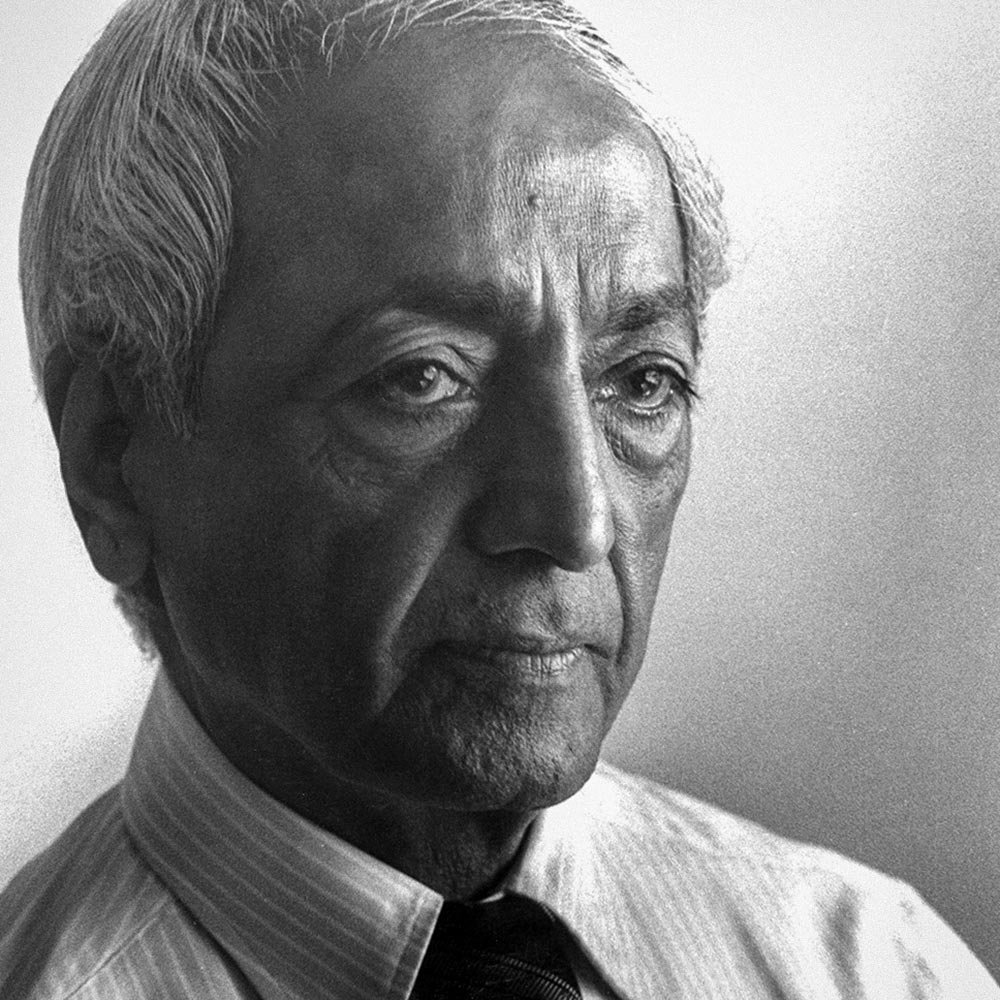
Three-quarters portrait photo of Krishnamurti

The Krishnamurti Foundation

Established in 1968 as a registered charity, and located at The Krishnamurti Centre, Krishnamurti Foundation Trust exists to preserve and make available Krishnamurti’s teachings.

The Foundation serves a global audience by providing worldwide free access to Krishnamurti videos, audio and texts to those who may be interested in pursuing an understanding of Krishnamurti’s work in their own lives.

In describing his intentions for the Foundations, Krishnamurti said: 

The Foundations will see to it that these teachings are kept whole, are not distorted, are not made corrupt.