
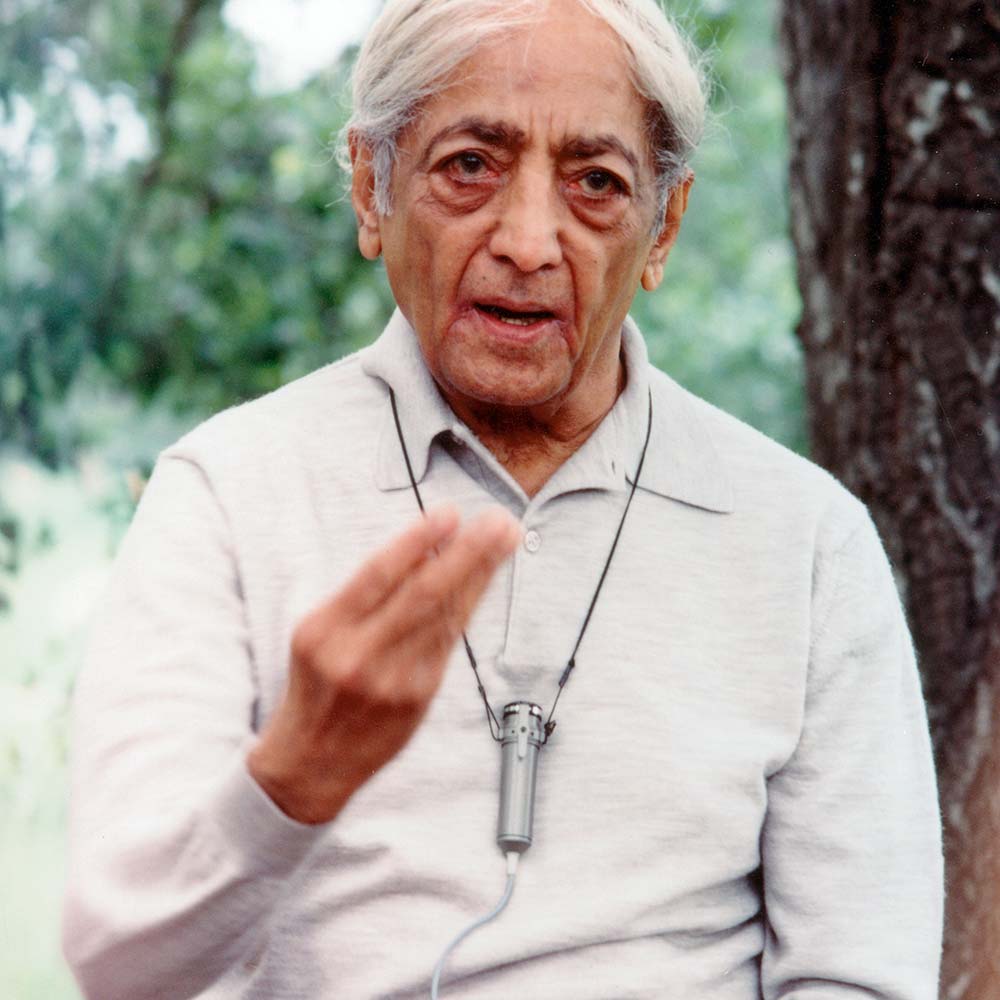
Photo of J. Krishnamurti

Most human beings are violent; they are terrible animals.

Krishnamurti, Inward Revolution

Read More

Most human beings are violent; they are terrible animals. We have the ideal of not being violent, so there is a contradiction between the fact and the idea. The fact is that human beings are violent, and the non-fact is the ideal of nonviolence. If there were no ideal at all, then you would deal with the fact, wouldn’t you? Can you put away the ideal altogether and face ‘what is’? Can you put away your convictions, your formulas, your ideals, your hopes because they prevent you from observing ‘what is’? ‘What is’ is violence. We do not know what to do with violence; therefore, we have ideals.

Violence is not only physical but much more psychological.

Read More

Violence is inherited from beyond time, from the animal, from the ape. We have inherited it. That is a fact. We are violent people. Otherwise, we would not be killing anybody, we would not be hurting anybody, we would not say a word against anybody. We are by nature violent. Now, what is the meaning of that word ‘violence’? Hold that word, feel the weight of it, the complications of it. Violence is not only physical but much more psychological. Violence is conformity, because to conform to something is to imitate, not to understand ‘what is’.

Violence isn’t only organised butchery in the name of God, society or country; violence is much more subtle, much deeper.

Read More

I am a violent human being. I have experienced violence in anger, violence in my sexual demands, violence in hatred, creating enmity, violence in jealousy and so on – I have experienced it, I have known it. I want to understand this whole problem, not just one fragment of it expressed in war, but this aggression in man which also exists in the animals and of which I am a part. Violence is not only killing another – it is violence when we use a sharp word, when we make a gesture to brush away a person, when we obey because of fear. So violence isn’t only organised butchery in the name of God, society or country; violence is much more subtle, much deeper. When you call yourself an Indian or a Muslim or a Christian or a European, or anything else, you are being violent. Do you see why it is violent? Because you are separating yourself from the rest of mankind. When you separate yourself by belief, by nationality, by tradition, it breeds violence. So one who is seeking to understand violence does not belong to any country, religion, political party or system; they are concerned with the total understanding of mankind.

Violence is the expression of insecurity.

Read More

Violence is the expression of insecurity. It is the language of the insecure. It is only the insecure that revolt, that create havoc in the world; it is only those who are insecure who bring war. The brain can only function harmoniously, easily, happily in security. When there is insecurity, the mind is distorted, and thought which is seeking security tries to find it in division, in separation, as in nationalism, in belief, in dogma, in formulas. This very division is the denial of security. So thought seeking security breeds insecurity. From this flows all corruption, violence, ambition and competition.

Fear breeds violence.

Krishnamurti, Inward Revolution

Read More

Fear breeds violence. Haven’t you noticed in a country that is becoming overpopulated, there naturally must be the growth of fear because of unemployment, lack of food, insoluble poverty and corrupt government? When you see all this, you are bound to be afraid, not only for your own security but also for the security of the coming generation, for your sons and your daughters. There is fear of death. Aren’t you all afraid of something or other? You had a physical pain a week ago, and you don’t want that pain repeated. Somebody has hurt you, and there is fear of that hurt. Fear breeds violence. So, unless you really are free of fear, you are bound to create chaos in the world.

The violence and disorder out there is the violence and disorder inside: the two are the same indivisibly.

Read More

This urge to do something outwardly, to reform, to change, to organise improvement, is the first symptom of a fatal disease. The other fatal symptom is the opposite of the first: saying that everything is in me and I must change first. Division is the cause of the disease – one can never separate the outer and the inner. The violence and disorder out there is the violence and disorder inside: the two are the same indivisibly. Nonviolence is only a slogan, a political instrument of the violence inside. There is compulsion, rigid discipline, conformity to a brutal pattern of what is considered morality. There is always this cruel conflict to conform to what is considered the highest virtue, and this is our own invention. We also force others to conform to our pattern. We are essentially traditionalists and therefore contradictory.

Division in any form must bring about not only conflict and violence but ultimately war.

Read More

One’s culture, the society in which one lives, naturally conditions the mind. From this background, one responds, and this response limits our responsibility. If one is born in India, Europe, America or wherever, one’s response will be according to nationalism or religious superstition – and all religions are superstitious structures. These condition one’s response, and they are always limited, finite; and so there is always contradiction, conflict and the arising of confusion. This is inevitable, and it brings about division between human beings. Division in any form must bring about not only conflict and violence but ultimately war. If one understands the meaning of the word ‘responsible’ and what goes on in the world today, one sees that responsibility has become irresponsible. In understanding what is irresponsible, we will begin to comprehend what responsibility is. Responsibility is for the whole, not for oneself, not for one’s family, not for some concept or belief, but for the whole of mankind.

Is violence involved in conformity to a pattern, however noble? Is violence part of the discipline imposed by oneself or by society? Is violence conflict within and without?

Read More

What is it that makes one violent, aggressive, competitive? Is violence involved in conformity to a pattern, however noble? Is violence part of the discipline imposed by oneself or by society? Is violence conflict within and without? I want to find out the origin, the beginning of violence, otherwise I am just spinning a lot of words. Is it natural to be violent in the psychological sense? Inwardly, is violence aggression, anger, hate, conflict, suppression, conformity? And is conformity based on the constant struggle to find, to achieve, to become, to arrive, to self-realise, to be noble and all the rest of it? All that lies in the psychological field. If we cannot go into it very deeply, we won’t be able to understand how we can bring about a different state in our daily life.

The ideal of nonviolence does not free the mind from violence.

Read More

It has been said for centuries that time is necessary to be free from violence. But this is mere habit, and there is no wisdom behind it. We are still violent. So time is not the factor of freedom; the ideal of nonviolence does not free the mind from violence. And cannot violence just cease, not tomorrow or ten years hence? It is only possible with the understanding of time. We are used to ideals; we are in the habit of resisting, suppressing, sublimating, substituting, all of which involves effort and struggle through time. The mind thinks in habits; it is conditioned to gradualism and has come to regard time as a means of achieving freedom from violence. With the understanding of the falseness of that whole process, the truth of violence is seen, and this is the liberating factor.

As long as there is a duality – that is, violence and non-violence – there must be conflict and therefore more violence.

Read More

As long as there is a duality – that is, violence and non-violence – there must be conflict and therefore more violence. As long as I impose on the fact that I am stupid the idea that I must be clever, there is the beginning of violence. When I compare myself with you, who are much more that I am, that is also violence. Comparison, suppression, control – all those indicate a form of violence. I am made like that. I compare, I suppress, I am ambitious. Realising that, how am I to live non-violently? I want to find a way of living without all this strife.

Can we go to the very root of violence and be free from it? Otherwise, we shall live everlastingly in battle with each other.

Read More

Most of us take pleasure in violence, in disliking somebody, hating a particular race or group of people, having antagonistic feelings towards others. In a state of mind in which all violence has come to an end, there is a joy which is very different from the pleasure of violence with its conflicts, hatreds and fears. Can we go to the very root of violence and be free from it? Otherwise, we shall live everlastingly in battle with each other. If that is the way you want to live, then carry on; if you say, ‘I’m sorry, violence can never end,’ then you and I have no means of communication; you have blocked yourself. But if you say there might be a different way of living, then we shall be able to communicate with each other. So let us consider together whether it is possible to totally end every form of violence in ourselves and still live in this monstrously brutal world. I think it is possible. I don’t want to have a breath of hate, jealousy, anxiety or fear in me. I want to live completely at peace.

Controlling violence is another form of violence, for the controller is the controlled. In total attention, the summation of all energy, violence in all its forms comes to an end.

Read More

You have read about the actions of violence, you have seen it in yourself and around you, and you have heard it. You have knowledge of all this and perhaps more, and yet violence has not come to an end. Why? The explanations and the causes of such behaviour have no real significance. If you are indulging in them, you are wasting your energy which you need to transcend violence. You need all your energy to meet and go beyond the energy that is being wasted in violence. Controlling violence is another form of violence, for the controller is the controlled. In total attention, the summation of all energy, violence in all its forms comes to an end. Attention is not a word, an abstract formula of thought, but an act in daily life. Action is not an ideology, but if action is the outcome of it, then it leads to violence.

No form of violence has changed society in the most fundamental way.

Read More

Revolutionaries and terrorists have not fundamentally changed the pattern of our societies. Physically violent revolutionaries have talked about freedom for all, forming a new society, but all the jargon and slogans have only further tortured the spirit and existence. They have twisted words to suit their own limited outlooks. No form of violence has changed society in the most fundamental way. Great rulers, through the authority of a few, have brought about some kind of order in society. Even the totalitarians have established, through violence and torture, a superficial semblance of order. We are not talking about such an order. We are saying very definitely and most emphatically that only having a sense of total responsibility for all mankind, which is love, can basically transform the present state of society.

There is no comparison between the false and the true; violence and love cannot be compared. Violence must cease for love to be.

Krishnamurti, BookTitle

Read More

When the false has dropped away, there is freedom for that which is not false to come into being. You cannot seek the true through the false; the false is not a stepping stone to the true. The false must cease wholly, not in comparison to the true. There is no comparison between the false and the true; violence and love cannot be compared. Violence must cease for love to be. The cessation of violence is not a matter of time. The perception of the false as the false is the ending of the false. Let the mind be empty, and not filled with the things of the mind.

In the woods where man kills rabbits, pheasants and squirrels, there is quite a different atmosphere. You are entering into a world where man has been, with his gun and peculiar violence. Then the woods lose their tenderness, their welcome, and some beauty has been lost, and that happy whisper has gone.

Read More

As one walked in the forest one afternoon, suddenly there was an abnormal silence. The birds stopped chattering, the monkeys were absolutely still, and everything seemed to be holding its breath. One stood still. And just as suddenly, everything came to life; the monkeys were playing and teasing each other, birds began their evening chatter, and one was aware that the danger had passed. In the woods where man kills rabbits, pheasants and squirrels, there is quite a different atmosphere. You are entering into a world where man has been, with his gun and peculiar violence. Then the woods lose their tenderness, their welcome, and some beauty has been lost, and that happy whisper has gone.

These quotes only touch on the many subjects Krishnamurti inquired into during his lifetime. His timeless and universal teachings can be explored using the Index of Topics where you will find texts, audio and video related on many themes. Another option is to browse our selection of curated articles or more short quotes. Krishnamurti’s reply when asked what lies at the heart of his teachings can be found here. Many Krishnamurti books are available, a selection of which can be explored here. To find out more about Krishnamurti’s life, please see our introduction and the biography. We also host a weekly podcast, and offer free downloads. Please visit our YouTube channel for hundreds of specially selected shorter clips. Below, you can learn more about Krishnamurti and our charity which he founded in 1968.
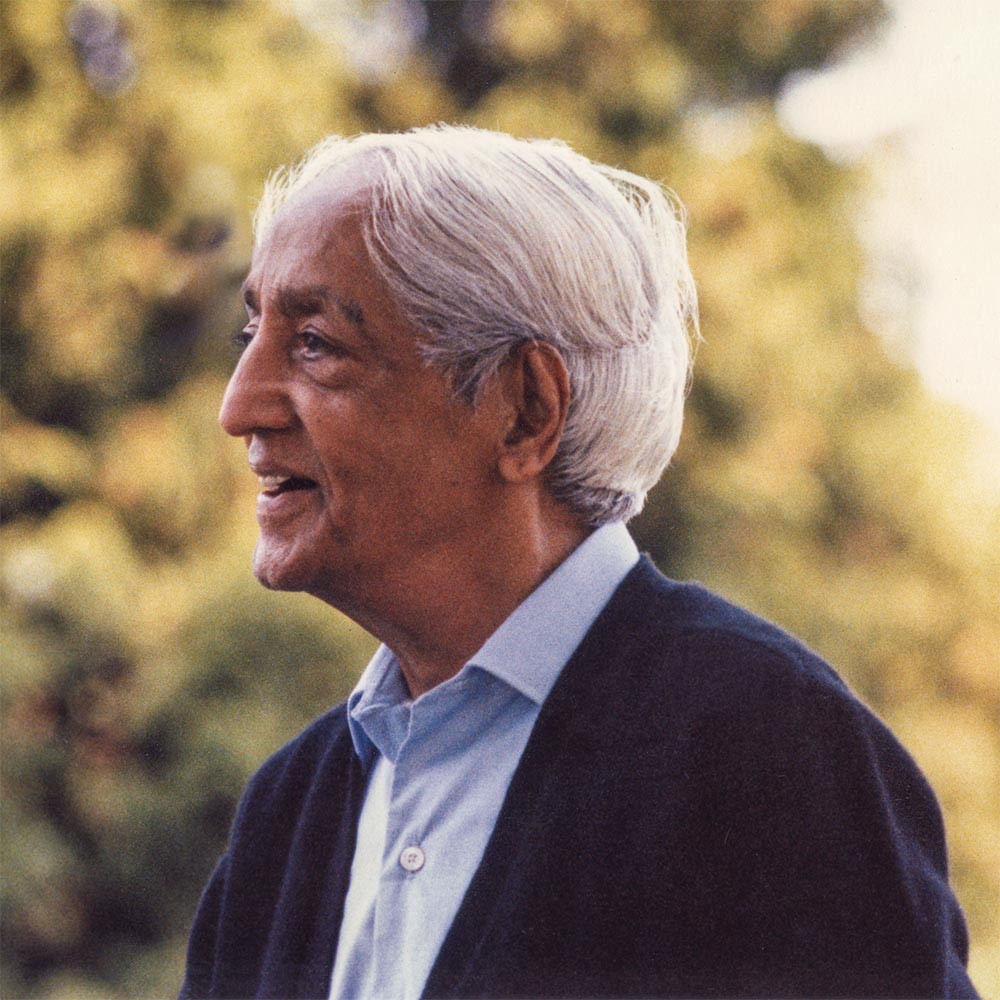
Krishnamurti outdoors smiling

Who Was Krishnamurti?

J. Krishnamurti (1895-1986) is widely regarded as one of the greatest thinkers and religious teachers of all time. He spoke throughout the world to large audiences and to individuals, including writers, scientists, philosophers and educators, about the need for a radical change in mankind. Referring to himself, Krishnamurti said:

He is acting as a mirror for you to look into. That mirror is not an authority. It has no authority, it’s just a mirror. And when you see it clearly, understand what you see in that mirror, then throw it away, break it up.

Krishnamurti was concerned with all humanity and held no nationality or belief and belonged to no particular group or culture. In the latter part of his life, along with continuing to give public talks, he travelled mainly between the schools he had founded in India, Britain and the United States, which educate for the total understanding of man and the art of living. He stressed that only this profound understanding can create a new generation that will live in peace.

Krishnamurti reminded his listeners again and again that we are all human beings first and not Hindus, Muslims or Christians, that we are like the rest of humanity and are not different from one another. He asked that we tread lightly on this earth without destroying ourselves or the environment. He communicated to his listeners a deep sense of respect for nature. His teachings transcend man-made belief systems, nationalistic sentiment and sectarianism. At the same time, they give new meaning and direction to mankind’s search for truth. His teaching is timeless, universal and increasingly relevant to the modern age.

I am nobody. It is as simple as that. I am nobody. But what is important is who you are, what you are.

Krishnamurti

Krishnamurti spoke not as a guru but as a friend. His talks and discussions are based not on tradition-based knowledge but on his own insights into the human mind and his vision of the sacred, so he always communicated a sense of freshness and directness, although the essence of his message remained unchanged over the years. When Krishnamurti addressed large audiences, people felt that he was talking to each of them personally, addressing their own particular problem. In his private interviews, he was a compassionate teacher, listening attentively to those who came to him in sorrow, and encouraging them to heal themselves through their own understanding. Religious scholars found that his words threw new light on traditional concepts. Krishnamurti took on the challenge of modern scientists and psychologists and went with them step by step, discussing their theories and sometimes enabling them to discern the limitations of their theories.

Krishnamurti left a large body of literature in the form of public talks, writings, discussions with teachers and students, scientists, psychologists and religious figures, conversations with individuals, television and radio interviews, and letters. Many of these have been published as books, in over 60 languages, along with hundreds of audio and video recordings.
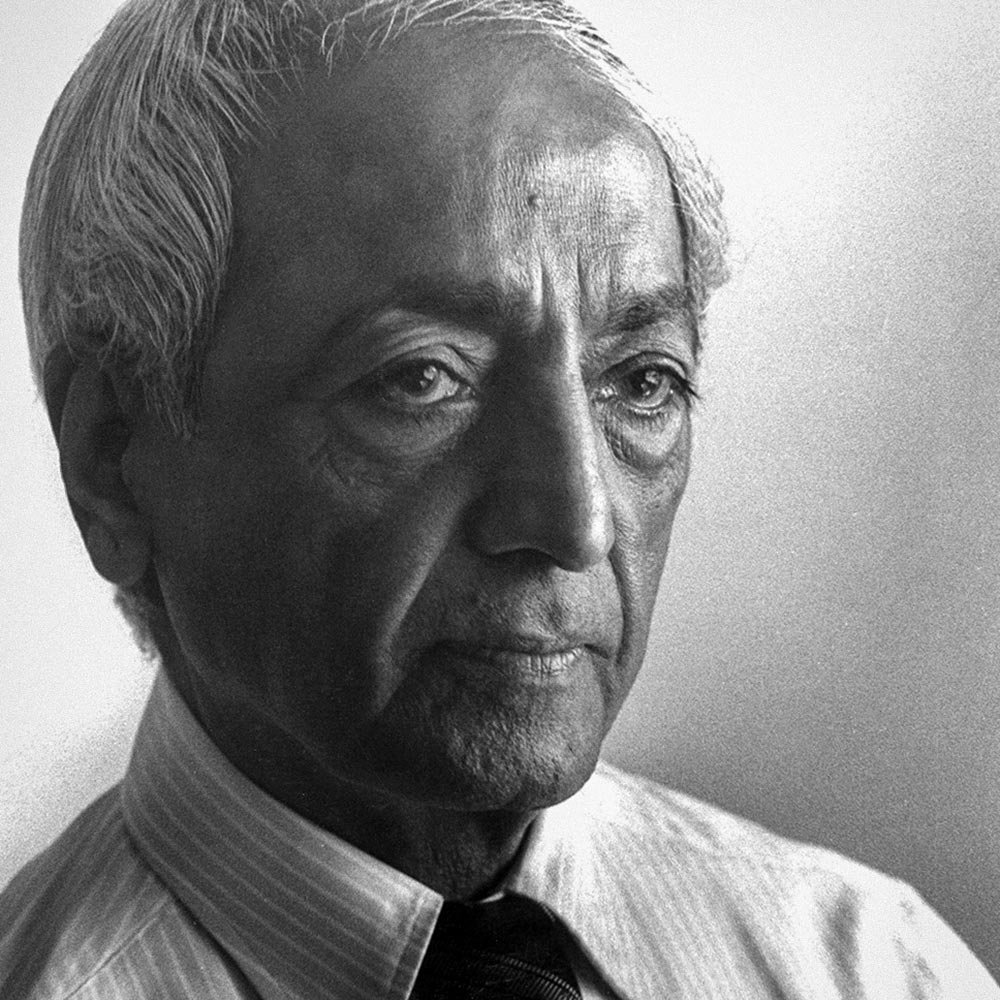
Three-quarters portrait photo of Krishnamurti

The Krishnamurti Foundation

Established in 1968 as a registered charity, and located at The Krishnamurti Centre, Krishnamurti Foundation Trust exists to preserve and make available Krishnamurti’s teachings.

The Foundation serves a global audience by providing worldwide free access to Krishnamurti videos, audio and texts to those who may be interested in pursuing an understanding of Krishnamurti’s work in their own lives.

In describing his intentions for the Foundations, Krishnamurti said: 

The Foundations will see to it that these teachings are kept whole, are not distorted, are not made corrupt.