
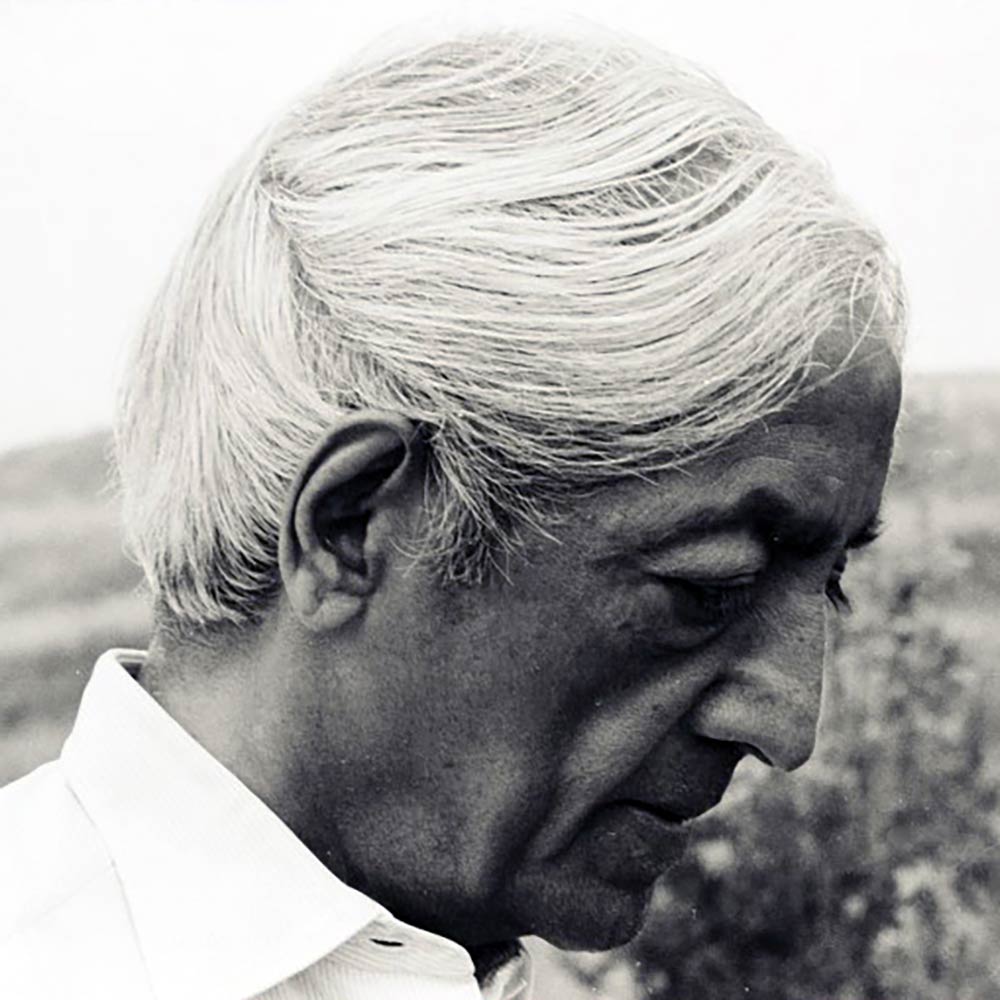
Photo of J. Krishnamurti

Question everything.

Krishnamurti, Beyond Violence

Read More

You must question everything, including your pet beliefs, your ideals, your authorities, scriptures and politicians. This means there must be a certain quality of scepticism. But scepticism must be kept on the leash; you must let it go when necessary so that the mind can see freely, run rapidly. When you question, it must be your own particular problem, not a casual, superficial question that will entertain you; it must be something of your own. If this is so, you will put the right question. And if it is the right question you will have the right answer, because the very act of putting that right question shows you the answer in itself.

Our so-called religious training discourages questioning and doubt, yet it is only when we inquire into the significance of the values that society and religion have placed about us that we begin to find out what is true.

Read More

Dogmas, mysteries and rituals are not conducive to a spiritual life. Religious education in the true sense is to encourage the child to understand their own relationship to people, things and nature. There is no existence without relationship, and without self-knowledge, all relationship, with the one and the many, brings conflict and sorrow. To explain this fully to a child is impossible, but if the educator and parents deeply grasp the full significance of relationship, then by their attitude, conduct and speech they will surely be able to convey to the child, without too many words and explanations, the meaning of a spiritual life. Our so-called religious training discourages questioning and doubt, yet it is only when we inquire into the significance of the values that society and religion have placed about us that we begin to find out what is true.

If we can establish a relationship with each other in which open dialogue takes place – a free, self-critical, self-aware dialogue of questioning, doubting, inquiring – then we are both learning, are both communing with each other’s point of view.

Read More

Suppose I am an educator and am full of arrogance, vanity, ambition and all the rest of it, the usual nonsense that goes on in human beings. In talking with the student or with somebody I am learning, learning that I am arrogant and that the student is also arrogant in his way, so we begin to talk about it. And a discussion like that, if one is honest and really self-critical, selfaware, has tremendous possibilities. If we can establish a relationship with each other in which an open dialogue takes place, a free, self-critical, self-aware dialogue of questioning, doubting, inquiring, then we are both learning, are both communing with each other’s point of view.

You must have the quality of a brain that is inquiring, looking, searching, asking, questioning, doubting. Not only doubting others, your books and so on, but doubting your own thinking, questioning your own responses and reactions.

Read More

In the perception of that which is true, there is peace, peace in oneself, in one’s own psyche. That means no conflict whatsoever. Is this possible? If you say it is not possible, that becomes a block which prevents you from looking at the possibility of opening the door to look. Or if you say it is possible, you are merely talking theoretically; then you have shut the door. You must have the quality of a brain that is inquiring, looking, searching, asking, questioning, doubting. Not only doubting others, your books and so on, but doubting your own thinking, questioning your own responses and reactions. That requires an alertness of mind.

One must begin with uncertainty, doubting, questioning, having a sceptical mind; then one comes to a place where there is absolute certainty.

Read More

No philosophy, no guru, no politician, nobody has solved our human problems. You can escape from them by joining some monastery, by taking certain vows or joining some cult, but no authority has ever solved these problems. We have reached a point where we do not believe in anything. We are utterly confused. Those who are certain at the beginning end up with uncertainty. I start life believing firmly in God or in some kind of mystical affair. If I am somewhat intelligent, as I grow up I begin to doubt everything. One must begin with uncertainty, doubting, questioning, having a sceptical mind; then one comes to a place where there is absolute certainty.

As there is an art in love, there is also an art in questioning and doubting; doubting one’s conclusions and opinions, questioning why we tolerate this vast burden of sorrow.

Krishnamurti, Total Freedom

Read More

We are asking whether sorrow can ever end, or must we always carry it throughout the future, from the past. Can that sorrow ever end? As there is an art in love, there is also an art in questioning and doubting; doubting one’s conclusions and opinions, questioning why we tolerate this vast burden of sorrow. Sorrow is also self-pity, the feeling of utter loneliness, and the sorrow that is brought about through great failures, through comparison, through the whole movement of feeling a sense of lack of relationship to anybody. But we never go to the very end of it. We would rather escape from it, seek some form of comfort, some form of drug that gives us solace. Could we not try to find an answer, not ask whether sorrow can be conquered, but be aware to see the full meaning of that word sorrow?

You can awaken intelligence by questioning the full value of any environment in which your mind is caught up. Then you will see that you are free of any particular environment, because then you are functioning intelligently, not being twisted, perverted or shaped by it.

Krishnamurti, Total Freedom

Read More

What is the perfect environment? Each will tell you what a perfect environment is to them. The artist will say one thing, the financier another, the actress another; each asks for a perfect environment which satisfies them, in other words, one that does not create conflict in them. Therefore, there cannot be a perfect environment. But if there is intelligence, then environment has no value or significance, because intelligence is then freed from circumstance; it is functioning fully. The question is not whether we can create a perfect environment, but rather how to awaken that intelligence that shall be free of environment, imperfect or perfect. I say you can awaken that intelligence by questioning the full value of any environment in which your mind is caught up. Then you will see that you are free of any particular environment because then you are functioning intelligently, not being twisted, perverted or shaped by it.

By right questioning and listening, the pattern moulded by thought and feeling – the pattern of the known – is shattered.

Read More

Our lives are so shallow and empty, with petty thoughts and petty activities, woven in conflict and misery. We are always journeying from the known to the known, demanding security. There is no security in the known, however much one may want it. Security is time, and there is no psychological time; it is a myth and illusion, breeding fear. There is nothing permanent now or in the hereafter, in the future. By right questioning and listening, the pattern moulded by thought and feeling – the pattern of the known – is shattered. Self-knowing, knowing the ways of thought and feeling, listening to every movement of thought and feeling, ends the known. The known breeds sorrow, and love is the freedom from the known.

Questioning not born of reaction, choice and motive explodes moral, respectable, self-centred activity; it is this activity that is always being reformed and never smashed.

Read More

Questioning the structure of sorrow and going beyond it is far more urgent than going to the moon or the temple. This questioning tears down the structure and doesn’t build a new and more expensive prison, with its gods and saviours, with its economists and leaders. This questioning destroys the machinery of thought and is not the substitution of one by another thought, conclusion or theory. This questioning shatters authority, the authority of experience, words and the most respected evil and power. This questioning, which is not born of reaction, choice and motive, explodes moral, respectable self-centred activity; it is this activity that is always being reformed and never smashed.

Might it be that you have never really inquired into the authoritarian way of existence? The very questioning of authority is the end of authority.

Read More

Might it be that you have never really inquired into the authoritarian way of existence? The very questioning of authority is the end of authority. There is no method or system by which the mind can be set free from authority and tradition; if there were, that system would become the dominating factor. Why do you accept authority, in the deeper sense of that word? You accept authority, as the guru also does, in order to be safe, to be certain, in order to be comforted, to succeed, to ‘reach the other shore’. You and the guru are worshippers of success; you are both driven by ambition. Where there is ambition, there is no love; and action without love has no meaning.

A religious mind is not a believing mind. It is a sceptical, doubting, questioning, inquiring mind, and so there is no sense of authority or hierarchical outlook on life.

Read More

The etymological meaning of the word ‘religion’ is not very clear. None of the dictionaries make the root meaning clear. But we can, more or less, by negating what is not the religious mind, come to discover for ourselves what a mind is that is truly religious. A mind that thinks in terms of ideals is not a religious mind – ideal in the sense of a projection of what should be, what might be, what ought to be, the end, the goal, the purpose, the conceptual statement of something other than what is. Such a mind, which functions in ideas and ideals, pursuing a direction laid down by thought, is not a religious mind. A religious mind is not a believing mind. It is a sceptical, doubting, questioning, inquiring mind, and so there is no sense of authority or hierarchical outlook on life. So there is no belief in some strange fanciful god, no belief in what I shall be. A religious mind has no conflict; it perceives the nature of conflict and eliminates it.

To understand what meditation is, there must be questioning, inquiry; and mere acceptance destroys inquiry.

Read More

You accept traditional systems of meditation because you are eager for results, for success; you want to ‘arrive’. To understand what meditation is, there must be questioning, inquiry; and mere acceptance destroys inquiry. You have to see for yourself the false as the false, and the truth in the false, and the truth as the truth; for none can instruct you concerning it. Meditation is the way of life; it is part of daily existence, and the fullness and beauty of life can only be understood through meditation. Without understanding the whole complexity of life, and the everyday reactions from moment to moment, meditation becomes a process of self-hypnosis. Meditation of the heart is the understanding of daily problems. You can’t go very far if you don’t begin very near.

There is a questioning which is merely to question, not trying to find an answer. That very questioning opens the door through which you can find out, look, observe and listen.

Krishnamurti, To Be Human

Read More

To fundamental questions there is no absolute answer of yes or no. What is important is to put a fundamental question, not to find an answer; and if we are capable of looking at that question without seeking an answer, that very observation of the fundamental brings about understanding. There is no answer to any problem, there is only an understanding of the problem. There is a questioning which is merely to question, not trying to find an answer. That very questioning opens the door through which you can find out, look, observe and listen. If you put a question without wanting an answer, you will find the answer. But if you put the question hoping to find the answer, your answer will then be according to your conditioning. Is it possible to live in this world with all the complications without a single shadow of conflict? You have planted this question in your brain; let it remain there and see what happens.

In the very process of looking, watching, discussing, doubting, questioning, having no beliefs or faith, you are already leading a religious life.

Krishnamurti, Meeting Life

Read More

When you begin to inquire into what religion is, you are living a religious life; not at the end of it. In the very process of looking, watching, discussing, doubting, questioning, having no beliefs or faith, you are already leading a religious life. You seem to lose all reason, logic and sanity when it comes to religious matters, so we have to be logical, rational, doubting, questioning all the things that man has put together: the gods, the saviours, the gurus and their authority – that is not religion, merely the assumption of authority by the few. You give them authority. So set all that completely aside.

The man who is ceaselessly questioning, who has no authority, who does not follow any tradition, any book or teacher, becomes a light unto himself.

Read More

He who would really find out what truth is, what God is, can have no authority, whether of the book, of the government, of the image or of the priest. He must be totally free of all that. This is very difficult for most of us because it means being insecure, standing completely alone, searching, groping, never being satisfied, never seeking success. But if we seriously experiment with it, we shall find that there is no longer any question of creating or following authority, because something else begins to operate. The man who is ceaselessly questioning, who has no authority, who does not follow any tradition, any book or teacher, becomes a light unto himself.

These quotes only touch on the many subjects Krishnamurti inquired into during his lifetime. His timeless and universal teachings can be explored using the Index of Topics where you will find texts, audio and video related on many themes. Another option is to browse our selection of curated articles or more short quotes. Krishnamurti’s reply when asked what lies at the heart of his teachings can be found here. Many Krishnamurti books are available, a selection of which can be explored here. To find out more about Krishnamurti’s life, please see our introduction and the biography. We also host a weekly podcast, and offer free downloads. Please visit our YouTube channel for hundreds of specially selected shorter clips. Below, you can learn more about Krishnamurti and our charity which he founded in 1968.
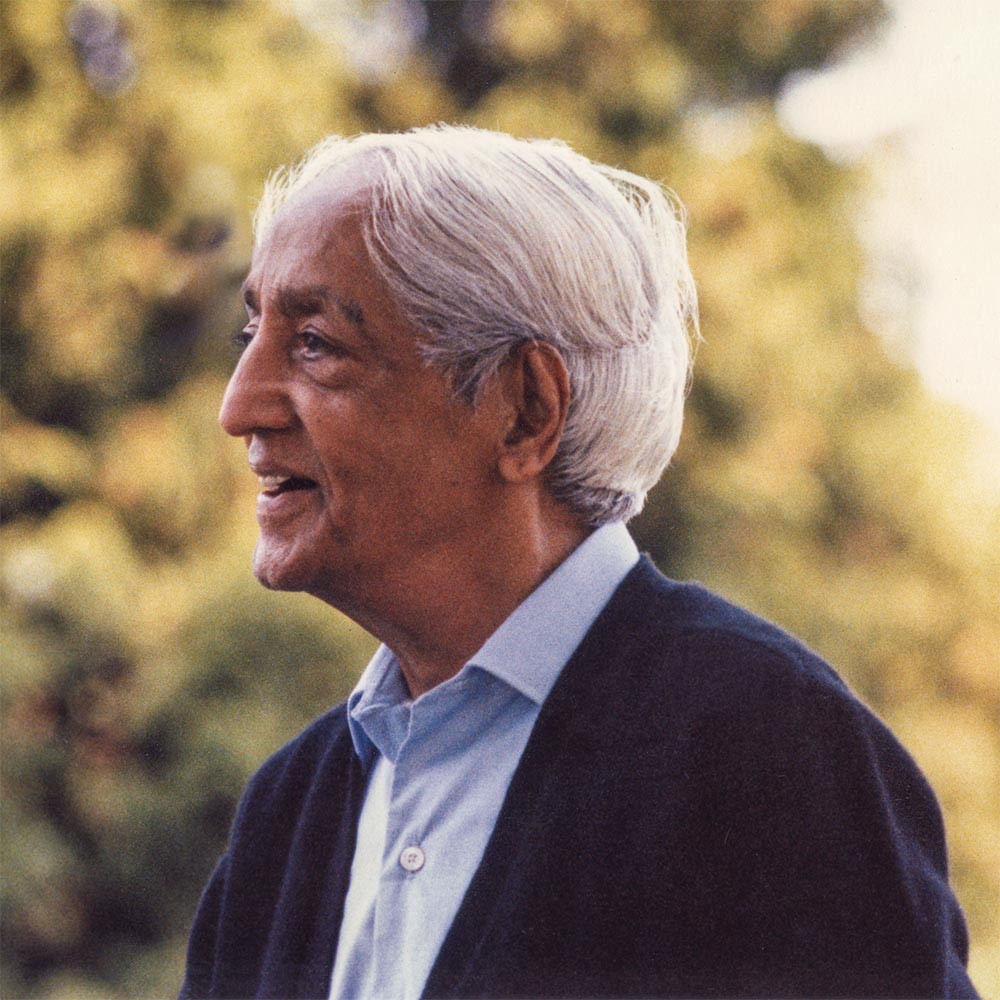
Krishnamurti outdoors smiling

Who Was Krishnamurti?

J. Krishnamurti (1895-1986) is widely regarded as one of the greatest thinkers and religious teachers of all time. He spoke throughout the world to large audiences and to individuals, including writers, scientists, philosophers and educators, about the need for a radical change in mankind. Referring to himself, Krishnamurti said:

He is acting as a mirror for you to look into. That mirror is not an authority. It has no authority, it’s just a mirror. And when you see it clearly, understand what you see in that mirror, then throw it away, break it up.

Krishnamurti was concerned with all humanity and held no nationality or belief and belonged to no particular group or culture. In the latter part of his life, along with continuing to give public talks, he travelled mainly between the schools he had founded in India, Britain and the United States, which educate for the total understanding of man and the art of living. He stressed that only this profound understanding can create a new generation that will live in peace.

Krishnamurti reminded his listeners again and again that we are all human beings first and not Hindus, Muslims or Christians, that we are like the rest of humanity and are not different from one another. He asked that we tread lightly on this earth without destroying ourselves or the environment. He communicated to his listeners a deep sense of respect for nature. His teachings transcend man-made belief systems, nationalistic sentiment and sectarianism. At the same time, they give new meaning and direction to mankind’s search for truth. His teaching is timeless, universal and increasingly relevant to the modern age.

I am nobody. It is as simple as that. I am nobody. But what is important is who you are, what you are.

Krishnamurti

Krishnamurti spoke not as a guru but as a friend. His talks and discussions are based not on tradition-based knowledge but on his own insights into the human mind and his vision of the sacred, so he always communicated a sense of freshness and directness, although the essence of his message remained unchanged over the years. When Krishnamurti addressed large audiences, people felt that he was talking to each of them personally, addressing their own particular problem. In his private interviews, he was a compassionate teacher, listening attentively to those who came to him in sorrow, and encouraging them to heal themselves through their own understanding. Religious scholars found that his words threw new light on traditional concepts. Krishnamurti took on the challenge of modern scientists and psychologists and went with them step by step, discussing their theories and sometimes enabling them to discern the limitations of their theories.

Krishnamurti left a large body of literature in the form of public talks, writings, discussions with teachers and students, scientists, psychologists and religious figures, conversations with individuals, television and radio interviews, and letters. Many of these have been published as books, in over 60 languages, along with hundreds of audio and video recordings.
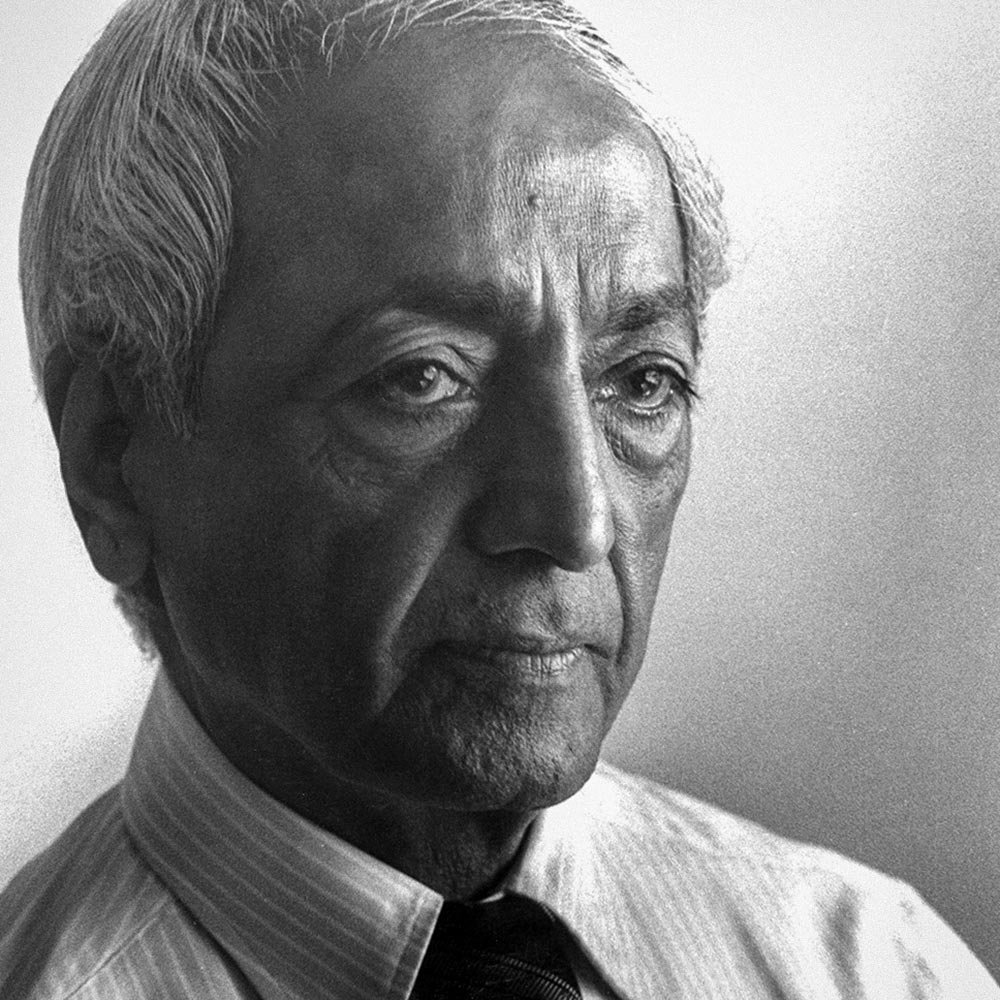
Three-quarters portrait photo of Krishnamurti

The Krishnamurti Foundation

Established in 1968 as a registered charity, and located at The Krishnamurti Centre, Krishnamurti Foundation Trust exists to preserve and make available Krishnamurti’s teachings.

The Foundation serves a global audience by providing worldwide free access to Krishnamurti videos, audio and texts to those who may be interested in pursuing an understanding of Krishnamurti’s work in their own lives.

In describing his intentions for the Foundations, Krishnamurti said: 

The Foundations will see to it that these teachings are kept whole, are not distorted, are not made corrupt.