
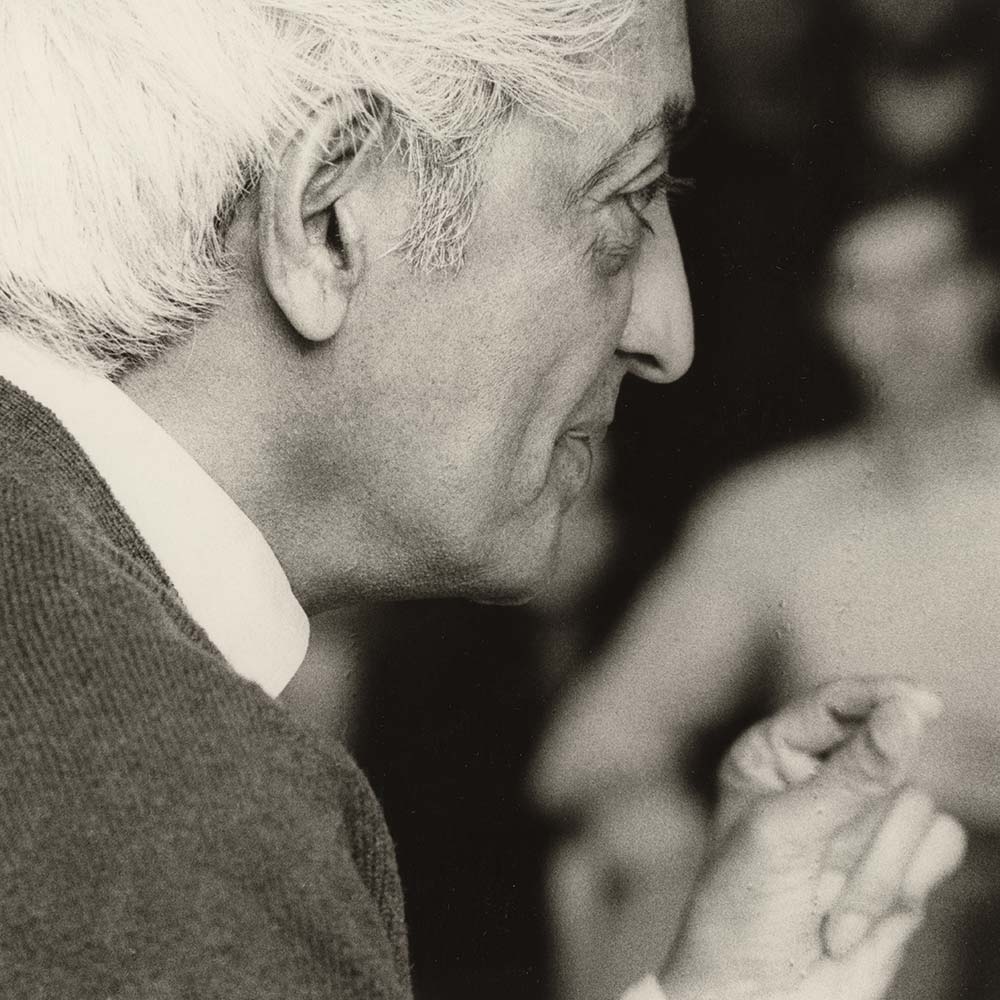
Photo of J. Krishnamurti

Why do we live with a sense of duality, opposing each other at all levels of our existence, resisting each other and bringing about conflict and war?

Read More

Why do we live with a sense of duality, opposing each other at all levels of our existence, resisting each other and bringing about conflict and war? This has been the pattern of human activity throughout the world, probably from the very beginning of time – this sense of separation dividing the artist, the soldier, the musician, the scientist, the so-called religious and the man of business. Although they talk of love and peace on earth, in this way there can be no peace; in this way we must be at war with each other. One wonders whether it must always be like this. Is it possible for human beings who are serious to find out if they can live in a state of non-duality, not ideologically or theoretically, but actually, both in form and essence? Is it at all possible for you and me to live a life in which this sense of duality ceases completely, not only at the verbal level but also in the deeper layers and recesses of the mind?

There is only ‘what is’, and because we are not able to solve it, we invent ‘what should be’, and there is duality that way.

Read More

Start with not knowing the assumptions of others, which are second-hand; wipe them all out. Is there duality? There is woman-man, light-darkness, tall-short, but apart from the factual duality, is there any other duality? I want to find out if there is psychological duality. There is obvious duality outwardly: a tall or short tree, different colours, different materials, and so on. There is only ‘what is’, and because we are not able to solve it, we invent the ‘what should be’, and there is duality that way. From the idea, the fact, the ‘what is’, there is an abstraction: the ideal, the ‘what should be’, the Aristotelian idea of perfection, and so on. But there is only ‘what is’.

We accept psychological duality as we accept objective duality; it is part of our conditioning. We never question this conditioning.

Krishnamurti, The Only Revolution

Read More

Is there a duality at all? Objectively there is, such as light and shade, but psychologically is there? We accept psychological duality as we accept the objective duality; it is part of our conditioning. We never question this conditioning. But is there, psychologically, a division? There is only ‘what is’, not ‘what should be’. ‘What should be’ is a division that thought has put together in avoiding or overcoming the reality of ‘what is’. Hence the struggle between the actual and the abstraction. The abstraction is the fanciful, the romantic, the ideal. What is actual is ‘what is’, and everything else is non-real. It is the non-real that brings about the fragmentation, not the actual. Pain is actual; non-pain is the pleasure of thought which brings about the division between pain and the state of non-pain. Thought is always separative; it is the division of time, the space between the observer and the thing observed. There is only ‘what is’, and to see ‘what is’, without thought as the observer, is the ending of fragmentation.

Demand is born out of duality: ‘I am unhappy, and I must be happy.’

Read More

Demand is born out of duality: ‘I am unhappy, and I must be happy.’ In that very demand that I must be happy is unhappiness. When one makes an effort to be good, in that very goodness is its opposite, evil. Everything affirmed contains its own opposite, and effort to overcome strengthens that against which it strives. When you demand an experience of truth or reality, that very demand is born out of your discontent with ‘what is’, and therefore the demand creates the opposite. And in the opposite, there is what has been. So one must be free of this incessant demand, otherwise there will be no end to the corridor of duality. This means knowing yourself so completely that the mind is no longer seeking. Such a mind does not demand experience; it cannot ask for a challenge or know a challenge; it does not say, ‘I am asleep’ or ‘I am awake.’ It is completely what it is. The frustrated, narrow, shallow, conditioned mind is always seeking the ‘more’. Is it possible then to live in this world without the ‘more’, without this everlasting comparison? Surely it is, but one has to find out for oneself.

As long as thought is measuring, there must be duality.

Krishnamurti, Can Humanity Change?

Read More

As long as thought is measuring, there must be duality. How has this conditioning come about? How has this constant measurement, comparison, imitation, the whole movement of measurement come about? Why has man been caught in it? Why are human beings, wherever they live, conditioned through this measurement? One wants to find out the source of this measurement.

Is there a basic duality at the very core, or does duality arise only when the mind moves away from ‘what is’?

Read More

Is there a basic duality at the very core, or does duality arise only when the mind moves away from ‘what is’? When I do not move away from the basic non-dualistic quality of the mind, is there duality? Does the mind create duality when it is completely with ‘what is’? I never think when I look at a tree. When I look at you, there is no division as the ‘me’ and the ‘you’. Words are used for linguistic and communicative purposes; the ‘me’ and the ‘you’ are somehow not rooted in me. So, where does a thinker separate from thought arise if the mind remains in ‘what is’, remains with pain? When there is no thinking of non-pain, there is the sense of suffering – that is ‘what is’; there is no feeling of wanting to be out of it. Where does duality arise? Duality arises when the mind says: I must be rid of pain.

The ‘I’ may divide itself into the organic ‘I’ and the ‘non-I’ or transcendental self, but this dualistic separation is an illusion in which the mind is caught.

Read More

Can the ‘I’ positively set about abnegating itself? If it does, its motive and intention is to gain that which is not to be possessed. Whatever its activity, however noble its aim, any effort on the part of the ‘I’ is still within the field of its own memories, idiosyncrasies and projections, whether conscious or unconscious. The ‘I’ may divide itself into the organic ‘I’ and the ‘non-I’ or transcendental self, but this dualistic separation is an illusion in which the mind is caught. Whatever may be the movement of the mind, of the ‘I’, it can never free itself; it may go from level to level, from stupid to more intelligent choice, but its movement will always be within the sphere of its own making.

If the maker of choice continues, there will ever be duality, the ‘I’ and the ‘not I’, merit and demerit, and so on.

Krishnamurti, The World Within

Read More

Without self-knowledge and self-awareness, right meditation is not possible. Without becoming aware of the thinker, merely to reshape thought is of little significance. Awareness, meditation, then, is self-discovery. To discover, there must be freedom from identification, from judgement, which is a very difficult task. Judgement and identification prevent the understanding of every thought-feeling. This freedom must be established from the very beginning. A wrong means will produce a wrong end; through a wrong means, the true cannot be found. From the very beginning, awareness must be choiceless. If the maker of choice continues, there will ever be duality, the ‘I’ and the ‘not I’, merit and demerit, and so on. Through duality, the one is not. The maker of effort, the maker of choice must be understood and dissolved. The maker of effort is the centre of accumulation, and what is accumulated is not the real. The elimination of this centre, of this thinker, of experience and memory must be resolved. The whole process of awareness or meditation is to reduce the maker of choice, the thinker, to silence.

When there is the cessation of becoming, of craving in its many forms, there is the falling away of dualism.

Krishnamurti, The World Within

Read More

We must observe the conflicts of our thoughts-feelings, their contradictions, appetites and hidden pursuits. If we attempt to do this earnestly and alertly all day, we will find that we naturally need, without any artificial enforcement, periods during the day for intense self-awareness and self-observation. Out of this self-knowledge, right thinking comes. Meditation is to free thought-feeling so that it can discover, for that which is discovered, being truth, is liberating and creative. When there is the cessation of becoming, of craving in its many forms, there is the falling away of dualism – the ‘me’ and the ‘not me’, the one who prays and that which is prayed to. Then we shall experience true being. Our happiness lies in its discovery and not in the delusions of craving, however noble.

Desire breeds the conflict of duality, and conflict is darkness.

Read More

Desire is never satisfied; there is no end to desire. Understanding desire, without trying to stop it or sustain it, is the beginning and the end of meditation. But there is something beyond this. It is strange how the meditator persists; he seeks to continue, he becomes the observer, the experiencer, a recollecting mechanism, the one who evaluates, accumulates, rejects. When meditation is of the meditator, it only strengthens the meditator, the experiencer. Stillness of the mind is the absence of the experiencer, the observer who is aware that he is still. When the mind is still, there is the awakened state. You can be intermittently awake to many things, you can probe, seek, inquire, but these are the activities of desire, will, recognition and gain. That which is ever awake is neither desire nor the product of desire. Desire breeds the conflict of duality, and conflict is darkness.

Love is not a thing of thought. A thing of thought has in it a duality, one opposing another, but as love is not put together by thought, it has no opposite.

Read More

See how thought breeds hatred and arrogance. See how thought creates the image of what it calls God and love. These opposites are the product of thought, and in this, human beings are endlessly caught. All this has nothing to do with love, has it? You know what we mean by that word? To be kind, to be gentle; love has no fear, love is not jealous. Love is not a thing of thought. A thing of thought has in it a duality, one opposing another, but as love is not put together by thought, it has no opposite. This is a great thing to understand. Spend some time observing all this. Learn about it. Then you will see for yourself that any form of belief becomes totally unnecessary, and you can live without any formula.

To live on words is to live in separation and hence in the conflict of duality.

Read More

To live on words is to live in separation and hence in the conflict of duality. To live without words is to see the movement of the whole. The symbol has become more urgent and meaningful than the fact. The philosophy of the word is the love of the surface of the common mind. It is the symbol that is worshipped and adored in the church and the temple, and even when, as in the mosque, there is no outward symbol, the word takes its place. Thought, in its search for the divine, inevitably makes it into a symbol or a word, and the whole conditioning of the mind begins.

Reform within duality becomes retrogression, and there is creative revolution only outside duality.

Krishnamurti, The World Within

Read More

Existence is pain, and should we not go beyond it? If life is an endless conflict of duality, there is no end to pain. Then there is no forward revolutionary movement, only different forms of pain. So reform within duality becomes retrogression, and there is creative revolution only outside duality. Society is the expression of ourselves, and if our thought-feeling is confined to thesis and antithesis, there will be division and confusion in all relationship.

Energy spent on ambition and competitiveness is part of the dualistic process of one’s life, on which society is built.

Read More

In what way is one to act in daily life without division; to behave, to talk, to use words so as not to create a division between you and me? It is possible only by being totally aware, completely sensitive, not only to what is going on inwardly, but also outwardly. To be so aware demands a great deal of energy. Do we have that energy? A great deal of energy is necessary to be alert, aware and sensitive. To understand this separating, dualistic life of resistance needs great energy, physically and mentally, the energy of great sensitivity. We ask how all this energy is to come about, knowing that we waste energy in useless talk, through indulging in various forms of images, sexual and otherwise, knowing that energy is spent in ambition and competitiveness that is part of this dualistic process of one’s life on which society is built. Can the mind and the brain, can the whole structure, which is the ‘me’, be aware of all this, not fragmentarily but totally?

The deep inward simplicity of austerity makes for a life that has no duality. This is the journey the mind must take to come upon this beauty without the word. This journey is meditation.

Krishnamurti, The Only Revolution

Read More

It is the act of beauty that abandons, and it is love that brings the deep inward clarity of austerity. Beauty is this love, in which measurement has come to an end. Then this love, do what it will, is beauty. The doing is not separate from ‘what is’. It is separation that brings conflict and ugliness. When there isn’t separation, living itself is the act of love. The deep inward simplicity of austerity makes for a life that has no duality. This is the journey the mind must take to come upon this beauty without the word. This journey is meditation.

These quotes only touch on the many subjects Krishnamurti inquired into during his lifetime. His timeless and universal teachings can be explored using the Index of Topics where you will find texts, audio and video related on many themes. Another option is to browse our selection of curated articles or more short quotes. Krishnamurti’s reply when asked what lies at the heart of his teachings can be found here. Many Krishnamurti books are available, a selection of which can be explored here. To find out more about Krishnamurti’s life, please see our introduction and the biography. We also host a weekly podcast, and offer free downloads. Please visit our YouTube channel for hundreds of specially selected shorter clips. Below, you can learn more about Krishnamurti and our charity which he founded in 1968.
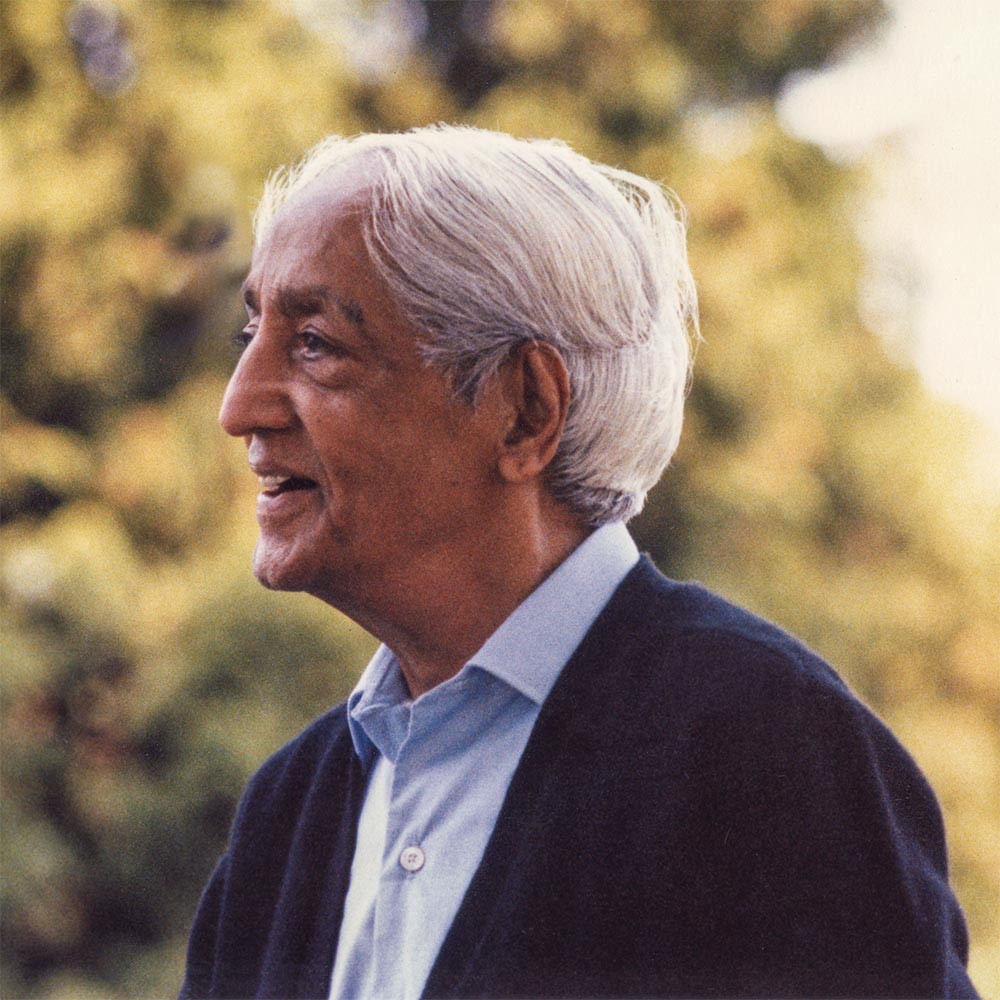
Krishnamurti outdoors smiling

Who Was Krishnamurti?

J. Krishnamurti (1895-1986) is widely regarded as one of the greatest thinkers and religious teachers of all time. He spoke throughout the world to large audiences and to individuals, including writers, scientists, philosophers and educators, about the need for a radical change in mankind. Referring to himself, Krishnamurti said:

He is acting as a mirror for you to look into. That mirror is not an authority. It has no authority, it’s just a mirror. And when you see it clearly, understand what you see in that mirror, then throw it away, break it up.

Krishnamurti was concerned with all humanity and held no nationality or belief and belonged to no particular group or culture. In the latter part of his life, along with continuing to give public talks, he travelled mainly between the schools he had founded in India, Britain and the United States, which educate for the total understanding of man and the art of living. He stressed that only this profound understanding can create a new generation that will live in peace.

Krishnamurti reminded his listeners again and again that we are all human beings first and not Hindus, Muslims or Christians, that we are like the rest of humanity and are not different from one another. He asked that we tread lightly on this earth without destroying ourselves or the environment. He communicated to his listeners a deep sense of respect for nature. His teachings transcend man-made belief systems, nationalistic sentiment and sectarianism. At the same time, they give new meaning and direction to mankind’s search for truth. His teaching is timeless, universal and increasingly relevant to the modern age.

I am nobody. It is as simple as that. I am nobody. But what is important is who you are, what you are.

Krishnamurti

Krishnamurti spoke not as a guru but as a friend. His talks and discussions are based not on tradition-based knowledge but on his own insights into the human mind and his vision of the sacred, so he always communicated a sense of freshness and directness, although the essence of his message remained unchanged over the years. When Krishnamurti addressed large audiences, people felt that he was talking to each of them personally, addressing their own particular problem. In his private interviews, he was a compassionate teacher, listening attentively to those who came to him in sorrow, and encouraging them to heal themselves through their own understanding. Religious scholars found that his words threw new light on traditional concepts. Krishnamurti took on the challenge of modern scientists and psychologists and went with them step by step, discussing their theories and sometimes enabling them to discern the limitations of their theories.

Krishnamurti left a large body of literature in the form of public talks, writings, discussions with teachers and students, scientists, psychologists and religious figures, conversations with individuals, television and radio interviews, and letters. Many of these have been published as books, in over 60 languages, along with hundreds of audio and video recordings.
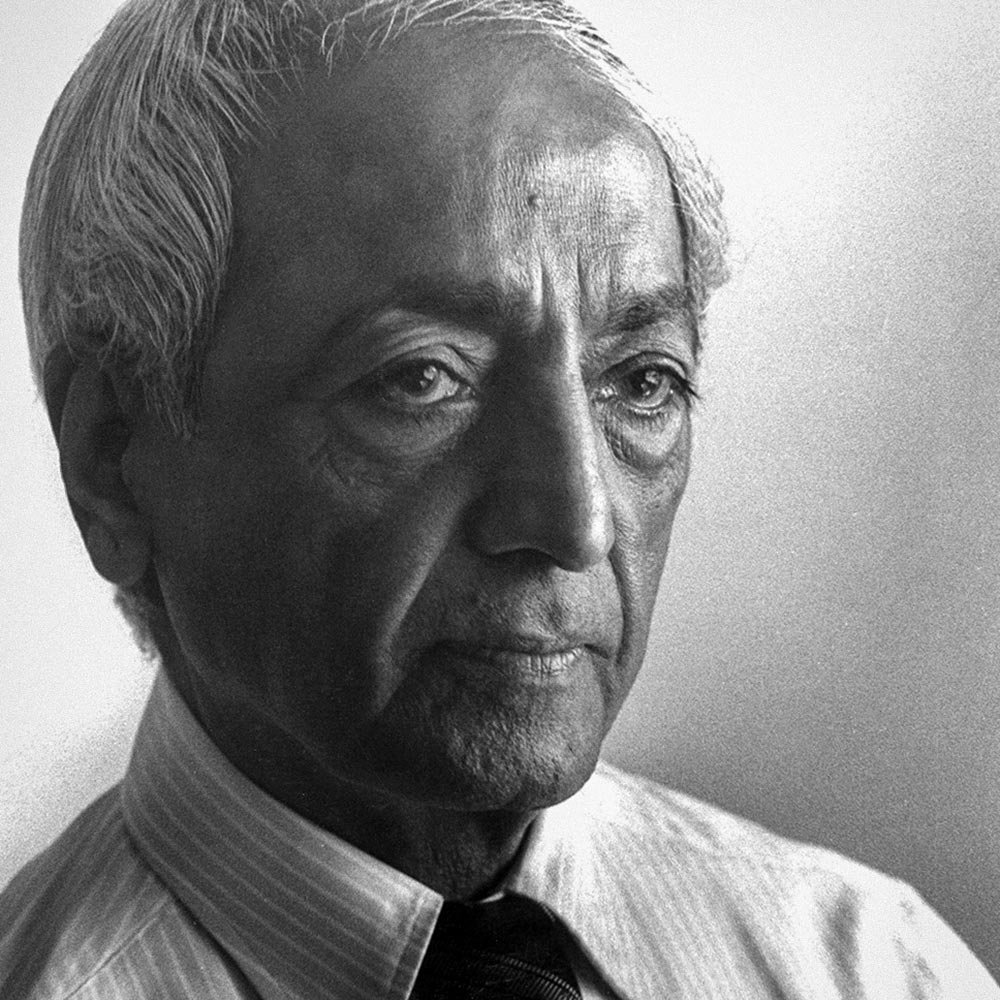
Three-quarters portrait photo of Krishnamurti

The Krishnamurti Foundation

Established in 1968 as a registered charity, and located at The Krishnamurti Centre, Krishnamurti Foundation Trust exists to preserve and make available Krishnamurti’s teachings.

The Foundation serves a global audience by providing worldwide free access to Krishnamurti videos, audio and texts to those who may be interested in pursuing an understanding of Krishnamurti’s work in their own lives.

In describing his intentions for the Foundations, Krishnamurti said: 

The Foundations will see to it that these teachings are kept whole, are not distorted, are not made corrupt.