
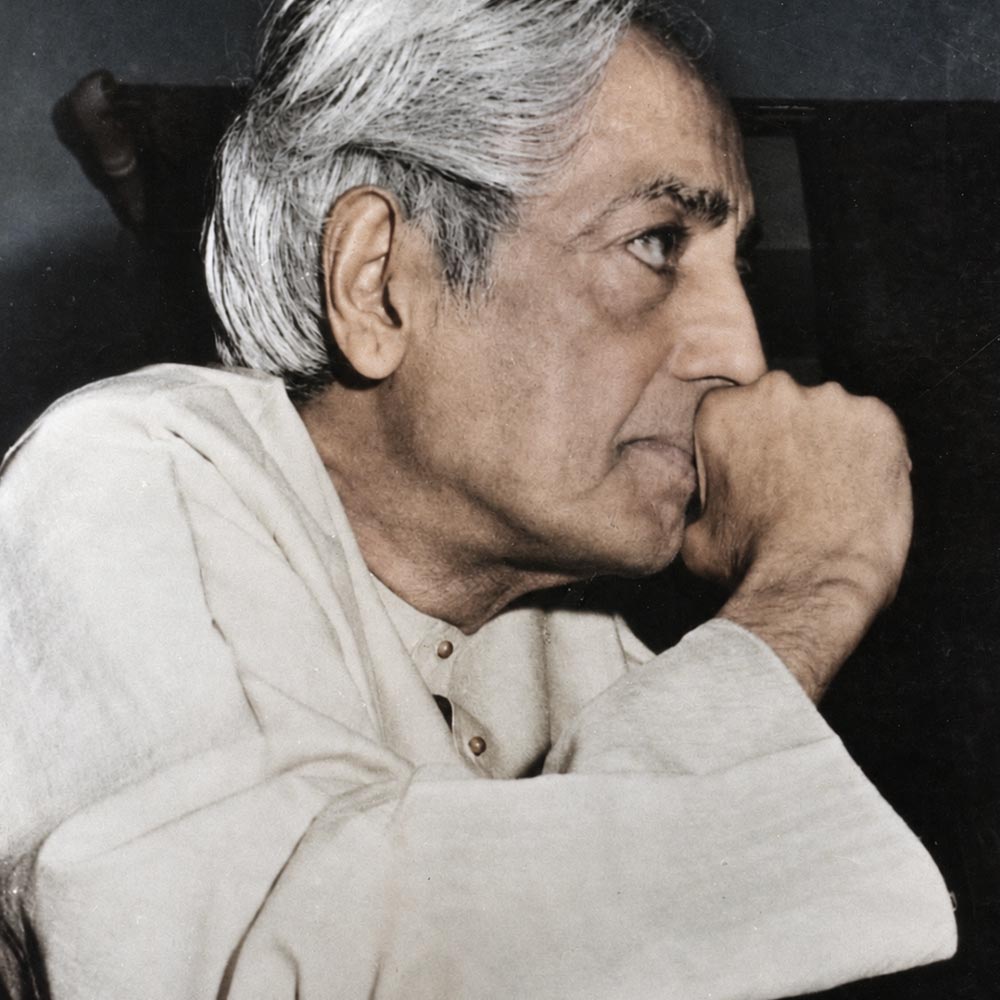
Photo of J. Krishnamurti

The world is as full of opinions as it is of people. Everyone has an opinion, but opinion is not truth. So do not listen to mere opinion, no matter whose it is, but find out for yourself what is true.

Krishnamurti, Think on These Things

Read More

The world is as full of opinions as it is of people. Everyone has an opinion, but opinion is not truth. So do not listen to mere opinion, no matter whose it is, but find out for yourself what is true. Opinion can be changed overnight, but truth cannot be changed. You want to find out for yourself whether God or truth is in the graven image, do you not? What is a graven image? It is a thing conceived by the mind and fashioned of wood or of stone by the hand. The mind projects the image; and do you think an image projected by the mind is God, though millions of people assert it is? You say that if the mind has faith in the image, then the image will give power to the mind. The mind creates the image and then derives power from its own creation. That is what the mind is everlastingly doing: producing images and drawing strength, happiness and benefit from those images, thereby remaining empty, inwardly poverty-stricken. So what is important is not the image, or what the millions say about it, but understanding the operation of your own mind.

If you have an opinion about a fact, the opinion becomes important, not the fact.

Read More

To know love, truth, God, there must be no opinions, no beliefs, no speculations with regard to it. If you have an opinion about a fact, the opinion becomes important, not the fact. If you want to know the truth or the falseness of the fact, you must not live in words, in the intellect. You may have a lot of knowledge and information about the fact, but the actual fact is entirely different. Put away the book, the description, the tradition, the authority, and take the journey of self-discovery. Love, and don’t be caught in opinions and ideas about what love is or should be. When you love, everything will come right. Love has its own action. Love, and you will know the blessings of it. Keep away from the authority who tells you what love is and what it is not. No authority knows; and he who knows cannot tell. Love, and there is understanding.

Your opinions are your prejudices, your pleasures and the conditions under which you were brought up.

Krishnamurti, Meeting Life

Read More

To learn is to listen, not only to me, but to the nearby river. Listen to it as we talk; listen to the boy shouting; listen to your own thoughts, to your own feelings, so you become completely familiar with them. Becoming familiar is to understand, and to understand there must be caring to listen, not only to your opinions, because you know very well what your opinions are. Your opinions are your prejudices, your pleasures and the conditions under which you were brought up. One must also listen to all the impacts, if one can, of the outward influences and one’s reaction to them. Through this listening and seeing, there comes a learning.

Opinions have no value, though the whole world is run on them. Opinions are limited.

Krishnamurti, Can Conflict End?

Read More

If we can talk together without bias or prejudice, with no conclusions or concepts about peace, we can go into it together. But if you have opinions about peace, what peace should be, then your inquiry stops. Opinions have no value, though the whole world is run on them. Opinions are limited. Your opinion or my opinion, the opinions of totalitarian and so-called democratic governments, or the opinions of the clergy, are all limited. So are your judgements and opinions about values. When you think about yourself from morning to night, as most people do, it is very, very limited. When you say you are American or British, it is very limited. So, opinions are limited. When you see that clearly, you do not cling to them or the values those opinions have created. Your opinion versus another opinion does not bring about peace.

Political opinion is dividing people all over the world. Opinion means a suggestion, lacking proof, based on an emotional reaction, with strong adherence to a conclusion.

Krishnamurti, Can Conflict End?

Read More

We are full of prejudices: your opinion versus someone else’s. Political opinion is dividing people all over the world. Opinion means a suggestion, lacking proof, based on an emotional reaction, with strong adherence to a conclusion. This divides people, and therefore there is conflict. Can we live without opinion and prejudice? After all, it is prejudice when you believe in some kind of god; when as a Christian you very strongly believe in a saviour, and someone else, a Hindu or Buddhist, believes something else. Your belief in a saviour is just a matter of belief or faith, without any proof. And your belief has not brought about peace in the world. When you see how belief, prejudice, conclusions and ideals divide people and breed conflict, you see that such activity is obviously not intelligence. Will you drop all your prejudices, all your opinions about what you are, what you are not, what you should be, and so on? Will you drop all that so that you have a free, uncluttered mind?

Truth does not lie in the dialectical process of opinion opposing opinion, prejudice against prejudice, but rather in trying to understand the whole movement of life.

Read More

If a teacher is learning, and really means it, they can convey honesty and a sense of integrity to the student. But if a teacher is using the word ‘learning’ to cover up their own obstinacy, their own lack of passion, then the student who is alert to hypocrisy will not listen at all. This fragmentation – the teacher and the student, the guru and the disciple – ceases when the teacher, the student, the guru and the disciple are learning, through discussion, through dialogue, through investigation. Truth does not lie in the dialectical process of opinion opposing opinion, prejudice against prejudice, but rather in trying to understand the whole movement of life.

Judgement implies vanity; whether the judge be neurotic or sane, there is always vanity.

Read More

Judgement implies vanity; whether the judge be neurotic or sane, there is always vanity. Can vanity perceive what is true, or do you need great humility to look, to understand, to love? It is one of the most difficult things to be sane in this abnormal, insane world. Sanity implies having no illusion, no image at all about oneself or about another. You say, ‘I am this, I am that,’ ‘I am great,’ ‘I am small,’ ‘I am good, I am noble’ – all those epithets are images about oneself. When one has an image about oneself, one is surely insane; one lives in a world of illusion. And I am afraid most of us do.

You stay fixed the moment you judge.

Read More

If there is no word or label, there is no centre. There is a dissolution, an emptiness – not the emptiness of fear. There is a sense of being as nothing because you have removed all the labels, or rather, you have understood why you give labels to feelings and ideas, so you are completely new. There is no centre from which you are acting. The centre, which is the word, has been dissolved. The label has been taken away, and where are you as the centre? You are there, but there has been a transformation. That transformation is a little bit frightening; therefore, you do not proceed with what is still involved in it; you are already beginning to judge it, to decide whether you like it or not. You don’t proceed with the understanding of what is coming, but you are already judging, which means that you have a centre from which you are acting. Therefore, you stay fixed the moment you judge – words ‘like’ and ‘dislike’ become important. But what happens when you don’t name it? You look at an emotion or sensation more directly and therefore have quite a different relationship to it, just as you have to a flower when you do not name it. You are forced to look at it anew.

When you condemn or have an opinion about something, that opinion or that prejudice prevents or distorts your observation.

Read More

When you observe a tree or the person next door, is recognition necessary? When you look at a tree, do you say it is a tree? You just look. If you begin to recognise it as an elm, an oak or a mango tree, then the past interferes with direct observation. In the same way, if you look at your wife or husband with all the memories of annoyances, irritations, pleasures, insults and so on, you are not really looking at her at all, but only at the image you have in your mind of her. So that prevents a direct perception. Direct perception does not need recognition. Recognition may be necessary of your wife or husband, your house, your children, your neighbour, but when you look, why should there be the interference of the past in the eyes, the mind and the heart? Doesn’t that prevent you from looking clearly? After all, when you condemn or have an opinion about something, that opinion or that prejudice prevents or distorts your observation.

If we would understand another, we must not judge them by their race, colour, name, and so on; we must put aside our prejudices and regard them with kindly and open consideration.

Krishnamurti, The World Within

Read More

Condemnation or acceptance does not help us solve the problem we face. We must understand this condemnation thoroughly and deeply, and also the desire to accept. Condemnation and its opposite prevent understanding from flowing, and understanding is what will solve his problem. This flowering of understanding is denied if we judge. If we would understand another, we must not judge them by their race, colour, name, and so on; we must put aside our prejudices and regard them with kindly and open consideration. Similarly, if we would understand our problem, we must cease judging it or welcoming it, and that is precisely where our difficulty lies. Condemning is easy, and accepting is easier, but neither creates understanding. In the flame of understanding, our problem will be consumed.

Realising that we identify and so prevent understanding, we must perceive the necessity of kindly, tolerant detachment, suspending judgement.

Krishnamurti, The World Within

Read More

To understand, we must have self-awareness, for out of self-awareness comes self-knowledge. There is no self-knowledge without meditation, and meditation is not possible without self-knowledge. Self-knowledge comes through alert watchfulness of all our thoughts and feelings. This awareness is dulled if there is identification. Realising that we identify and so prevent understanding, we must perceive the necessity of kindly, tolerant detachment, suspending judgement. We must observe the conflicts of our thoughts-feelings, their contradictions, their appetites, their hidden pursuits. If we attempt to do this earnestly and alertly all day, we will find that we need, naturally, without any artificial enforcement, periods during the day for intense self-awareness and self-observation. Out of this self-knowledge, right thinking comes.

If you try sitting very quietly as a fun, amusing thing, you will find that the mind begins to settle down without any effort on your part to control it. Then there is no censor, no judge, no evaluator.

Krishnamurti, Think on These Things

Read More

When you listen to a song, how do you listen? You may like the person who is singing; they may have a nice face, and you may follow the meaning of the words, but behind all that, when you listen to a song, you are listening to the tones and to the silence between the tones. In the same way, try sitting very quietly without fidgeting, without moving your hands or even your toes, and just watch your mind. It is great fun. If you try it as a fun, amusing thing, you will find that the mind begins to settle down without any effort on your part to control it. There is then no censor, no judge, no evaluator. When the mind is thus very quiet of itself, spontaneously still, you will discover what it is to be gay. Do you know what gaiety is? It is just to laugh, to take delight in anything or nothing, to know the joy of living, smiling, looking into the face of another without any sense of fear.

Your mind must be extraordinarily swift, not anchored to any idea or ideal, to any judgement or opinion.

Read More

If you are listening to me and are trying to follow, with not too great an effort, what I wish to convey, then there is a possibility of our understanding each other. But if you are all the time criticising, throwing up your opinions, what you have learned from books, what somebody else has told you, and so on, then you and I are not related, because this screen is between us. If we are both trying to find out the issues of a problem, which lie in the problem itself, if both of us are eager to go to the bottom of it, find the truth of it, discover what it is, then we are related. Then your mind is both alert and passive, watching to see what is true in this. Therefore your mind must be extraordinarily swift, not anchored to any idea or ideal, to any judgement, to any opinion that you have consolidated through your particular experiences. Understanding comes when there is the swift pliability of a mind which is passively aware. Then it is capable of reception; then it is sensitive. A mind is not sensitive when it is crowded with ideas, prejudices, opinions, either for or against.

If you have conclusions, opinions or judgments, put them aside because it is only a brain that is free that can look.

Read More

Look at things as they are, without prejudice or conclusion. If you have conclusions, opinions or judgments, put them aside because it is only a brain that is free that can look. Can you put aside all opinions, judgments, evaluation and tradition, and look at things as they are? Not as a politician, not as a foreigner, not as a person who has read a great deal and can speak endlessly, but as a human being? Our brains are conditioned to solve problems, so the brain itself has a problem, and therefore whatever it meets turns into a problem. Is it possible to not have a brain that is conditioned to the solution of problems; to have a brain that is free to look and not make a problem of what it looks at? Can the brain cells themselves, without any compulsion, without any instigation, without any pressure, outwardly or inwardly, bring about a change, a mutation in themselves?

The true and the false are not based on opinion or judgement, however wise and old.

Read More

The true and the false are not based on opinion or judgement, however wise and old. To perceive the true in the false, and the false in what is said to be true, and to see truth as truth, demands a mind not held in its own conditioning. How can one see whether a statement is true or false if one’s mind is prejudiced, caught in the framework of its own or another’s conclusions and experiences? For such a mind, what is important is to be aware of its own limitations.

These quotes only touch on the many subjects Krishnamurti inquired into during his lifetime. His timeless and universal teachings can be explored using the Index of Topics where you will find texts, audio and video related on many themes. Another option is to browse our selection of curated articles or more short quotes. Krishnamurti’s reply when asked what lies at the heart of his teachings can be found here. Many Krishnamurti books are available, a selection of which can be explored here. To find out more about Krishnamurti’s life, please see our introduction and the biography. We also host a weekly podcast, and offer free downloads. Please visit our YouTube channel for hundreds of specially selected shorter clips. Below, you can learn more about Krishnamurti and our charity which he founded in 1968.
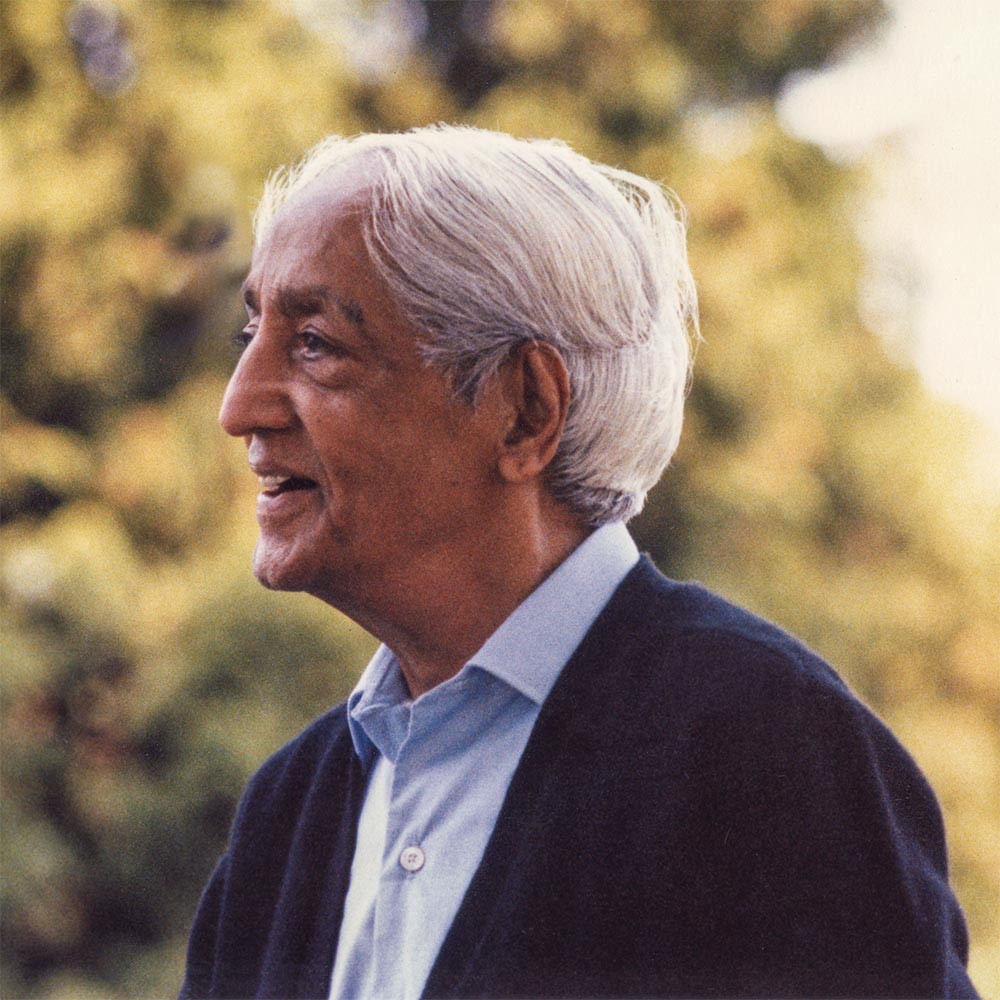
Krishnamurti outdoors smiling

Who Was Krishnamurti?

J. Krishnamurti (1895-1986) is widely regarded as one of the greatest thinkers and religious teachers of all time. He spoke throughout the world to large audiences and to individuals, including writers, scientists, philosophers and educators, about the need for a radical change in mankind. Referring to himself, Krishnamurti said:

He is acting as a mirror for you to look into. That mirror is not an authority. It has no authority, it’s just a mirror. And when you see it clearly, understand what you see in that mirror, then throw it away, break it up.

Krishnamurti was concerned with all humanity and held no nationality or belief and belonged to no particular group or culture. In the latter part of his life, along with continuing to give public talks, he travelled mainly between the schools he had founded in India, Britain and the United States, which educate for the total understanding of man and the art of living. He stressed that only this profound understanding can create a new generation that will live in peace.

Krishnamurti reminded his listeners again and again that we are all human beings first and not Hindus, Muslims or Christians, that we are like the rest of humanity and are not different from one another. He asked that we tread lightly on this earth without destroying ourselves or the environment. He communicated to his listeners a deep sense of respect for nature. His teachings transcend man-made belief systems, nationalistic sentiment and sectarianism. At the same time, they give new meaning and direction to mankind’s search for truth. His teaching is timeless, universal and increasingly relevant to the modern age.

I am nobody. It is as simple as that. I am nobody. But what is important is who you are, what you are.

Krishnamurti

Krishnamurti spoke not as a guru but as a friend. His talks and discussions are based not on tradition-based knowledge but on his own insights into the human mind and his vision of the sacred, so he always communicated a sense of freshness and directness, although the essence of his message remained unchanged over the years. When Krishnamurti addressed large audiences, people felt that he was talking to each of them personally, addressing their own particular problem. In his private interviews, he was a compassionate teacher, listening attentively to those who came to him in sorrow, and encouraging them to heal themselves through their own understanding. Religious scholars found that his words threw new light on traditional concepts. Krishnamurti took on the challenge of modern scientists and psychologists and went with them step by step, discussing their theories and sometimes enabling them to discern the limitations of their theories.

Krishnamurti left a large body of literature in the form of public talks, writings, discussions with teachers and students, scientists, psychologists and religious figures, conversations with individuals, television and radio interviews, and letters. Many of these have been published as books, in over 60 languages, along with hundreds of audio and video recordings.
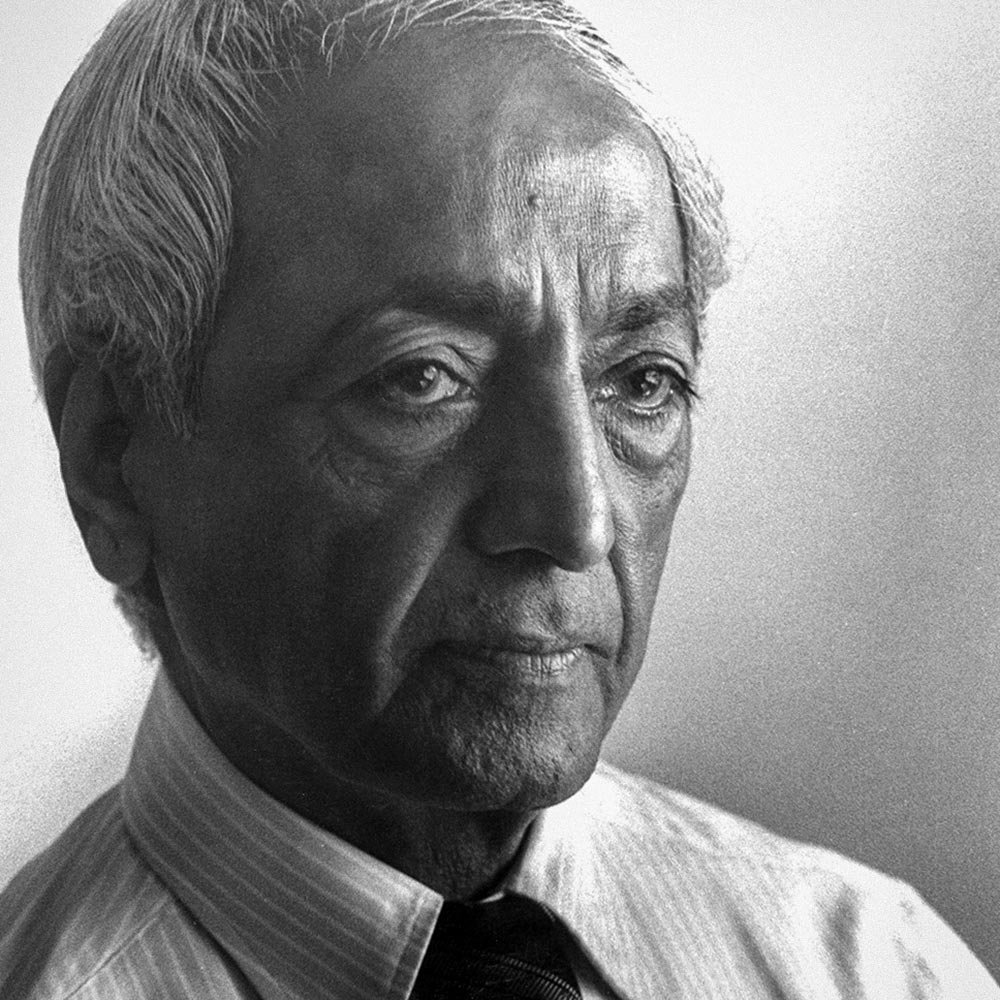
Three-quarters portrait photo of Krishnamurti

The Krishnamurti Foundation

Established in 1968 as a registered charity, and located at The Krishnamurti Centre, Krishnamurti Foundation Trust exists to preserve and make available Krishnamurti’s teachings.

The Foundation serves a global audience by providing worldwide free access to Krishnamurti videos, audio and texts to those who may be interested in pursuing an understanding of Krishnamurti’s work in their own lives.

In describing his intentions for the Foundations, Krishnamurti said: 

The Foundations will see to it that these teachings are kept whole, are not distorted, are not made corrupt.